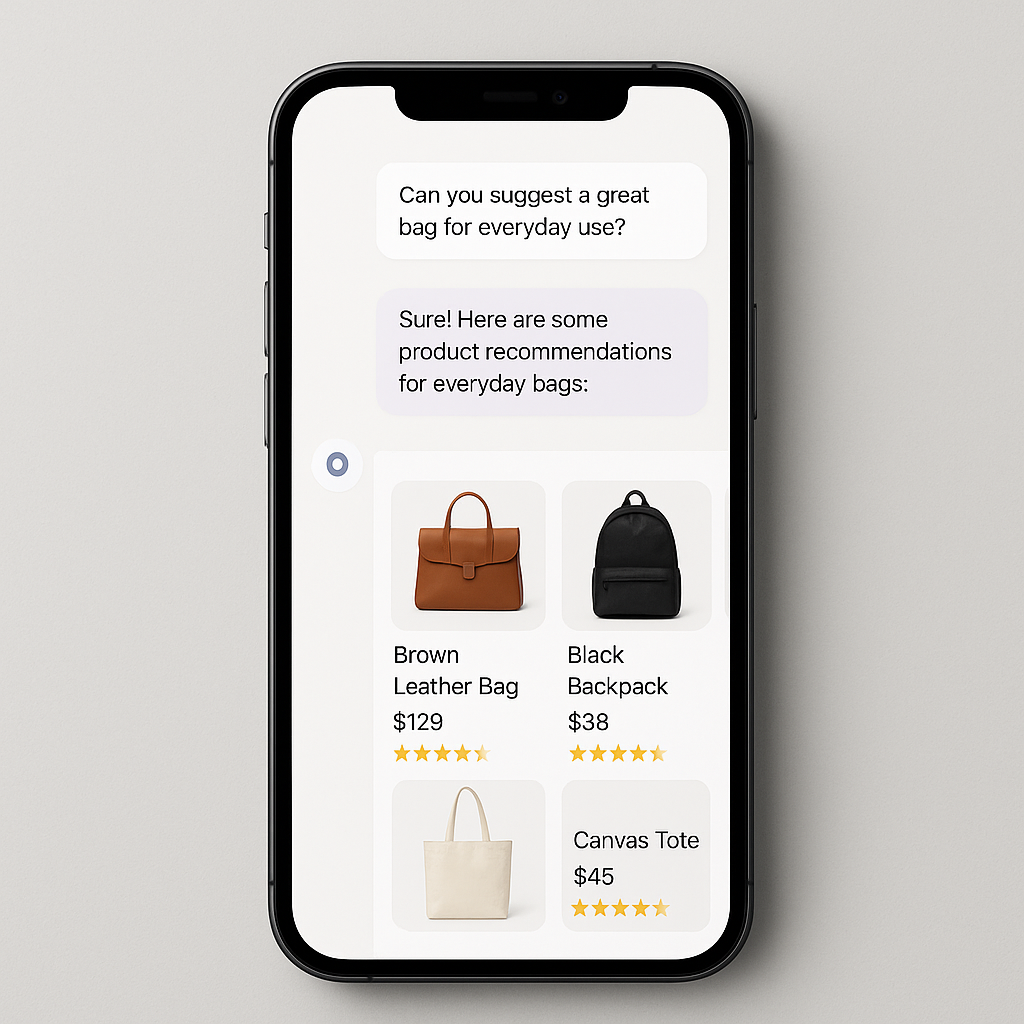
Since January 2025, Shopify has reported a 15x increase in orders coming directly from AI search platforms. ChatGPT, Perplexity, Google AI Overviews, and Microsoft Copilot are sending real buyers to Shopify stores. Over 1 million merchants have already opted into AI discovery through Shopify’s platform.
This is not a future trend. It is happening right now. One in five American shoppers uses AI platforms when making purchase decisions. And the rules for getting your products recommended are different from traditional SEO.
Answer engine optimization (AEO) is how you structure your store so AI systems can understand your products, trust your brand, and recommend you to shoppers. This guide covers what AEO is, why it matters for Shopify stores, and the specific steps you can take today.
In this post
- What is answer engine optimization?
- How AI shopping assistants choose products
- ChatGPT + Shopify: what changed in 2026
- 7 steps to optimize your Shopify store for AI
- Why product structure matters for AEO
- How to measure AEO success
- Frequently asked questions
- Related reading
What is answer engine optimization?
Traditional SEO gets your pages ranked in search results. AEO gets your products mentioned in AI-generated answers.
When a shopper asks ChatGPT “What is the best leather messenger bag under $200?”, the AI reads content across the web, evaluates products, and recommends specific items. If your product page is structured well, has clear product data, and is linked from trustworthy sources, the AI is more likely to recommend your bag.
AEO is not a replacement for SEO. It builds on it. The stores that perform best in AI search also tend to have strong traditional SEO. But AEO adds specific practices that help AI systems parse, understand, and trust your product data.
How AI shopping assistants choose products
AI shopping assistants do not browse stores the way humans do. They parse data. Here is what they look at:
- Product titles and descriptions. The AI reads your product page content to understand what you sell. Clear, specific titles (“Navy Blue Leather Messenger Bag, 15-inch Laptop Compartment”) perform better than vague ones (“Bag Style A”).
- Structured data (JSON-LD). Product schema with price, availability, reviews, and specifications. This is the data AI can parse most reliably.
- Reviews and ratings. AI systems weigh social proof. Products with more reviews and higher ratings get recommended more often.
- Content freshness. URLs cited in Google AI Overviews are 25.7% fresher than those in traditional search results. Regularly updated content gets more AI citations.
- Page authority and backlinks. Just like traditional SEO, but AI systems also evaluate the context of linking pages to determine relevance.
- Product feed data. Shopify’s Global Catalog feeds product data directly to AI platforms. Accurate, complete product data in your Shopify admin matters more than ever.
ChatGPT + Shopify: what changed in 2026
In March 2026, Shopify launched Agentic Storefronts. This is a direct integration between Shopify and AI platforms. Here is what it means:
- Products appear inside ChatGPT. When a shopper asks a shopping question, ChatGPT shows relevant products with images, prices, and buy links. These come from Shopify’s Global Catalog.
- Purchase happens on your store. The buyer clicks through to your Shopify store to complete checkout. No intermediary.
- Multiple AI platforms. Agentic Storefronts connect to ChatGPT, Microsoft Copilot, Google AI Mode, and the Gemini app. One integration, multiple channels.
- Over 1 million merchants opted in. Shopify uses specialized AI models to categorize products, enrich data, and standardize information so AI agents can parse it reliably.
- Image and voice search. Shoppers can find products by uploading photos or describing items conversationally (“I need a blue bag like this one but bigger”).
This changes the game. Your product data is not just for your website anymore. It feeds directly into AI recommendation engines that millions of shoppers use.
7 steps to optimize your Shopify store for AI
1. Write product titles that answer questions
AI systems match products to shopper queries. A title like “Handmade Leather Messenger Bag, 15-inch Laptop, Brass Hardware, Cognac Brown” contains multiple attributes that AI can match to questions like “leather bag for laptop” or “brown messenger bag handmade.”
Include: product type, key material, primary feature, color/size, and brand name.
2. Write unique product descriptions with details
AI reads your product description to understand what makes your product different. Generic descriptions get skipped. Specific details get cited.
Instead of: “High quality leather bag, great for work.”
Write: “Full-grain vegetable-tanned leather that develops a patina over time. Fits laptops up to 15 inches in the padded main compartment. Brass YKK zippers. Adjustable crossbody strap. Handstitched in our Istanbul workshop.”
3. Add FAQ sections to product and collection pages
AI assistants answer questions. If your product page already answers common questions, the AI can extract and cite them directly. Add an FAQ section with real customer questions:
- “Is this bag big enough for a 15-inch MacBook?”
- “What type of leather is used?”
- “Does the color darken over time?”
Use FAQPage schema markup so AI can parse the Q&A format programmatically.
4. Complete every field in Shopify product admin
Shopify feeds product data to AI platforms through its Global Catalog. Every empty field is a missed signal. Fill in:
- Product type and category
- Vendor/brand name
- All variant options with clear names (“Color: Navy Blue” not “Option 1: NB”)
- Weight, dimensions, materials
- SKU and barcode
- Image alt text (descriptive, not keyword-stuffed)
5. Use separate products for visual variants
This is where product structure directly affects AI visibility. A single product with 8 color variants has one URL and one set of metadata. AI sees one product.
Eight separate products (one per color) have 8 URLs, 8 unique titles, 8 descriptions, and 8 product feed entries. AI sees 8 products, each optimized for its specific color. When someone asks “best navy blue t-shirt,” your navy page has a better chance of being recommended than a generic “T-Shirt” page with 8 variants.
Use a combined listings app to connect them with swatches so customers can still switch between colors. Rubik Combined Listings does this while keeping each product’s URL, SEO, and AI discoverability intact. Read more in separate products vs variants: the SEO impact.
6. Optimize images with descriptive alt text
AI shopping now supports image search. Shoppers upload a photo and say “find me something like this.” Your product images need descriptive alt text that matches how people describe products conversationally.
Good: “Navy blue leather messenger bag, brass buckle, shown on shoulder with laptop visible”
Bad: “IMG_4521.jpg” or “bag blue leather product”
If you use Rubik Variant Images, each variant’s images are grouped separately. When AI or Google Images indexes your product, it finds variant-specific images with relevant alt text rather than a mixed gallery of 8 colors.
7. Keep content fresh
URLs cited in Google AI Overviews are 25.7% newer than those in traditional search. AI systems prefer recent content. Update your product descriptions seasonally. Add new blog posts that reference your products. Update comparison pages with current data.
Why product structure matters for AEO
The way you structure your Shopify products has a direct impact on AI visibility:
| Single product with variants | Separate products + combined listings | |
|---|---|---|
| URLs indexed by AI | 1 | 1 per color/style |
| Unique meta titles | 1 | 1 per color/style |
| Product feed entries | 1 | 1 per color/style |
| AI can recommend specific color | Difficult | Easy (dedicated page) |
| Image search matches | Mixed gallery | Variant-specific images |
| Internal cross-links | None | Swatches create mutual links |
Combined listings give AI systems more surface area to work with. Each product has a clear identity. The swatch links create a semantic relationship that AI uses to understand the product family. Read the SEO and AEO benefits documentation for technical details.
How to measure AEO success
- AI Citation Share. How often your brand is mentioned in AI-generated answers. Tools like Semrush, Advanced Web Ranking, and Profound can track this.
- Referral traffic from AI platforms. Check Google Analytics for traffic from chat.openai.com, perplexity.ai, and gemini.google.com.
- Shopify Agentic Storefront analytics. If you have opted into Agentic Storefronts, Shopify provides data on AI-driven product discoveries and purchases.
- Google Search Console AI Overviews. Monitor which queries trigger AI Overviews that cite your pages.
Frequently asked questions
What is answer engine optimization for Shopify?
AEO is the process of structuring your Shopify store so AI platforms (ChatGPT, Perplexity, Google AI) can understand, trust, and recommend your products. It involves clear product data, structured markup, FAQ content, and product architecture that gives AI multiple entry points to your catalog.
How is AEO different from SEO?
SEO ranks your pages in search results. AEO gets your products mentioned in AI-generated answers. AEO builds on SEO but adds practices specific to AI: FAQ schema, conversational content, product data completeness, and architecture that gives AI clear signals per product.
Can shoppers buy from my Shopify store through ChatGPT?
Yes. Since March 2026, Shopify’s Agentic Storefronts connect your store to ChatGPT, Microsoft Copilot, Google AI Mode, and Gemini. Shoppers discover your products in the AI interface and complete checkout on your Shopify store. Over 1 million merchants have opted in.
Do separate products help with AI discoverability?
Yes. Each separate product has its own URL, title, description, and feed entry. AI systems can recommend specific colors or styles. A single product with 8 variants has one URL and one set of metadata, giving AI less to work with. Use a combined listings app to connect separate products with swatches.
What should I do first?
Start with product data: complete every field in Shopify admin, write specific product titles and descriptions, and add FAQ sections with schema markup. Then consider product structure: separate products for visual variants connected with a combined listings app. These steps give AI systems the data quality they need to recommend your products.
Related reading
- How to make your Shopify products show up in ChatGPT and AI shopping results
- Separate products or variants? The SEO impact (Rubikify)
- Why separate Shopify products rank better in AI recommendations
- How to show only the selected variant’s images (Rubik Variant Images)
- Shopify combined listings without Plus (Rubikify)