New York Synthetic Performer Law: What Shopify Sellers Using AI Models Need to Know
The New York synthetic performer law Shopify sellers keep asking about is real, it took effect June 9 2026, and the short version is this: if you knowingly put an AI-generated human “performer” in a commercial advertisement, you have to conspicuously disclose it, or face a $1,000 fine on the first violation and $5,000 on each one after. That’s New York General Business Law section 396-b. Whether it touches your static product photos is the part nobody can answer cleanly yet.
So let’s separate what the statute actually says from what panicked Reddit threads claim it says. Because there’s a lot of daylight between those two.
The law was signed December 11 2025 (bills S.8420-A and A.8887-B) and became effective June 9 2026. It targets advertisers and creators, not the platforms that merely carry the ad. And it has two genuinely ambiguous pieces baked in: what counts as “conspicuous” disclosure, and whether a still image of an AI model even qualifies as a “performance” at all. We’ll get into both.
One thing up front. If your store sells products and your photos show products (the mug, the hoodie, the candle, on a table or a plain backdrop), with no AI-generated human in them, this law is almost certainly not about you. Pure product-only images are generally exempt. The obligation centers on AI-generated people, faces and models, and routine editing never triggers it. Keep that anchor in mind the whole way down.
In this post
- What is the New York synthetic performer law?
- Who is actually liable, and when?
- Does it cover AI models in static product photos?
- What does “conspicuous disclosure” mean here?
- The Fashion Workers Act consent angle
- How to label AI model photos without wrecking your feed
- FAQ
What is the New York synthetic performer law?
It’s a disclosure law requiring advertisers to conspicuously reveal when a “synthetic performer” appears in a commercial advertisement, when they have actual knowledge of that use. A synthetic performer, under section 396-b, is a digitally created asset built, reproduced, or modified by computer using generative AI or a software algorithm, made to create the impression of an audiovisual or visual performance by a human who is not recognizable as any identifiable real person.
Read that definition twice. It’s doing a lot. The key words are “performance” and a human performer “not recognizable as any identifiable” real person. So it’s aimed at fully invented people: the AI spokesperson, the synthetic actor, the model who never existed. Not a real person whose likeness was cloned (that’s a different set of laws), and arguably not a coffee mug.
The statute applies broadly, including to digital advertising. It names specific categories too: newspapers, magazines, television, radio, streaming, cable, billboards, and transit ads. (It doesn’t say “any medium,” so don’t let anyone tell you it does.) The point is, online retail advertising is plausibly inside the tent. The question is which of your images count as an “advertisement” with a “performance,” and that’s where it gets murky.
Who is actually liable, and when?
Primary liability sits with the advertiser or creator, not with Shopify, not with Meta, not with the marketplace. If you produced or created the ad for a commercial purpose and you had actual knowledge a synthetic performer was in it, you’re the one on the hook. The New York Attorney General enforces it. There’s no private right of action, so random plaintiffs can’t sue you under this statute.
Platforms and publishers that merely disseminate someone else’s ad are exempt, and they’re Section 230 protected on top of that. There’s a wrinkle worth understanding: a platform that gets notice of an undisclosed synthetic performer has to either stop distributing it or insert the disclosure within five days (or as soon as feasible). That five-day window is a notice-and-remediation clock for platforms, not the moment your liability as an advertiser begins. Don’t conflate the two. Your obligation is at the point you knowingly create the ad.
The “actual knowledge” standard is your friend here, honestly. If you genuinely didn’t know an asset was AI-generated, the law’s trigger isn’t met. But if you typed the prompt yourself? You knew. There’s no pleading ignorance about the model you generated this morning.
Does the New York synthetic performer law cover AI models in static product photos?
The honest answer: it’s unresolved, and it depends on how regulators read the word “performance.” An AI-generated human model in a still product photo may be covered, or may not be. The statute repeatedly emphasizes a “performance,” which leans toward video and motion, where a synthetic figure is doing something. A frozen frame of an AI woman wearing your dress is arguably not a “performance” at all. Arguably.
But “arguably” is not “definitely,” and the AG hasn’t drawn that line publicly. So this is a genuine gray zone, and anyone telling you AI model stills “are covered” or “are exempt” with confidence is guessing. Here’s what’s clearer:
| Your image | NY section 396-b status |
|---|---|
| Product only, no AI human (real or AI background) | Generally exempt, outside scope |
| Routine edits: lighting, crop, background removal, retouch | Does not trigger it |
| AI-generated human model in a static product photo | Gray zone (may be covered, depends on enforcement) |
| AI synthetic person in a video ad / motion creative | Most likely covered if you have actual knowledge |
| Cloned likeness of a real, identifiable person | Different laws apply (not this “not recognizable” definition) |
My take? If you’re using AI fashion models on apparel listings and you ship to New York, the cautious move is to label them, because a small text disclosure costs you nothing and the downside of guessing wrong is $1,000 then $5,000 a pop. The compliance burden is trivial compared to the ambiguity. That’s not legal advice (see the disclaimer below), it’s operator math. The same gray-zone logic shows up across the cluster, including our deeper look at AI fashion models and Shopify disclosure laws.
What does “conspicuous disclosure” mean under the law?
Nobody knows precisely, because the statute never defines it. There’s no required wording, no mandated size, no specified placement, no language requirement. The drafters left “conspicuous” wide open. That’s a feature for flexibility and a headache for anyone who wants a checkbox to tick.
So what do you do with a standard that has no spec? Most lawyers point to the FTC’s long-running “clear and conspicuous” benchmark as a practical guide: the disclosure should be hard to miss, in a place people actually look, in plain language, not buried in a footer or hidden behind a tooltip. For a product image, that practically means a visible, readable label on or right next to the image, not a line of legalese three scrolls down.
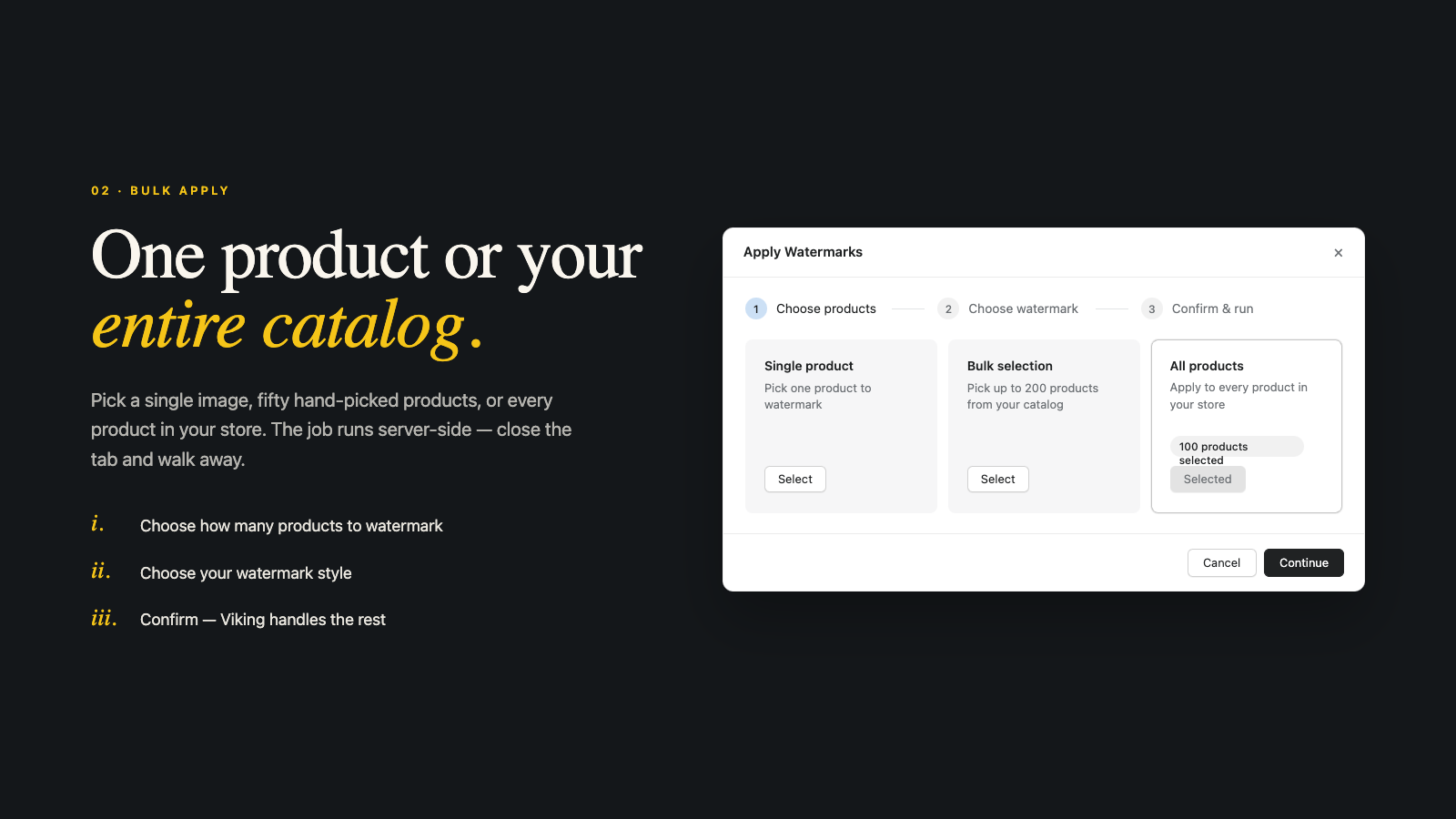
A short stamp like “AI Generated” on the image itself is about as conspicuous as it gets. Which is one reason a watermarking workflow fits this so neatly. Viking Watermark (a Shopify app by Aegis, new on the App Store) can stamp a text watermark reading “AI Generated” onto images, applied to a single image, a whole collection, by tag, by product status, or all at once. For the visible-label half of compliance, that’s the workflow.
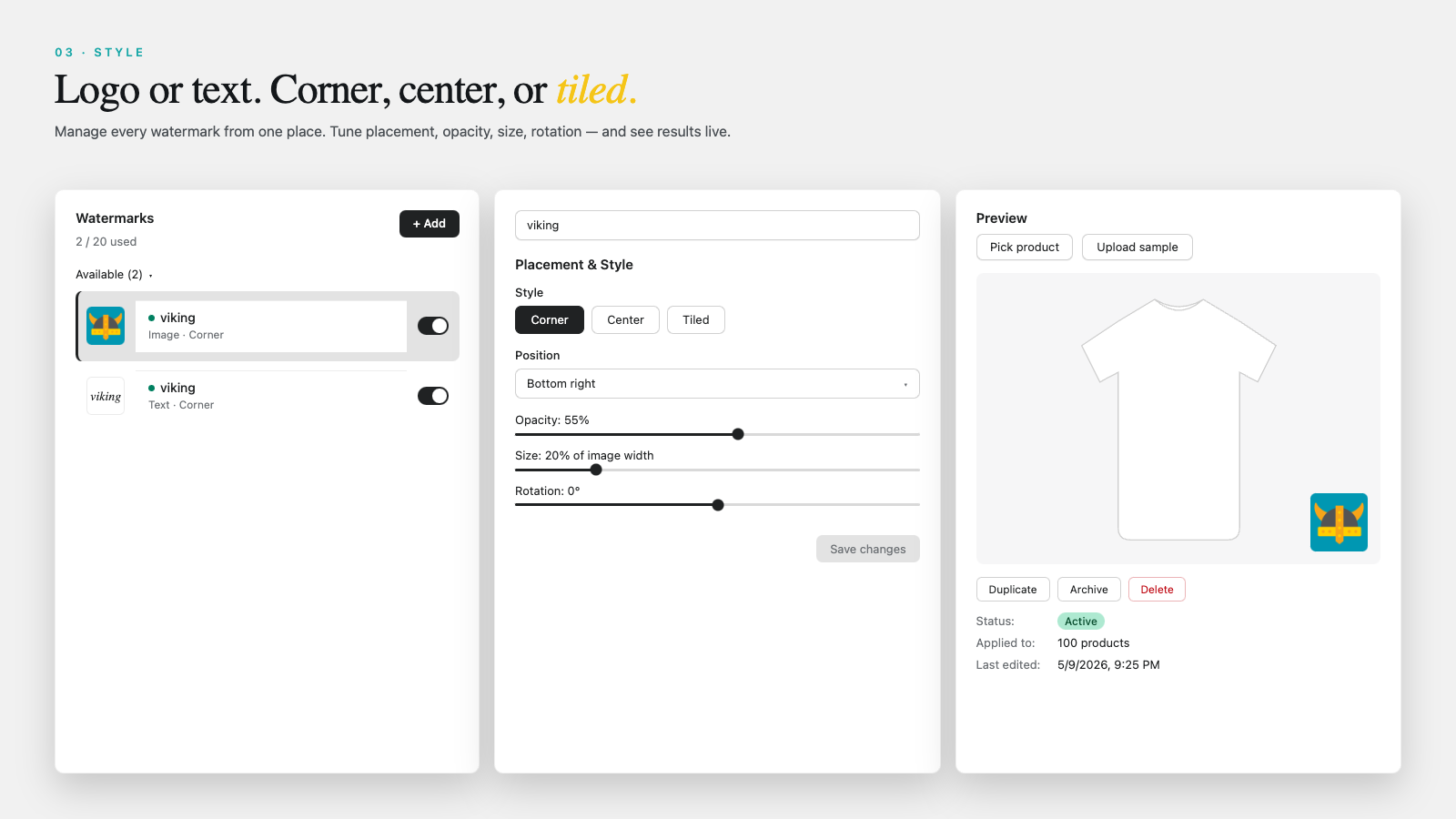
One honest caveat. A visible text stamp covers the conspicuous-disclosure layer. It does not embed machine-readable C2PA or IPTC metadata, and it is not an EU “provider” marking tool. So treat it as the visible-label half, not the whole stack. If you also need the metadata route for Google Merchant Center, that’s a separate mechanism (more on the feed conflict below). You can read about Viking’s approach on the Viking Watermark site.
How does the NY Fashion Workers Act fit in?
It’s a separate but related consent rule, and it bites a different problem: AI replicas of real models. The New York Fashion Workers Act requires clear written consent before a brand creates or uses a model’s AI digital replica, and that consent has to spell out scope, purpose, duration, and compensation.
Why does this matter for a Shopify store? Because some merchants don’t generate a fictional model from scratch. They photograph a real model once, then use AI to spin up dozens of variant looks from that shoot. The moment you create an AI digital replica of an actual person, you’re in Fashion Workers Act territory, and you need their signed consent. Section 396-b deals with synthetic performers who aren’t identifiable people; the Fashion Workers Act deals with the real people you’re cloning. Two laws, two triggers. You can be subject to both in the same campaign.
How do you label AI model photos without breaking your Google feed?
Carefully, because Google Merchant Center and a visible disclosure want opposite things from your primary image. Google requires IPTC DigitalSourceType metadata on AI product images (metadata only, no visible label) and it disallows watermarks or logos over the product on feed images. New York wants the disclosure to be conspicuous, which usually means visible. See the tension?
The practical fix is to keep your primary feed image clean and put the visible “AI Generated” label on secondary gallery shots, or to stamp images and roll back the clean originals before a feed sync. Viking’s rollback restores the untouched originals saved in Shopify Files in one click, with no quality loss, which makes that dance survivable. (There’s a real gap to know about too: Shopify’s CDN strips EXIF and IPTC metadata on compression, so the invisible-metadata route alone is shakier than it sounds.) We dig into the feed side in our guide on whether watermarks hurt Shopify SEO and Google Shopping, and the broader compliance timeline lives in the 2026 AI image disclosure compliance calendar.
A rough order of operations for a New York-facing apparel store using AI models:
- Tag every product that uses AI-generated human imagery so you can target it in bulk.
- Apply a visible “AI Generated” text label to the AI model shots (secondary images first, to protect the feed).
- Turn on auto-watermark so new uploads get labeled automatically, no manual step.
- Keep clean originals available for the Google feed, or roll back before syncing, then re-apply.
- If any AI image is a replica of a real model, get Fashion Workers Act consent in writing first.
This same labeling logic carries over when AI imagery lands on AI-generated variant images and on combined listings with AI model photos, where one disclosure decision has to hold across grouped products. If your real worry is image theft rather than disclosure, that’s a different problem covered in how to stop image theft on Shopify and protecting product photography from competitors.
And one more reason to bulk-label properly: it’s also a clean way to watermark Shopify product images in bulk if you ever want brand marks on the same workflow. Worth checking it against your product image SEO setup so the labels don’t fight your rankings.
This post is general information, not legal advice. New York section 396-b has real ambiguity, and you should consult a qualified attorney about your specific store before relying on any of this.
FAQ
When did the New York synthetic performer law take effect?
It was signed December 11 2025 and became effective June 9 2026, under New York General Business Law section 396-b (bills S.8420-A and A.8887-B). The disclosure obligation applies from that effective date forward.
What are the penalties under NY GBL 396-b?
$1,000 for a first violation and $5,000 for each subsequent violation, enforced by the New York Attorney General. There is no private right of action, so individuals cannot sue you under this statute.
Do AI human models in static product photos count?
It is unresolved. The statute emphasizes a “performance,” which leans toward motion, so a still image of an AI model may or may not be covered depending on how regulators interpret it. Pure product-only images with no AI human are generally exempt and outside scope, and routine editing never triggers it.
What counts as conspicuous disclosure?
The statute does not define it: no required wording, size, placement, or language. Lawyers commonly point to the FTC “clear and conspicuous” standard as a practical benchmark, meaning a disclosure that is easy to notice and understand, not buried in fine print.
Is Shopify or my ad platform liable?
No. Primary liability is on the advertiser or creator. Platforms that merely disseminate ads are exempt and Section 230 protected; a platform given notice has five days (or as soon as feasible) to cease distribution or insert the disclosure, which is a remediation window, not your liability trigger.
How is the Fashion Workers Act different?
The Fashion Workers Act requires clear written consent (covering scope, purpose, duration, and compensation) before creating or using an AI digital replica of a real model. Section 396-b deals with synthetic performers who are not identifiable people; the two laws can apply to the same campaign.
Will a visible AI label hurt my Google Shopping feed?
It can. Google Merchant Center disallows watermarks or logos over the product on feed images and prefers IPTC metadata instead. Keep your primary feed image clean and put the visible label on secondary gallery images, or roll back to clean originals before a feed sync.
Related reading
- Do you have to disclose AI-generated product images on Shopify?
- EU AI Act Article 50 and Shopify AI product photos
- How to add an AI Generated label to Shopify product images
- Multi-region AI disclosure for combined listings (EU and NY)
- Does blocking right-click protect Shopify images?
Section 396-b is law now, the gray zone around still images is wide, and the AG gets to decide where the line falls. Until then, a readable label costs you a few minutes and a clean rollback. Skipping it costs you five grand a shot. Pick.

Umid
Co-Founder at Craftshift