2026 AI Image Disclosure Compliance Calendar for Shopify Merchants

The AI image disclosure compliance calendar 2026 every Shopify merchant needs comes down to five dates: June 9 (New York), June 10 (Washington), August 2 (EU AI Act plus California SB 942), December 2 (EU machine-readable marking deadline), and January 1 2027 (California’s large-platform rule). If you sell products imaged with AI-generated people, those are the days your obligations start. Product-only shots? Mostly fine.
Updated 16 August 2026. The European Commission published its Article 50 guidelines on 20 July 2026 and reads “objects” in the deepfake definition as including consumer goods, so an AI product image that misleads about the real product needs disclosure even with nobody in the frame. For that reason the August 2 entry below has been corrected. The full picture is in do AI product photos need a label in the EU.
Here’s the part most roundups bury: the panic is overblown for the average store. The laws landing in 2026 mostly target AI tool makers (the model providers) and advertisers who knowingly put a fake human face in front of customers. A clean photo of a candle, a backpack, a coffee mug? Generally exempt, even if AI touched it. The trigger is AI-generated humans, not AI-generated objects.
But the dates are real, the penalties are real, and the gray zones are genuinely unresolved. So instead of another fear post, this is a reference. A calendar you can pin. We build image tooling for Shopify, so we read these statutes line by line (not the headlines). And a lot of the headlines get it backwards.
One disclaimer up front, repeated near the FAQ: this is general information, not legal advice. For your specific catalog and markets, talk to a qualified attorney.
In this post
- The 2026 compliance calendar (the table)
- June 9: New York Synthetic Performer Law
- June 10: Washington SSB 5886
- August 2: EU AI Act + California SB 942
- December 2 and January 1 2027
- What actually applies to your store
- How to comply without breaking your feed
- FAQ
The 2026 AI image disclosure compliance calendar
Here is the whole year on one screen. Each row is a law, its effective date, who it actually binds, and the maximum penalty. Read the “Who it binds” column carefully, because that’s where most merchants over-worry.
| Date | Law / region | Who it binds | Max penalty |
|---|---|---|---|
| June 9, 2026 | NY Synthetic Performer Law (GBL 396-b) | Advertisers who knowingly use a synthetic human performer in an ad | $1,000 first, $5,000 each later |
| June 10, 2026 | Washington SSB 5886 | Anyone using an unauthorized AI likeness of a real person | $3,000 plus actual damages |
| Aug 2, 2026 | EU AI Act Article 50 | Providers (mark outputs) + deployers (disclose deepfakes) | Up to EUR 15M or 3% global turnover |
| Aug 2, 2026 | California SB 942 (AI Transparency Act) | Covered Providers: AI tools with 1M+ CA users (not ordinary merchants) | $5,000 per violation, per day |
| Dec 2, 2026 | EU AI Act Art 50(2) marking grace ends | Gen-AI systems already on the market before Aug 2 | Same EU tier as above |
| Jan 1, 2027 | CA AB 853 large-platform rule | Online platforms with 2M+ CA users | Per-violation under SB 942 |
Notice a pattern? Two of these six rows (SB 942 and the AB 853 platform rule) don’t bind an ordinary Shopify store at all. They bind the people who build the AI and the people who run giant platforms. More on that below, because it’s the single most misreported fact in this whole topic.
June 9: what does the New York Synthetic Performer Law require?
New York’s Synthetic Performer Disclosure Law (General Business Law 396-b) takes effect June 9, 2026, and requires advertisers to conspicuously disclose when an ad contains an AI-generated human “performer,” if they have actual knowledge it’s there. It was signed December 11, 2025. The advertiser carries the liability, not the platform that merely shows the ad. A platform that just disseminates content is exempt under the law’s safe harbor; if a platform is given notice, it then has five days to cease or insert a disclosure. So that five-day window is a cure period for platforms, not the trigger for your liability as the advertiser.
A “synthetic performer” is a digitally created human, made or modified with generative AI, built to seem like a human performance, where the figure isn’t a recognizable real person. Penalties run $1,000 for a first violation and $5,000 for each one after, enforced by the New York Attorney General. There’s no private right of action, so random shoppers can’t sue you over it.
So where does e-commerce land? Honestly, in a gray zone, and anyone telling you it’s settled is guessing. The statute leans hard on the word “performance,” which fits video ads cleanly. A static product photo with an AI human model? That may be covered, it may not, and it depends on how regulators read it. The cautious move is to disclose. Routine editing (lighting, crop, background removal, retouch) never triggers it.
“Conspicuous disclosure” isn’t defined: no required wording, size, or placement. Lawyers point to the FTC’s “clear and conspicuous” standard as a sane benchmark. The law names specific categories (TV, radio, streaming, billboards, transit, print) and applies broadly, including digital advertising. It does not reach “any medium,” so be careful with sources that claim it does. For the deeper breakdown, see our New York synthetic performer law guide.
One more NY thread: the Fashion Workers Act requires clear written consent before creating or using a real model’s AI digital replica. If you’re cloning an actual person’s likeness, that’s a separate, firmer rule.
June 10: what changes with Washington SSB 5886?
Washington’s SSB 5886 takes effect June 10, 2026, and extends personality rights to cover AI deepfakes of real people, with a civil penalty of $3,000 plus actual damages. It targets a “forged digital likeness,” meaning AI-manipulated audio, video, or image that misrepresents a real person and would likely deceive a reasonable viewer.
For most product catalogs, this one barely registers. It bites when you use an AI likeness of a specific identifiable human without permission (a celebrity face, a known influencer, a real model you didn’t license). On top of the $3,000 civil penalty, the law allows non-economic damages and injunctive relief. Fully synthetic, fictional faces that resemble nobody real are a different question, and generally not the target here.
August 2: how do the EU AI Act and California SB 942 differ?
August 2, 2026 is the big one, with two very different laws landing the same day: the EU AI Act’s Article 50 transparency rules become enforceable, and California’s SB 942 (delayed from January by AB 853) takes its operative date. They sound similar. They aren’t.
EU AI Act Article 50
Article 50 splits the work by role. Providers of generative AI must mark synthetic image, audio, video, and text outputs in a machine-readable format detectable as AI-generated (as far as is technically feasible). Deployers (that’s you, publishing the image) must disclose when content is a deepfake. The deepfake definition is broad: AI-generated or manipulated media resembling real persons, objects, places, entities, or events that would falsely appear authentic. Note that it covers objects, places, and events too, not only people.
For e-commerce, that distinction matters. A real product against an AI background, or an upscale, does not trigger the Article 50.4 deepfake disclosure. A fully AI-generated product image can: the Commission’s July 2026 guidelines read “objects” in the definition as including consumer goods, and treat an image that misleads about the actual product appearance, characteristics or use as a deepfake. But an AI-generated human face or model on apparel does require deepfake disclosure when it resembles a plausible real person and could appear authentic. (Photorealism alone isn’t the trigger; resemblance to something that could pass as a real entity, plus potential to mislead, is.) Even for object images, the provider’s machine-readable marking under Art 50(2) can still apply.
Penalties for Article 50 violations reach up to EUR 15 million or 3% of total worldwide annual turnover, whichever is higher. (That higher 35M/7% number you’ve maybe seen? That’s the prohibited-practices tier, a different rule. Don’t conflate them.) And it’s extraterritorial: it applies whenever the output is used in the EU, regardless of where you’re established. A non-EU Shopify seller shipping AI-imaged products to EU shoppers is in scope. Disclosure must be clear and distinguishable, at the latest at first exposure. Full version: our EU AI Act Article 50 breakdown.
California SB 942
This is the one people get most wrong, so read slowly: SB 942 binds “Covered Providers,” meaning gen-AI systems with more than 1 million monthly users accessible in California. The AI tool makers. Not ordinary Shopify merchants who merely use third-party AI tools.
If you generate an image in a popular AI tool and post it on your store, you are generally not a Covered Provider and not directly obligated under SB 942. The law makes the tool add a manifest disclosure (a visible label) and a latent disclosure (embedded C2PA-style metadata) on AI image, video, and audio (text is exempt). Penalty is $5,000 per violation, each day counting separately, enforced by the CA AG, city attorneys, and county counsels. Real teeth, but aimed at the model makers. Don’t let a headline scare you into thinking you personally face that fine.
December 2 and January 1, 2027: the deadlines after the rush
Two later dates close out the calendar: December 2, 2026 ends the EU grace period for older gen-AI systems, and January 1, 2027 starts California’s large-platform rule. Neither is a merchant action item, but you should know they exist.
The EU gave gen-AI systems already on the market before August 2 a runway: they have until December 2, 2026 to meet the Art 50(2) machine-readable marking requirement. Note the asymmetry. The deepfake deployer disclosure (50.4) gets no grace period at all. It’s live August 2.
Then California’s AB 853 adds a “large online platform” obligation (sites with more than 2 million California monthly users) starting January 1, 2027. That’s a platform-level rule. Unless you’re operating at that scale, it isn’t about you. It’s about the marketplaces and networks that distribute content.
What actually applies to your store?
For a typical Shopify store, the live obligations are narrow: disclose AI-generated human models, especially in ads (NY) and in the EU (Article 50 deepfake rule), and never use an unauthorized AI likeness of a real person (WA). Pure product images are generally exempt. Let me say that again because it’s the whole point.
Object-only images sit outside the New York and California rules. In the EU they are outside Article 50 only while they do not misrepresent the real product, a line the Commission drew in its July 2026 guidelines. Routine editing never triggers disclosure. The obligation centers on AI-generated people, faces, and models. So the real question for your catalog isn’t “did I use AI,” it’s “did I put a fake human in the frame.” If you sell variant-heavy apparel with AI model shots, our friends at Rubik cover the variant angle in labeling AI-generated variant images, and the grouped-product side in disclosing AI model photos in combined listings.
What about Shopify itself? Shopify has no product-image AI-disclosure requirement and actively promotes AI photography through Shopify Magic. There’s no “I used AI” checkbox like the one Etsy added on January 14, 2026. So the disclosure decision is fully on you. The FTC, meanwhile, applies its existing deception and endorsement rules to AI with no carve-out: AI testimonials must reflect real users’ honest views, and substantive misleading edits (face swaps, voice clones) need disclosure even though routine retouching does not.
How do you comply without breaking your product feed?
Practical compliance is two layers: a visible label on images that show AI humans, plus machine-readable provenance metadata. The honest answer is most stores need the visible layer first, because that’s what NY and the EU deployer rule actually ask for on the storefront. But there’s a trap with feeds.
Here’s the conflict. Google Merchant Center wants IPTC DigitalSourceType metadata on AI product images (invisible, metadata-only) and disallows watermarks or logos over the product on feed images. So your primary feed image must stay clean. Worse: Shopify’s CDN strips EXIF and IPTC metadata on compression, which quietly breaks the Google metadata route. C2PA Content Credentials (embedded by Adobe Firefly, DALL-E 3, Imagen) is the open provenance standard, but credentials get stripped when files are resaved. Metadata is invisible but fragile. A visible watermark is durable but croppable. Best practice is both layers, applied to the right images.
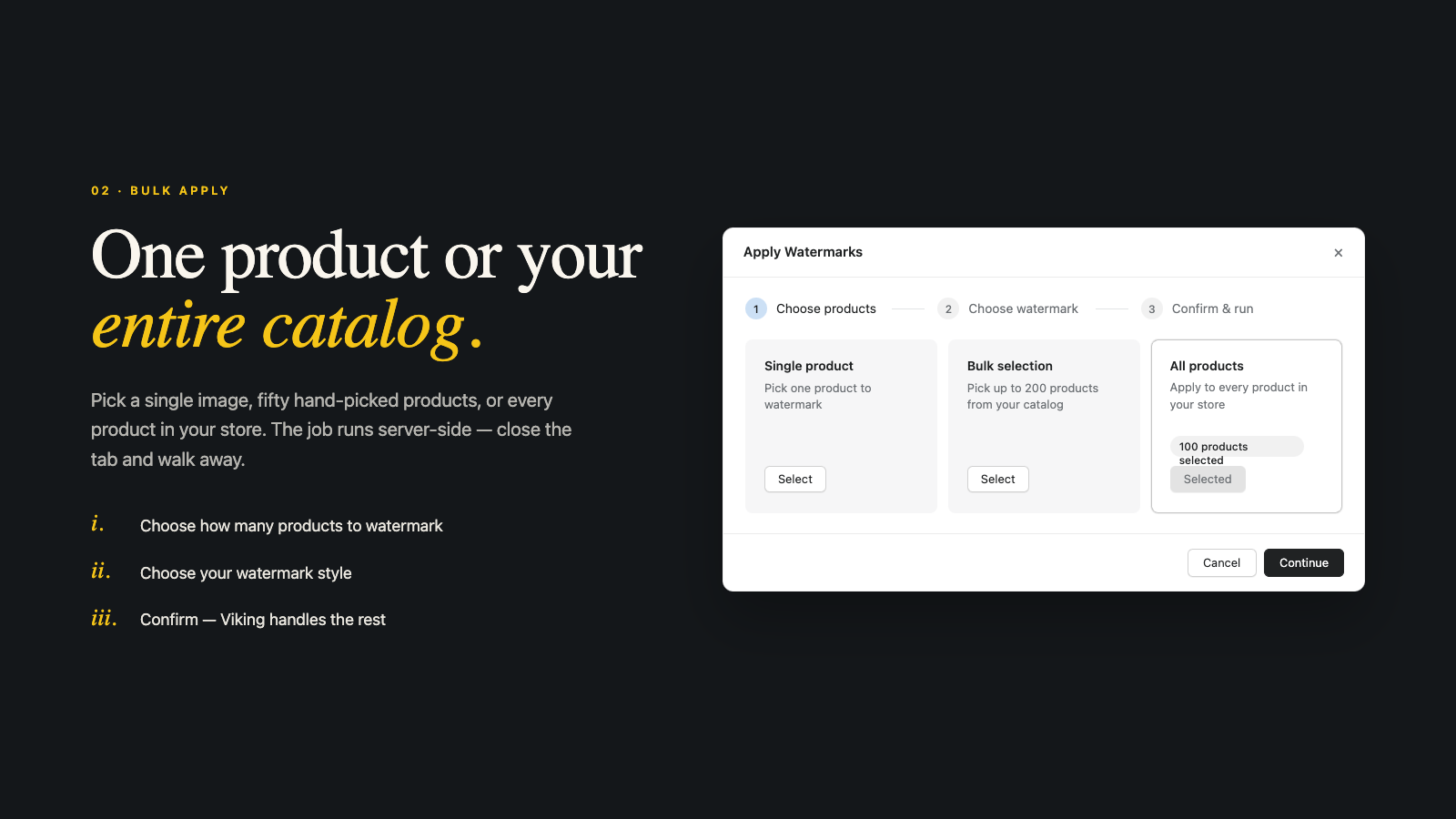
That’s where a text-watermark workflow helps. Viking Watermark (by Aegis, new on the App Store) stamps an “AI Generated” text label on images, and it can apply by single image, collection, tag, product status, or all at once. Auto-watermark applies your template to new uploads. It also does storefront protection on every plan. Be honest about scope though: Viking covers the visible-label half (the conspicuous disclosure NY wants, the EU deployer visible label). It does not embed C2PA or IPTC metadata and is not an EU provider marking tool, so pair it with provenance metadata for the machine-readable half. Details on the Viking Watermark site.
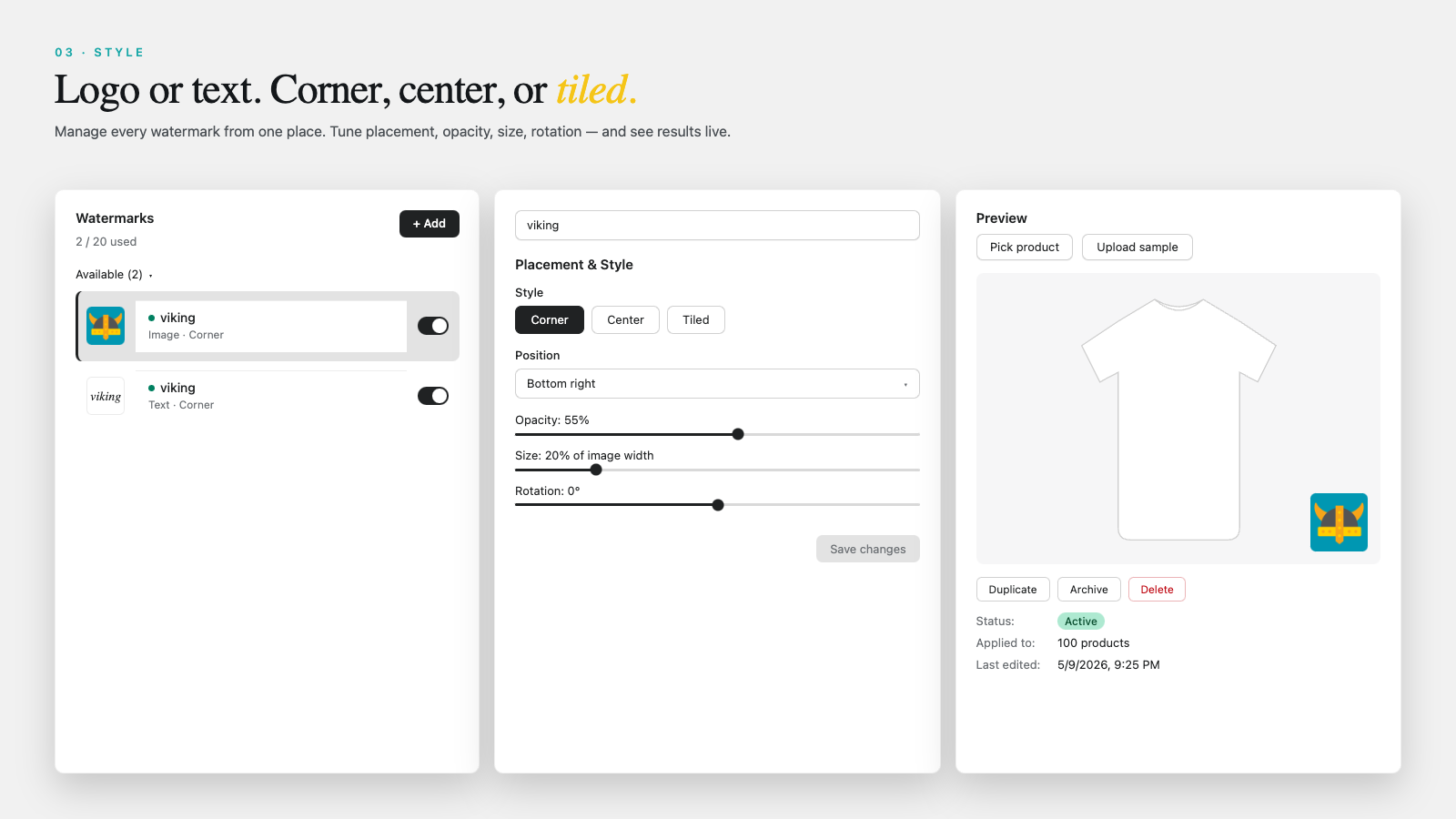
So how do you respect both Google and the disclosure laws? Keep the primary feed image clean (or roll back before a feed sync), and label your secondary shots. Viking’s one-click rollback restores the clean originals saved in Shopify Files, no quality loss, in JPEG, PNG, WebP, or GIF. Want to think harder about whether labels cost you SEO? We dug into that in do watermarks hurt Shopify SEO and Google Shopping, and the broader workflow lives in our bulk watermarking guide.
Viking pricing is flat (not tied to your Shopify plan): Free at $0 for 100 images and 2 designs, Starter $5 for 1,000, Growth $15 for 5,000, Pro $30 for 20,000. Bulk apply and auto-watermark start at Starter, with roughly 17% off annually. For the step-by-step label flow, see our companion post on adding an AI Generated label to Shopify images.
FAQ
Quick legal note before the answers: this is general information, not legal advice. Consult a qualified attorney for your specific catalog and markets.
When does the New York synthetic performer law take effect?
June 9, 2026. It requires advertisers to conspicuously disclose an AI-generated human performer in an ad when they have actual knowledge it’s used. Penalties are $1,000 for a first violation and $5,000 for each later one, enforced by the NY Attorney General. Whether static e-commerce product photos with AI models are covered is an unresolved gray zone.
Does California SB 942 apply to ordinary Shopify merchants?
Generally no. SB 942 binds “Covered Providers,” meaning gen-AI tools with more than 1 million monthly California users. Merchants who simply use third-party AI tools are not Covered Providers and are not directly obligated. The $5,000-per-violation penalty targets the AI tool makers, not the store posting the image.
What is the EU AI Act penalty for Article 50 violations?
Up to EUR 15 million or 3% of total worldwide annual turnover, whichever is higher. It applies whenever AI output is used in the EU, even for non-EU sellers shipping into the EU. The higher 35M/7% figure is a separate prohibited-practices tier and does not apply to Article 50.
Do I have to disclose AI-generated product photos with no people?
Usually no. AI backgrounds, upscaling and routine editing never trigger disclosure, and New York and California do not reach object-only images at all. The EU does, if the generated image misleads about the real product. The obligations center on AI-generated people, faces, and models. The EU may still apply provider machine-readable marking to synthetic outputs.
Why can’t I just watermark my Google Shopping feed image?
Google Merchant Center disallows watermarks or logos over the product on feed images and prefers invisible IPTC DigitalSourceType metadata instead. So keep your primary feed image clean (or roll back before a feed sync) and label secondary shots. Note Shopify’s CDN strips EXIF and IPTC metadata on compression, which is a real gap for the metadata route.
Does Shopify require an AI image disclosure?
No. Shopify has no product-image AI-disclosure requirement and promotes AI photography through Shopify Magic. There’s no “I used AI” checkbox like Etsy added on January 14, 2026. Any disclosure is your responsibility, driven by the regional laws above, not by Shopify policy.
Related reading
- Do you have to disclose AI-generated product images on Shopify?
- AI fashion models on Shopify: the 2026 disclosure laws
- How to add an AI Generated label to Shopify product images
- The Shopify product image SEO guide
- Multi-region AI disclosure for combined listings (EU + NY)
Pin the table. Mark June 9 and August 2 on a real calendar. Then go check exactly one thing: which of your product photos contain a human face you didn’t shoot.

Umid
Co-Founder at Craftshift