How to prevent Shopify returns with better product information (not stricter policies)

When return rates rise, many retailers are tempted to tighten their return policies by adding a restocking fee, shortening the return window, or even charging for return shipping. But the truth is that such moves are unfair to customers for a reason that goes beyond just customer satisfaction: they amount to a tax on the customer for a problem the retailer itself created.
Revolve, the fashion retailer that does hundreds of millions in annual revenue, reported a 60% return rate (not disclosed by their CFO on the latest earnings call). But instead of charging customers return fees, the co-CEOs are using virtual try-on, improved fit guides, size comparison tools and video product images to try to better inform customers up front about what to expect when they receive their order. Co-CEO Mike Karanikolas told Sourcing Journal that after exploring the issue of high return rates at the retailer, he determined that size and product quality weren’t the issues, but customer expectations versus reality were.
As Zachary McClung put it: “A stricter return policy doesn’t fix the reason people are returning. It simply punishes the customer for returning products the seller couldn’t sell. A customer who returned a product because it came in the wrong size isn’t given better inventory information, they’re just charged a fee and sent away. The customer leaves the store unhappy.
That logic applies to every Shopify fashion and apparel store, not just billion-dollar retailers. Fix the expectation gap and returns come down without fighting your customers over it. This guide covers the three biggest causes of the expectation gap and how to close each one.
In this post
- The expectation gap: why customers return
- Fix 1: Show only the selected variant’s images
- Fix 2: Add accurate size charts on the product page
- Fix 3: Variant-specific product descriptions
- Return policy vs return prevention
- FAQ
The expectation gap: why customers return
This rating refers to the discrepancy between what a customer expected to receive based on what they saw on the product page and what actually got there. These differences are largely caused by 3 factors:
- Wrong color or appearance. The customer selected “Navy Blue” but the gallery showed mixed photos of all colors. They bought based on a photo of a different variant, or the swatch color did not match the real product color. The product arrives and the color is not what they expected.
- Wrong size or fit. No size chart visible on the product page. Or the size chart was generic (not specific to this garment). Or the size chart was on a separate page that the customer never found. The product arrives and it does not fit.
- Wrong material or feel. The description said “cotton” but the product feels different from what the customer imagined. No variant-specific descriptions for different materials. No close-up texture photos. The product arrives and the material is not what they expected.
None of these are product defects. The product is fine. The information on the product page was insufficient or misleading. That is what needs fixing.
Fix 1: Show only the selected variant’s images
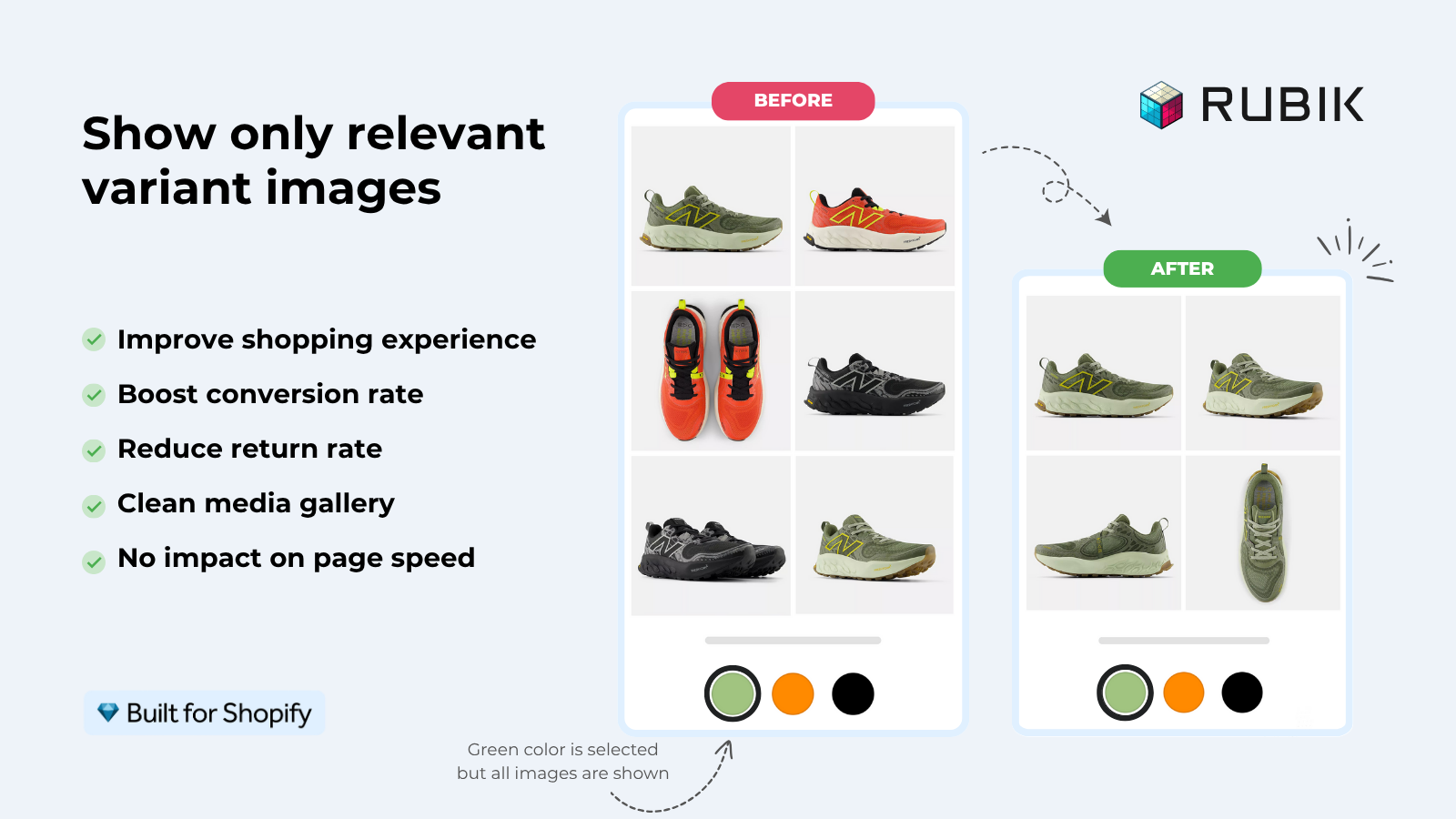
Incorporate only “Navy Blue” images into the color gallery, not all 30 images for all 8 colors. Every gallery should not include every color image; just the images that directly pertain to what a customer has selected (e.g. Navy Blue). So instead of 30 images, there would be maybe 4 to 6. Not a generic product image.
Customers wouldn’t even see the variants without variant image filtering. This would create a jumbled gallery where customers have to form expectations based on the few images that catch their eye. Meanwhile the variant picker says “Navy Blue”. Customer adds “Sage Green” to cart. Product arrives in Navy Blue. Returns ensue.
Fixing this requires two things: correctly assigning images to variants and enabling gallery filtering. Rubik Variant Images handles both. AI auto-assign matches images to variants using filenames and alt text. Bulk assign uses gallery order for stores with organized image sets. Once assigned, the gallery automatically filters to show only the selected variant’s photos.
Additional image improvements that reduce returns:
- Accurate swatch colors. Set custom hex values so the swatch matches the actual product color. Generic CSS color mapping (“Red” = #FF0000) often does not match the real product shade.
- Color name labels. “Navy” and “Black” look identical as small circles. Text labels prevent wrong-color selections, especially for colorblind customers (8% of men).
- Multiple angles per variant. Front, back, close-up, and on-model for each color. Customers who see the product from 4+ angles have fewer “this is not what I expected” moments.
Fix 2: Add accurate size charts on the product page
Size-related returns are the number one return reason for apparel stores. The fix: put a visible, accurate size chart directly on the product page, not on a separate page, not in the footer, not behind a link that most customers never click.
What a good size chart setup looks like:
- Per-product or per-category charts. A slim-fit t-shirt and an oversized hoodie should not share the same size chart. Different garments have different measurements at the same labeled size.
- Visible without scrolling. The chart should be accessible near the size selector, ideally as a tab or popup that opens in one click. If customers have to scroll past 3 sections of content to find sizing info, they will not find it.
- Both cm and inches. International customers need both measurement systems. Automatic unit conversion removes the need for customers to do math.
- Fit notes. “This runs small, size up” or “relaxed fit, true to size” is more useful than raw measurements for most shoppers. Honest fit guidance builds trust and prevents returns.
CSC: Size Chart and Size Guide is a great Shopify app for embedding a size chart into your product pages. The app uses AI technology to suggest the correct size, you can generate a size chart with one click by importing the product’s information, it includes 18 ready made templates (shirts, pants, dresses, shoes, rings, etc.) and size charts can be automatically assigned to collections or product types within the app. There is a free plan with 2 published charts, which should be enough for basic stores. It also comes with a theme app block, so the size chart will appear right next to the size selector on the product page.
By incorporating an accurate size chart into your product page in addition to allowing variant image filtering, you are providing customers two critical pieces of information before they make the purchase. Firstly, customers get to see what the product looks like in the color that they are purchasing, and secondly, customers know what size to order meeting the expectations that have been set. Returns are drastically decreased.
Fix 3: Variant-specific product descriptions
When variants offer different options i.e. where variants differ in material (cotton vs polyester), composition or options the description should note the differences. A shirt made from cotton and a shirt made from polyester of the same design have different feels, same look but different weights and different wash instructions. An incorrect description can mean that the published description fails to adequately describe the variant to customers.
Per-variant descriptions via metafields–swap out the regular description text for the specific variant. So, the Cotton variant could have specific washing instructions for cotton, and the Polyester variant would have details about its specs instead of those for polyester. Customer sees the correct description as they switch the variant picker. No more “returning this item as not as described” because customer saw incorrect variant description before purchasing.
If your colours live as separate products rather than variants of one product, Rubik Combined Listings groups them into a single listing with swatches instead. Free to install, 5.0 stars across 78 reviews.
Return policy vs return prevention
Revolve, a fashion retailer with high 60% return rates, have chosen not to penalise customers with return fees but instead have invested in ensuring the information quality on their product pages to help bring the return rate down so customers make better purchasing decisions.
For Shopify stores, the math works the same way:
| Approach | Short-term effect | Long-term effect |
|---|---|---|
| Stricter return policy | Fewer returns (some customers just keep unwanted items) | Lower customer satisfaction, negative reviews, reduced repeat purchases |
| Better product information | Fewer returns (customers buy the right product the first time) | Higher satisfaction, better reviews, more repeat purchases, lower support cost |
The ROI on better information is incredibly high. Variant image filtering costs a few dollars per month for an e-commerce store, compared to the cost of processing a single return. A size chart app might cost less than the cost of shipping two returned items. Per-variant descriptions cost nothing to write, and only take a moment to read.
For retailers who list each color of an item as a separate product, Rubik Combined Listings displays all the colors of an item with swatches in a gallery on the product page. With swatches from all the colors of the item, the For stores like these, there is no chance of color mix up, and there is no chance of the wrong material being described. The gallery is confined to images of the specific product you’re viewing on the product page.
“We’ve tried several solutions for managing variant images, but Rubik Variant Images stands out. It’s like giving our product pages a much-needed declutter. Customers now see only the images that match their selection, which has noticeably reduced the ‘Is this the right color?’ support queries. The setup was intuitive, and the results were instant.”
Livspace Home, India, Rubik Variant Images on the Shopify App Store
Frequently asked questions
What is the biggest cause of returns for Shopify apparel stores?
The #1 reason for returns are “Size/fit issues” followed closely by “Color/Appearance doesn’t match as shown”. Both of these can be product page information problems rather than issues with the product itself. Providing accurate size charts for items and allowing customers to filter by variant can help prevent these kinds of returns.
Does a stricter return policy reduce returns?
By preventing some returns, you reduce the number of items that need to be processed. However, returns that are prevented often result in dissatisfied customers who write negative reviews and do not become repeat customers. Preventing returns through better information about sizes keeps satisfied customers coming back to your store.
How does variant image filtering reduce returns?
By showing only photos of the gallery of the single color of the product, customers have accurate expectations of what the product will look like. There are no surprises from other colors being shown in the gallery. Customers are not misled into purchasing a different variant of the product because of a photo they saw in the gallery. What they see in the gallery is what they get.
What size chart app works best for Shopify?
CSC: Size Chart and Size Guide is a great app that uses AI to suggest the best features for you. It comes with 18 predefined templates and automatically assigns sizes to your size chart based on the collections in your store. It’s a great value, and you can also start with the free plan. The app integrates as a full theme app block, and unlike other variant image apps, this one does not conflict with other apps on your store.
How much do returns actually cost Shopify stores?
Direct costs to process a returned item like paying for return shipping, inspecting the returned item, repackaging the item, and the restocking labor. Indirect costs like lost future sales, negative reviews, and support time required to handle return requests. For apparel retailers with high return rates, the total cost of returns can actually exceed 10% of sales. Providing enough information to avoid only a small percentage of returns can therefore have a big impact on profitability for a retailer with a high return rate, who loses 20% to 40% of sales in returns.
Related reading

Umid
Co-Founder at Craftshift