Best Shopify apps for clothing and fashion stores 2026
Running a clothing store on Shopify requires a different set of apps compared with a gadget store or food delivery brand. For example, a fashion store has a unique set of requirements given the high number of variants for different colours and sizes, image heavy product pages, return due to size and fit issues and the majority of customers accessing and purchasing on your store via mobile. While there are some apps that are universal and can benefit any store, there are others that are specific to Fashion stores and help to address the particular pain points faced by Fashion store owners.
Before the list: Craftshift builds Rubik Variant Images and Rubik Combined Listings, so we are ranking a category we compete in. Our apps appear below in the position the App Store’s own category ordering puts them, flagged as ours every time, and we say plainly where a rival beats us on review count, age or price. Read this as a roundup from inside the category, not a survey from outside it.
This guide outlines clothing store apps by most relevant categories, reviews each category’s main features, and chooses an app to serve as a starting point for each category. This guide is devoid of unnecessary product reviews that don’t add value to an online clothing store.
In this post
- 1. Variant image filtering
- 2. Color swatches
- 3. Combined listings (product grouping)
- 4. Size charts and fit guides
- 5. Product reviews with photos
- 6. Email marketing
- 7. Returns and exchanges
- FAQ
1. Variant image filtering
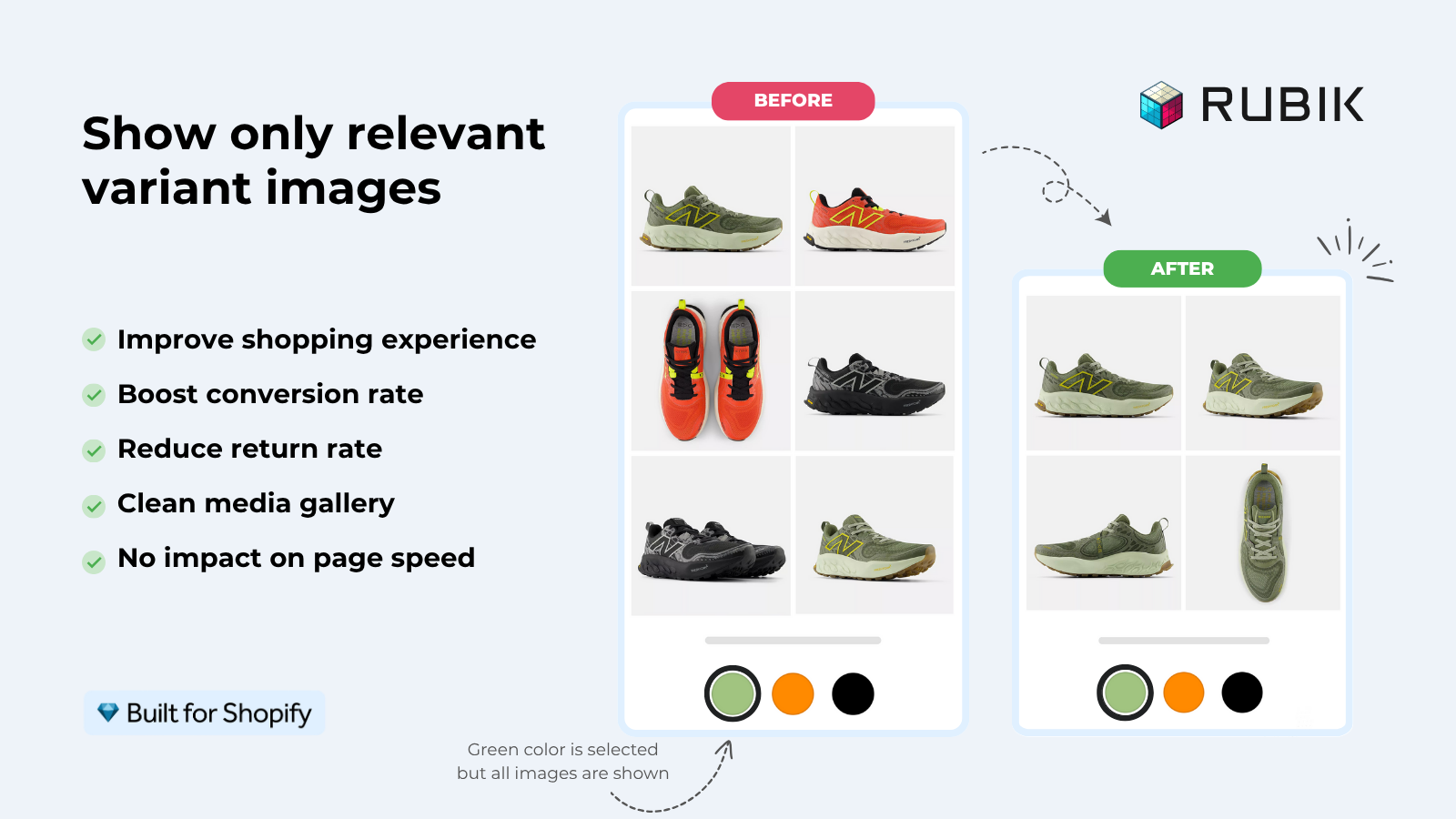
The most relevant app category for clothing stores. A dress in 8 colors has 40+ images in the gallery. Without filtering, a single “Blue” image will have 40+ variants including 35 of other colours. With filtering, the customer is shown the 5 blue images which are relevant to their search.
What to look for: automatic image-to-variant assignment (manual is too slow for large catalogs), support for multiple images per variant, no external API calls (speed matters), and compatibility with your theme.
Rubik Variant Images, Filter through the vast array of variant images with both Shopify Bulk assign and AI auto assign for large product catalogs. Loading variant images for a Rubik Variant Images app tag won’t affect speed. Suitable for any Shopify theme and all 7 page builders (Beae, EComposer, Foxify, GemPages, Instant, PageFly, Replo). Free plan available for stores with up to 1 product.
2. Color swatches
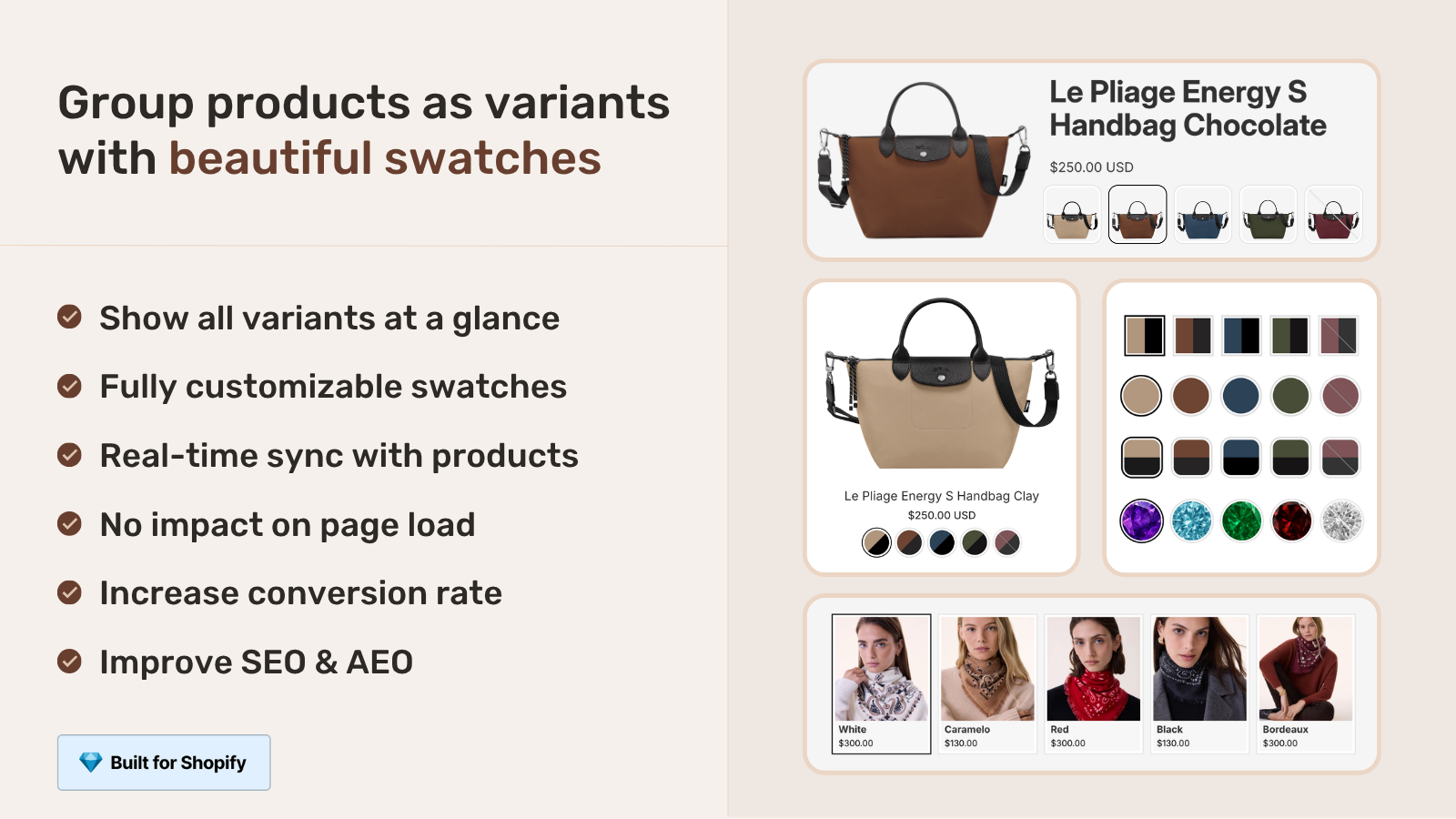
Clothing stores with multiple color variants typically need swatches instead of dropdowns for faster decision making. Swatches allow customers to see all variants at the same time, give immediate feedback, and are one of the highest-impact A/B test wins on apparel stores.
Features that your product swatches should have: Color circles (or boxes) AND swatches for patterns and textures. Editable border and size. Handling of sold out variants (both disabled and hidden variants). tooltips with color names.
Rubik Variant Images. Swatches and image filtering, with 3 swatch types (color, image, pill), over 100 CSS variables to control look and feel, and the ability to mix swatch types on a per option basis. No need for a separate swatch app.
3. Combined listings (product grouping)
For stores where each color is a separate product (Different photos. Different descriptions. etc.) product grouping allows you to group the related products together using color swatches on collection pages and individual product pages allowing customers to navigate between the related products. Each product remains its own unique entity with its own SEO URL, gallery and description.
What to look for: collection page swatches (not just product page), AI auto-grouping for large catalogs, real-time sync when products change, and mobile-optimized swatch layouts.
Rubik Combined Listings by Rubik, Add products with 4 swatch types, use AI to auto-group similar products, generate multiple groups at once from a csv file, and offer separate layouts for desktop and mobile. Comes with a free plan that includes 5 groups or less. No need for Shopify Plus.
4. Size charts and fit guides
The number one reason for clothing returns is size and fit. Putting a visible, accurate size chart ON THE PRODUCT PAGE can help reduce returns and give customers confidence to purchase. Some themes support size charts but dedicated clothing apps go further with features like measurement guides, fit based on body measurements and per product size charts, differentiated by garment type.
What to look for: per-product or per-collection charts (not one chart for all), measurement unit conversion (cm/inches), mobile-friendly display, and the ability to attach charts to specific product types automatically.
5. Product reviews with photos
Reviews with customer photos are the strongest trust signal for clothing items. Star rating indicates product quality. Written reviews explain why. Customer photos prove it will look good on real people, not just in a models clothing line, and help lower return rates for fashion items as customers can more accurately determine how a garment will look on them based on how it looks on different body types.
Short Description: Gathers together photo and video reviews. Automatically sends review request emails. Displays reviews on product pages AND on reviews pages. Displays star ratings in Google Shopping search results. Imports reviews from other sources (useful for dropshippers who import products from AliExpress).
6. Email marketing
Email is the best performing marketing channel for Fashion brands, Email drives the highest ROI of any marketing channel for fashion brands. From abandoned cart email and new arrivals to back in stock and season sale promotion emails, email offers the highest return for retailers of fashion.
What to look for: Shopify integration (pull product data, cart contents, customer segments), automated flows (welcome series, abandoned cart, post-purchase), segmentation by purchase history and browse behavior, and SMS support for time-sensitive promotions.
7. Returns and exchanges
Clothing stores experience higher return rates than other e-commerce categories. Turning one-time customers into repeat customers requires a simple return process. Creating anger from a bad return process can lead to negative reviews and chargebacks. The good return management app turns what could be a refund into an exchange, keeping the revenue, not losing it.
What to look for: branded return portal (not just emailing customers with return information), exchange incentives (e.g. customers receive store credit or can exchange for another size/color), automated return shipping labels, and analytics about why returns occur (to determine if it’s a sizing or product quality issue).
“Hands Down the best customer support of all the variation/swatch apps I have used till date. The app does everything. From individual variant gallery to really detailed customizable swatch’s. All in a single app. Originally we used to use two different apps so this is so much more cost efficient for us.”
Bellissima Covers, India, Rubik Variant Images on the Shopify App Store
See the Rubik Variant Images demo store and the Rubik Combined Listings demo store.
Frequently asked questions
How many apps should a clothing store have on Shopify?
5 to 10 is a good range. variant images/swatches, reviews, email marketing, returns analytics. Each app you add can bring either a minor speed impact and a new layer of apps and management to keep up with, or a significant speed impact and new apps to manage, or a significant speed impact and impact to sales/operations that you want to monitor and optimize. Install only the apps you find truly valuable to you and your business.
Do I need separate apps for swatches and variant images?
Note that some apps do both (e.g. Rubik Variant Images), it might be useful to aim for an app that does both a color swatch picker for the variant picker and an image filter for the gallery, as opposed to having two separate apps that could conflict with each other.
What is the most important app for a fashion store?
Show variant images and color swatches Fashion is visual. That’s why customers need to see the actual fashion product from multiple angles. Instead of “Blue” give them a swatch that they can click on to see the variant, and a gallery that they can filter on to see blue images.
Will too many apps slow down my clothing store?
It depends on the apps. Metafield-based apps (Rubik) have minimal speed impact, whereas apps with heavy JavaScript or external API calls can have latency implications. It is recommended to periodically audit your app stack and test the speed implications of each individual app by temporarily disabling them one at a time.
Do I need Shopify Plus for fashion store apps?
No. All categories of apps covered in this guide can be used with any Shopify plan. Both Rubik Variant Images and Rubik Combined Listings are compatible with all Shopify plans, including the basic plan. Shopify Plus however has some additional features for checkout customization and automation, but these are not necessary for most clothing retailers to create a successful online store.
Related reading

Umid
Co-Founder at Craftshift