AI Fashion Models on Shopify: When Virtual Models Trigger Disclosure Laws in 2026
The honest answer to AI fashion models Shopify disclosure questions in 2026 is this: a synthetic person wearing your clothes is the single riskiest product image you can publish, because one shot can touch five separate rules at once. AI human models in apparel photos sit in a legal cluster (New York’s gray zone, the EU deepfake rule, Washington’s forged-likeness law, the NY Fashion Workers Act, and right of publicity) that pure product-only photos simply do not.
Updated 16 August 2026. The European Commission published its Article 50 guidelines on 20 July 2026 and reads “objects” in the deepfake definition as including consumer goods, so an AI product image that misleads about the real product needs disclosure even with nobody in the frame. For that reason the EU rows below have been corrected. The full picture is in do AI product photos need a label in the EU.
This is the part most guides get backwards. They lump every AI image together. But there’s a hard line in 2026 law, and it runs right through your apparel catalog. On one side: object-only product shots (the folded tee, the shoe on plain white, even an AI background) that are generally exempt. On the other side: AI-generated people, faces, and models. Clothes need bodies to look good. So apparel stores live on the wrong side of that line by default.
And the twist that catches people? A disclosure label, on its own, does not cure a lookalike or right-of-publicity problem. You can stamp “AI Generated” on an image and still get sued if the synthetic face resembles a real, identifiable person without consent. Labeling and likeness are two different obligations. Here are the laws that hit apparel specifically, and what actually keeps you covered.
In this post
- Why AI fashion models are a special legal case
- Does the New York synthetic performer law cover AI models on Shopify?
- Do AI fashion models trigger EU deepfake disclosure?
- What does Washington’s SSB 5886 add for lookalike faces?
- The NY Fashion Workers Act and AI digital replicas
- Why a label alone does not fix a likeness problem
- What apparel stores should actually do
- FAQ
Why AI fashion models are a special legal case
AI fashion models are a special legal case because they combine two regulated elements in one image: a synthetic human (which triggers disclosure rules) and a face that might resemble a real person (which triggers likeness and publicity rules). A flat-lay hoodie does neither. Put that same hoodie on an AI-generated body and you’ve crossed into territory three or four statutes care about. That’s the heart of AI fashion models Shopify disclosure: the body is what moves you across the line.
Think about a typical apparel listing. Several model shots per product, multiple angles, often the same synthetic face reused across an entire collection for visual consistency. That reuse is exactly what raises the stakes. The more you lean on one believable AI face, the more it starts to read as a specific person, and the closer you get to right-of-publicity exposure.
Here is the rule of thumb, with one update. Object-only images sit outside New York and California. Under the EU rules, following the Commission’s July 2026 guidelines, they still need disclosure if the generated image misleads about the real product. The obligations center on AI-generated people. Routine editing (lighting, crop, background removal, retouch) never triggers disclosure on its own. So a brand that uses AI only for backgrounds and product cleanup is in a very different position than one that generates the models themselves. If you sell variant-heavy apparel, the same caution applies to your AI-generated variant images, where a model appears on every color swatch.
Does the New York synthetic performer law cover AI models on Shopify?
It may, but it’s unresolved. New York’s Synthetic Performer Disclosure Law (General Business Law section 396-b) took effect June 9 2026 and requires advertisers to conspicuously disclose a “synthetic performer” in an advertisement when they have actual knowledge it’s there. Whether a static AI model in a product photo counts as a “performer” depends on how regulators read the word “performance.” That gray zone is real, and nobody should tell you otherwise yet.
A synthetic performer, under the statute, is a digitally created asset built or modified by generative AI or a software algorithm, meant to create the impression of a human performer who is not recognizable as any identifiable real person. The law was clearly aimed at audiovisual and visual performances (think commercials, deepfake spokespeople). E-commerce sits at the edge. Pure product-only images are outside scope. AI human models in static product photos? That’s the unsettled part. It may be covered, it may not, and the answer depends on enforcement.
A few facts that matter for Shopify sellers:
- “Conspicuous disclosure” is not defined in the statute. No required wording, size, placement, or language. Lawyers point to the FTC “clear and conspicuous” standard as a practical benchmark.
- Penalties are $1,000 for a first violation and $5,000 for each subsequent one. The NY Attorney General enforces it. There’s no private right of action.
- Primary liability sits with the advertiser or creator. Platforms that merely disseminate are exempt (and Section 230 protected). A platform given notice has five days (or as soon as feasible) to cease distribution or insert the disclosure. That five-day window is a notice-and-remediation rule, not the trigger for your own liability.
- The law applies broadly, including to digital advertising. It names specific categories (newspapers, magazines, TV, radio, streaming, cable, billboards, transit ads). It does not say “any medium.”
So what’s the practical move while the gray zone stays gray? If you’re already publishing AI models, a conspicuous “AI Generated” label is cheap insurance. It costs you almost nothing and it pre-empts the disclosure argument entirely. For the full breakdown of this one statute, see our deeper guide on the New York synthetic performer law for Shopify AI models.
Do AI fashion models trigger EU deepfake disclosure?
Yes, AI-generated human models on apparel do require EU deepfake disclosure when the face resembles a plausible real person and could appear authentic. Article 50 of the EU AI Act becomes enforceable August 2 2026, and it splits responsibility into two roles: providers (the AI tool makers) must mark synthetic outputs in a machine-readable format, and deployers (you, the merchant publishing the image) must disclose when content is a deepfake.
What’s a deepfake under the Act? Article 3(60) defines it as AI-generated or manipulated image, audio, or video resembling existing persons, objects, places, entities, or events, that would falsely appear authentic. Notice the breadth. It’s not only about people. But for apparel, the human trigger is what bites. An object-only product image (even AI-generated, even with an AI background or upscaling) does not trigger the Article 50.4 deepfake deployer disclosure. An AI model whose face looks like a real, plausible person and could mislead a viewer does.
One detail worth getting right: it’s not photorealism alone that creates the obligation. A stylized, clearly artificial figure is different from a believable face that a shopper would assume is a real model. The closer your AI model gets to “this looks like an actual human being,” the more clearly you’re in deepfake-disclosure territory. (And Article 50(2) provider machine-readable marking can still apply to synthetic outputs separately.)
| Image type | EU Art 50.4 deepfake disclosure? |
|---|---|
| Real product, real or AI background | No |
| Fully AI-generated product image that alters the real product | Yes, deployer must disclose |
| AI-upscaled or cleaned-up product photo | No |
| AI model with a believable, real-looking face | Yes, deployer must disclose |
| Clearly stylized, obviously-artificial figure | Depends on whether it could appear authentic |
Two more things that surprise people. The Act is extraterritorial: it applies as long as the output is used in the EU, irrespective of where you’re established. A non-EU Shopify seller shipping AI-imaged apparel to EU customers is in scope. And the penalty for Article 50 violations is up to 15 million euros or 3% of total worldwide annual turnover, whichever is higher. (Don’t confuse that with the higher prohibited-practices tier.) Gen-AI systems already on the market before August 2 2026 get until December 2 2026 to meet the machine-readable marking obligation, but deepfake disclosure has no grace period. The full picture lives in our EU AI Act Article 50 guide for Shopify product photos.
What does Washington’s SSB 5886 add for lookalike faces?
Washington’s SSB 5886, effective June 10 2026, extends personality rights to AI deepfakes and raises the civil penalty to $3,000 plus actual damages for unauthorized AI digital likenesses. This is the law that punishes the lookalike problem directly, separate from any disclosure question. It defines a “forged digital likeness” as AI-manipulated audio, video, or image that misrepresents a person and is likely to deceive a reasonable person.
Why does this matter for apparel? Because AI image tools sometimes generate faces that resemble real people, including real models or public figures, without anyone intending it. If your synthetic apparel model happens to look like an identifiable person, a label saying “AI Generated” does not make the likeness authorized. Washington adds actual damages, possible non-economic damages, and injunctive relief on top of the flat penalty. That’s the difference between a disclosure rule and a likeness rule. One asks “did you label it?” The other asks “did you have the right to use that face?”
The NY Fashion Workers Act and AI digital replicas
The NY Fashion Workers Act requires clear written consent before a model’s AI digital replica is created or used, and that consent must specify scope, purpose, duration, and compensation. If your “AI model” is actually a digital replica of a real model you photographed or licensed, you can’t just generate variations and reuse the face forever. The consent has to cover what you’re doing with it.
This is the piece apparel brands forget. A lot of “AI fashion” workflows start from a real human shoot, then use AI to generate poses, colorways, or expressions. The moment you’re reproducing a real model’s likeness with AI, written consent (scope, purpose, duration, compensation) isn’t optional. It’s the law in New York. Train-from-scratch synthetic faces with no real-person source are a different animal, but if there’s a real model in the lineage, get the paperwork.
Why a label alone does not fix a likeness problem
A label alone does not fix a likeness problem because disclosure and consent are two separate legal duties. Conspicuous disclosure answers “is this AI?” Right of publicity and forged-likeness laws answer “did you have permission to use this person’s face?” You can satisfy the first and completely fail the second. Most operators conflate them, and that’s the expensive mistake.
So a compliant apparel image often needs two things stacked together:
- A visible “AI Generated” disclosure (covers NY conspicuous disclosure and the EU deployer visible-label half).
- A clean likeness pedigree: either a fully synthetic face with no real-person source, or written consent if a real model is in the mix.
- Machine-readable provenance where it applies (the EU provider marking, Google Merchant Center metadata). This is a separate, technical layer.
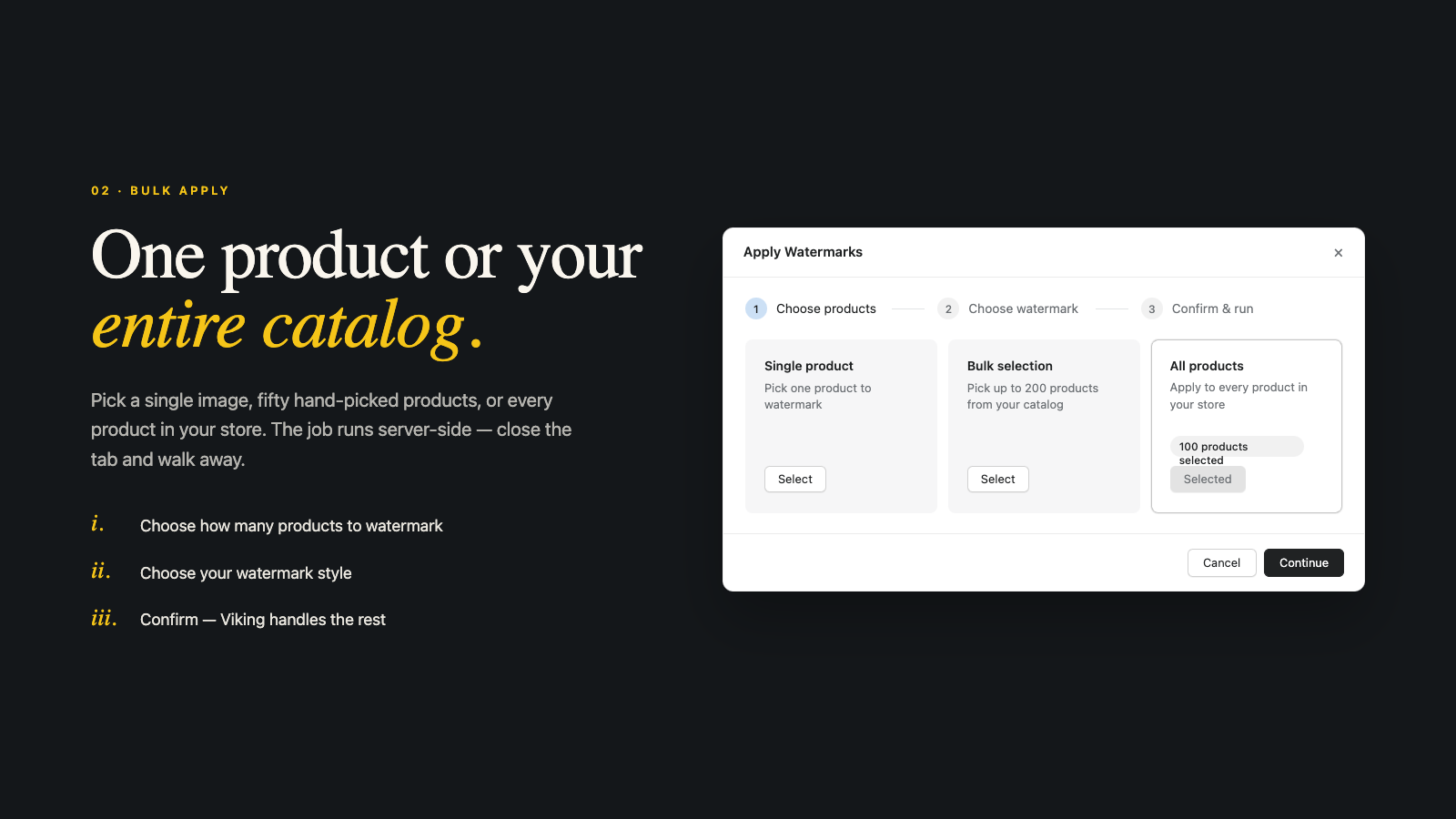
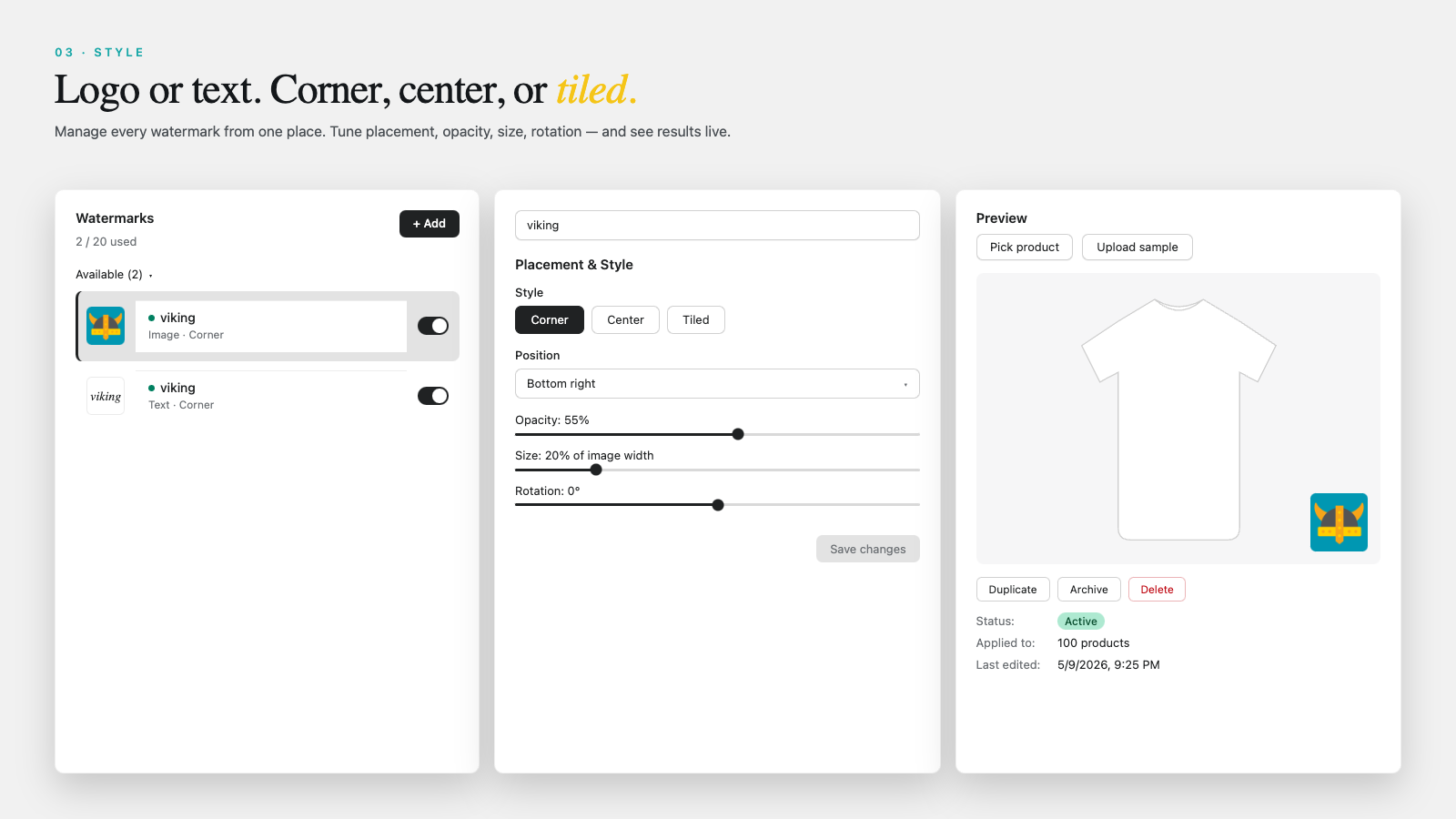
On the visible-label half, a watermarking app is the fast path. Viking Watermark (by Aegis, new on the App Store) stamps a logo or text watermark like “AI Generated” onto product images. You can apply it to a single image, by collection, by tag, by product status, or to everything at once, and auto-watermark adds your template to new uploads automatically. If you ever need to remove it, one-click rollback restores the clean originals saved in Shopify Files with no quality loss. It works on JPEG, PNG, WebP, and GIF. To be precise about what it does: Viking covers the visible-label layer. It does not embed C2PA or IPTC machine-readable metadata, and it isn’t an EU “provider” marking tool. For the metadata layer you’d handle that separately. More on the tool at vikingwatermark.com.
One Google caveat to keep in mind. Google Merchant Center wants IPTC DigitalSourceType metadata on AI product images (metadata only, no visible label) and disallows watermarks or logos over the product on feed images. So keep your primary/feed image clean, or roll back the watermark before a feed sync, and label your secondary shots. There’s a related wrinkle worth knowing: Shopify’s CDN strips EXIF and IPTC metadata on compression, which is a real gap for the Google metadata route. If you care about how watermarks interact with rankings, read whether watermarks hurt Shopify SEO and Google Shopping.
What apparel stores should actually do
Apparel stores should label visible AI models, keep feed images clean, and verify face provenance before publishing. That’s the short version. The longer version sorts your catalog by risk and acts accordingly. Object-only shots? Relax, they’re generally exempt. AI models on bodies? That’s where you spend your attention.
| Law | Hits AI fashion models? | What it asks of you |
|---|---|---|
| NY GBL 396-b | Gray zone (may apply) | Conspicuous disclosure if covered |
| EU AI Act Art 50 | Yes, for real-looking faces | Deployer deepfake disclosure |
| WA SSB 5886 | Yes, for lookalikes | Don’t use a real person’s likeness without rights |
| NY Fashion Workers Act | Yes, for digital replicas | Written consent (scope, purpose, duration, pay) |
| CA SB 942 | Binds AI tool makers, not most merchants | Generally no direct obligation on you |
One reassurance on California, because the headlines scare people. SB 942 (amended by AB 853, operative August 2 2026) covers “Covered Providers,” meaning gen-AI systems with over a million monthly California users. Those are the tool makers. Ordinary Shopify merchants who just use third-party AI tools are not Covered Providers and are generally not directly obligated by SB 942. The $5,000-per-violation penalty isn’t pointed at you for using DALL-E or Firefly. (The AB 853 “large online platform” rule for sites with over 2 million CA monthly users starts January 1 2027, also platform-level.)
And the FTC sits over all of it. It applies existing deception and endorsement rules to AI with no carve-out. AI testimonials must reflect real users’ honest views. Routine retouching doesn’t require disclosure; substantive misleading edits (face swap, voice clone) do. If you’re grouping model shots across linked products, the same logic applies to your combined listings AI model photos, where one synthetic face can show up across an entire grouped gallery. Want the dates in one place? Our 2026 AI image disclosure compliance calendar lays out every effective date. And the pillar overview, do you have to disclose AI-generated product images on Shopify, is the place to start if this is all new.
Pricing on Viking is flat, not tied to your Shopify plan: Free at $0 for 100 images and 2 designs, Starter at $5 for 1,000, Growth at $15 for 5,000, and Pro at $30 for 20,000 images. Bulk apply and auto-watermark start at the Starter tier, and there’s roughly a 17% saving on annual billing. Storefront protection (blocking right-click, copy, and drag-to-save) is on every plan, which is a separate nicety if image theft is on your radar; more on that in our guide on whether blocking right-click actually protects Shopify images.
Frequently asked questions
This article is general information, not legal advice. Laws change and interpretations vary. Consult a qualified attorney about your specific situation before relying on any of this.
Do I have to disclose AI fashion models on my Shopify store?
It depends on the market and the image. Under EU Article 50, yes: AI models with believable, real-looking faces shipped to EU customers require deployer deepfake disclosure. Under New York’s law it’s a gray zone for static product photos, so a label is smart insurance. Object-only product shots are generally exempt everywhere.
Does putting an “AI Generated” label on the image make me fully compliant?
No. A label handles the disclosure question. It does not authorize a likeness. If your AI model resembles a real, identifiable person, Washington’s forged-likeness law and right-of-publicity rules still apply regardless of the label. Disclosure and consent are separate duties.
Are AI backgrounds or retouched product photos a problem?
Mostly no. AI-generated backgrounds, upscaling and routine editing do not trigger the EU deployer disclosure or the New York rule. The exception, added by the Commission’s July 2026 guidelines, is a fully AI-generated product image that misleads about the real garment. The obligations center on AI-generated people, not on cleaning up a shoe or a folded shirt.
Am I liable under California SB 942 for using AI image tools?
Generally no. SB 942 binds “Covered Providers,” meaning gen-AI tool makers with over a million California monthly users. Ordinary Shopify merchants who use third-party AI tools are not Covered Providers and are generally not directly obligated. The per-violation penalty targets the tool makers, not you.
What’s the penalty if I get EU disclosure wrong?
Article 50 violations carry penalties of up to 15 million euros or 3% of total worldwide annual turnover, whichever is higher. The Act is extraterritorial, so non-EU Shopify sellers shipping AI-imaged apparel into the EU are in scope. Deepfake disclosure has no grace period.
Should I watermark my primary product image?
Be careful here. Google Merchant Center disallows watermarks or logos over the product on feed images and prefers IPTC metadata instead. Keep your primary/feed image clean (or roll back the watermark before a feed sync) and apply the visible “AI Generated” label to secondary shots.
Related reading

Umid
Co-Founder at Craftshift