Do You Have to Disclose AI-Generated Product Images on Shopify in 2026?

Whether you have to disclose AI-generated product images on Shopify in 2026 comes down to one question: is there an AI-generated person in the shot? Pure product photos with no fake humans sit outside the New York and California rules. The EU is the exception, and it changed in July 2026: an AI product shot that misleads about the real product needs disclosure even with nobody in the frame. AI-generated models, faces, or “people” wearing your product are where disclosure rules start to bite.
Updated 16 August 2026. The European Commission published its Article 50 guidelines on 20 July 2026 and reads “objects” in the deepfake definition as including consumer goods, so an AI product image that misleads about the real product needs disclosure even with nobody in the frame. For that reason the EU sections below have been corrected. The full picture is in do AI product photos need a label in the EU.
That single fork in the road decides almost everything. And most guides get it backwards. They either scare every dropshipper into thinking a clean studio render of a coffee mug needs a warning label, or they wave the whole thing off as “not a real law yet.” Both are wrong.
Three laws land in mid-2026. New York’s Synthetic Performer Disclosure Law goes live June 9. The EU AI Act’s transparency rules become enforceable August 2. California’s AI Transparency Act (SB 942) shares that August 2 date. They don’t all hit the same images, and they don’t all hit you. So before you stamp a watermark on every photo in your catalog, let’s map which rule touches which image, and what the practical fix actually is.
Quick disclaimer up front (we’ll repeat it near the FAQ): this is general information, not legal advice. If you’re sweating a specific catalog, talk to a qualified attorney.
In this post
- The only distinction that matters: two image types
- The AI image disclosure decision tree
- Does the New York synthetic performer law cover my product photos?
- Does the EU AI Act require disclosing AI product images?
- Am I regulated by California SB 942 as a Shopify merchant?
- Mapping the three laws to the two image types
- The practical fix: a visible label plus clean metadata
- FAQ
The only distinction that matters: two image types
There are two kinds of AI-generated product image, and the law treats them very differently. Type one: object-only shots. The product on a white sweep, an AI-generated background, an upscaled render, a color variant generated by AI. No humans. Type two: images with an AI-generated person, a synthetic model wearing your jacket, a face that looks like a real human but isn’t.
Here is the part that changed in July 2026, and most guides have not caught up: product-only images are outside the New York and California rules, but not automatically outside the EU one. Routine editing, lighting tweaks, background removal, a crop, retouching, never triggers any of these disclosure rules. The obligation centers on AI-generated people. That’s it. If your catalog is mugs, candles, and phone cases shot (or rendered) without a single fake human, you are mostly in the clear. If you sell apparel and use AI fashion models, you’re in the zone that needs care. We dig deeper into that exact split in our piece on AI fashion models and Shopify disclosure laws.
Why does this binary exist? Because all three laws were written to stop deception about real or realistic humans, not to police whether your product render had a real photographer. A teapot can’t mislead anyone about its identity. A photorealistic “model” who never existed can.
The AI image disclosure decision tree
Run each AI image through four questions, in order. This is the whole framework.
- Is the image AI-generated or AI-manipulated at all? If it’s a normal photo with only routine edits (lighting, crop, background removal), stop. No disclosure rule applies.
- Does it contain a person? If it is object-only, you are outside New York and California. For the EU, ask the follow up question: does the image misrepresent the real product? Keep your feed image clean for Google and move on.
- Does that AI person resemble a plausible real human and could appear authentic? A synthetic model that reads as a believable person is the trigger. Cartoon mascots and obviously stylized art are not the target.
- Where are your customers? New York shoppers, EU shoppers, California, each maps to a different rule. We’ll cover them below.
If you answered “no person” at step two, the rest of this post is mostly background reading for you. If you answered “yes, a realistic AI person,” keep going. This is where the year 2026 gets interesting.
Does the New York synthetic performer law cover my product photos?
New York’s Synthetic Performer Disclosure Law (General Business Law section 396-b) requires a conspicuous disclosure when an advertisement contains a “synthetic performer” and the advertiser has actual knowledge of it. It was signed December 11, 2025 and takes effect June 9, 2026. A synthetic performer is a digitally created human, made with generative AI, intended to look like a human performance but not recognizable as any real person.
So does your AI model photo count? The honest answer: it’s unresolved. The statute leans on the word “performance,” and static product photography sits in a gray zone. An AI human model in a still product photo may be covered, depending on how the New York Attorney General reads it. Don’t let anyone tell you it’s settled either way. It isn’t. We break down the statute line by line in our New York synthetic performer law guide for Shopify.
What’s clear: pure product-only images are outside the law’s scope entirely. Routine editing doesn’t trigger it. The penalties are $1,000 for a first violation and $5,000 for each one after, enforced by the NY Attorney General, with no private right of action (no one can sue you personally over it). The law applies broadly, including to digital advertising. Primary liability sits with the advertiser who creates the ad. Platforms that merely disseminate third-party ads are exempt and Section 230 protected; a platform that’s given notice then has five days to cease distribution or insert the disclosure (that five-day window is a remediation clock for platforms, not the thing that creates your liability).
“Conspicuous disclosure” isn’t defined in the statute. No required wording, size, or placement. Lawyers point to the FTC’s “clear and conspicuous” standard as a sane benchmark. Translation: if you choose to label, make the label easy to see and read. A faint grey watermark in a corner that nobody notices defeats the point.
One more New York wrinkle if you ever scan or replicate a real model: the NY Fashion Workers Act requires clear written consent (scope, purpose, duration, compensation) before you create or use anyone’s AI digital replica. That’s a separate obligation from disclosure, and it’s not optional.
Does the EU AI Act require disclosing AI product images?
The EU AI Act requires deepfake disclosure for AI images that resemble real persons, objects, places, entities, or events and could falsely appear authentic, with transparency obligations enforceable August 2, 2026. For e-commerce, this splits cleanly along the same line. The Commission’s Article 50 guidelines, published 20 July 2026, read “objects” in that definition as including consumer goods, and give a worked example: an AI-generated image of a product that misleads “as to the actual product appearance, characteristics or use” is a deepfake, while a real product against an AI-generated background is not, as long as it does not mislead about the product itself. So AI-upscaling, colour fixes and background swaps stay outside, and a generated hero shot of a product nobody photographed does not. AI-generated human models on apparel do require deepfake disclosure when they resemble a plausible real person and could appear authentic.
Important nuance, because the EU definition is broader than “people.” Under Article 3(60), a deepfake is AI-generated or manipulated content resembling existing persons, objects, places, entities, or events that would falsely appear authentic. The trigger for human images is resemblance to a plausible real entity plus the potential to mislead, not photorealism on its own. A clearly fictional or stylized image isn’t automatically a deepfake. Our deep dive on EU AI Act Article 50 and Shopify AI product photos walks through the edge cases.
Two roles matter here. Providers (the AI tool makers) must mark synthetic outputs in a machine-readable format, effective and reliable as far as technically feasible. Deployers (you, the merchant publishing the image) owe the visible deepfake disclosure, clear and distinguishable at the latest at first exposure. Gen-AI systems already on the market before August 2, 2026 get until December 2, 2026 to meet the machine-readable marking requirement, but the deployer deepfake disclosure has no grace period.
And yes, this reaches you even outside the EU. The Act applies wherever the output is used in the EU. A non-EU Shopify seller shipping AI-imaged products to EU customers is in scope. Penalties for Article 50 violations run up to 15 million euros or 3% of total worldwide annual turnover, whichever is higher. (You may see a scarier figure floating around online. That higher number belongs to the prohibited-practices tier, a different category. It is not the Article 50 number, so don’t let it spook you.)
Am I regulated by California SB 942 as a Shopify merchant?
Almost certainly not directly, and this one gets misreported constantly. California’s AI Transparency Act (SB 942, amended by AB 853) binds “Covered Providers,” meaning generative AI systems with more than 1 million monthly users accessible in California. That’s the AI tool makers, not the people using the tools. Ordinary Shopify merchants who just use a third-party AI image generator are not Covered Providers and are generally not directly obligated by SB 942.
So don’t panic over the penalty number you might have seen. SB 942 carries $5,000 per violation, with each day counting as a separate violation, enforced by the CA Attorney General, city attorneys, and county counsels. But that’s aimed at the providers. The original operative date was January 1, 2026; AB 853 pushed it to August 2, 2026. The law requires those providers to offer manifest disclosure (a visible label) and latent disclosure (embedded C2PA-style metadata) on AI image, video, and audio. Text is exempt.
There’s a separate “large online platform” rule in AB 853 (sites with more than 2 million California monthly users) that starts January 1, 2027. That’s platform-level. It isn’t most merchants either. Read the practical takeaway as: California shapes what your AI tools must do, not what your store must do, in most cases.
Worth a side note: Washington’s SSB 5886 takes effect June 10, 2026 and extends personality rights to AI deepfakes, with a civil penalty of $3,000 plus actual damages for unauthorized AI likenesses of a real person. And the FTC applies its existing deception and endorsement rules to AI with no carve-out, AI testimonials must reflect real users’ honest views, and substantive misleading edits (face swaps, voice clones) need disclosure while routine retouching does not.
Mapping the three laws to the two image types
Here’s the whole thing on one screen. Read the row for your image type, then the column for your customers.
| Image type | New York (396-b) | EU AI Act (Art 50) | California (SB 942) |
|---|---|---|---|
| Real product, AI background, upscale, colour fix | Outside scope | Generally no deployer disclosure | You’re not a Covered Provider |
| Fully AI-generated product image that flatters or alters the real product | Outside scope | Yes, deployer disclosure | You’re not a Covered Provider |
| AI-generated realistic person / model | Gray zone, may be covered, unresolved | Deepfake disclosure required if it could appear authentic | Obligation sits on the AI tool, not you |
| Routine edits only (lighting, crop, retouch) | Not triggered | Not a deepfake | Not in scope |
Notice the pattern? New York and California stay calm about objects; the EU does not, once the image stops matching the product in the box. The AI-person row is where you act. New York is genuinely unsettled, the EU is the firm one for merchants, and California mostly regulates the tool you used, not your storefront. If you sell to EU shoppers and use synthetic models, the EU rule is your north star.
If you run variant-heavy apparel where each color or model shot is its own image, the same logic applies per variant. Our friends cover that exact case for swatch and variant galleries in labeling AI-generated variant images, and for merged listings in combined listings with AI model photos.
The practical fix: a visible label plus clean metadata
The compliant setup is two layers: a visible “AI Generated” label on the human-model shots, plus machine-readable metadata where you can keep it. Neither layer alone is enough, and here’s why.
A visible watermark is durable but croppable, and it changes how the image looks. Metadata (IPTC DigitalSourceType or C2PA Content Credentials) is invisible but trivially stripped when a file gets resaved. Worse for the metadata route: Shopify’s CDN strips EXIF and IPTC on compression, so your provenance tag can vanish the moment Shopify processes the upload. That’s a real gap, not a theoretical one. Best practice is both layers, knowing each covers the other’s weakness.
There’s a Google catch too. Google Merchant Center wants IPTC DigitalSourceType metadata on AI product images (metadata only, no visible label) and disallows watermarks or logos over the product on feed images. So your primary, feed-facing image needs to stay clean. The move: keep the primary image clean for the feed, put the visible “AI Generated” label on secondary gallery shots, or roll back to a clean original before a feed sync. We get into the trade-offs in do watermarks hurt Shopify SEO and Google Shopping.
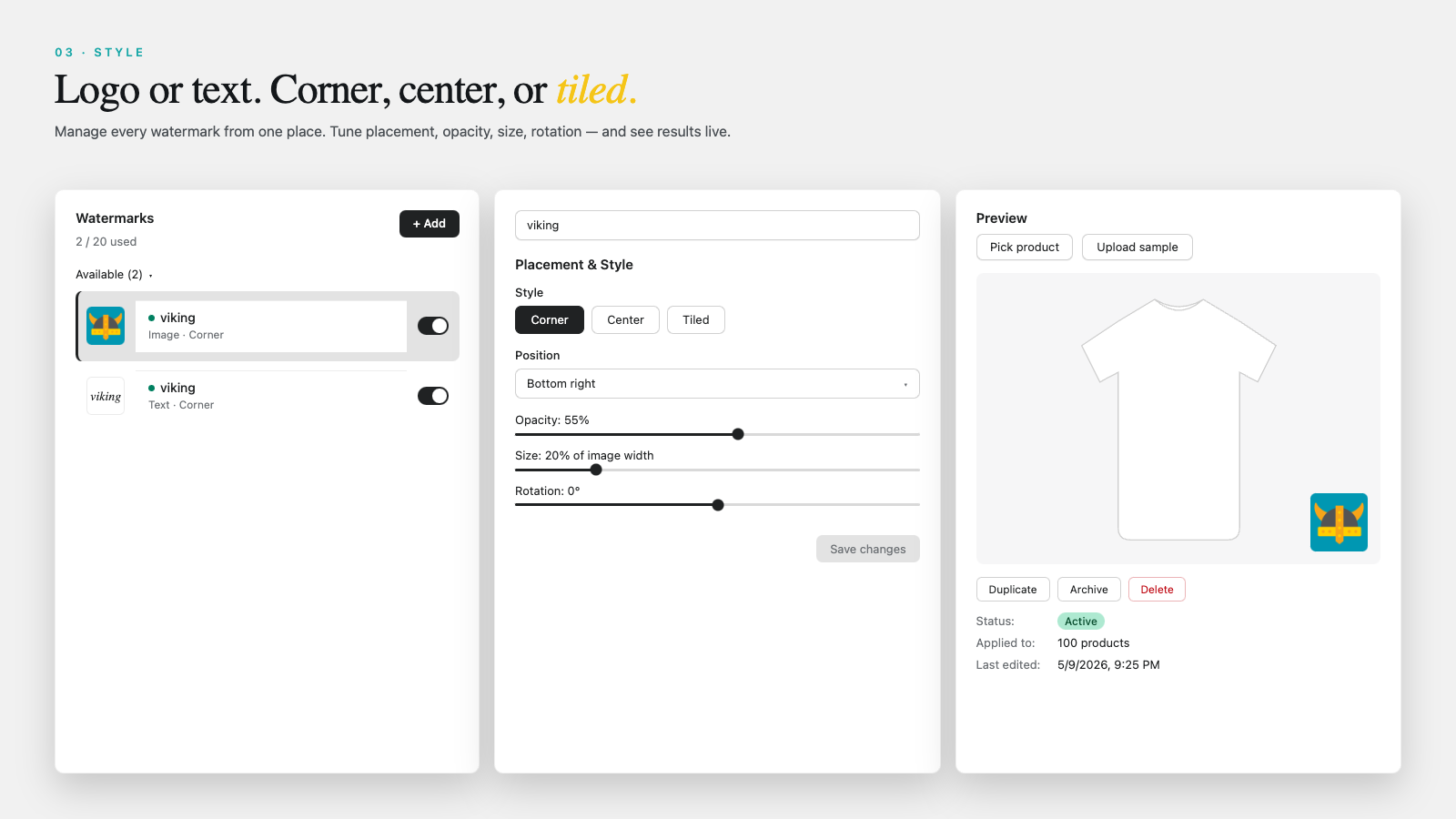
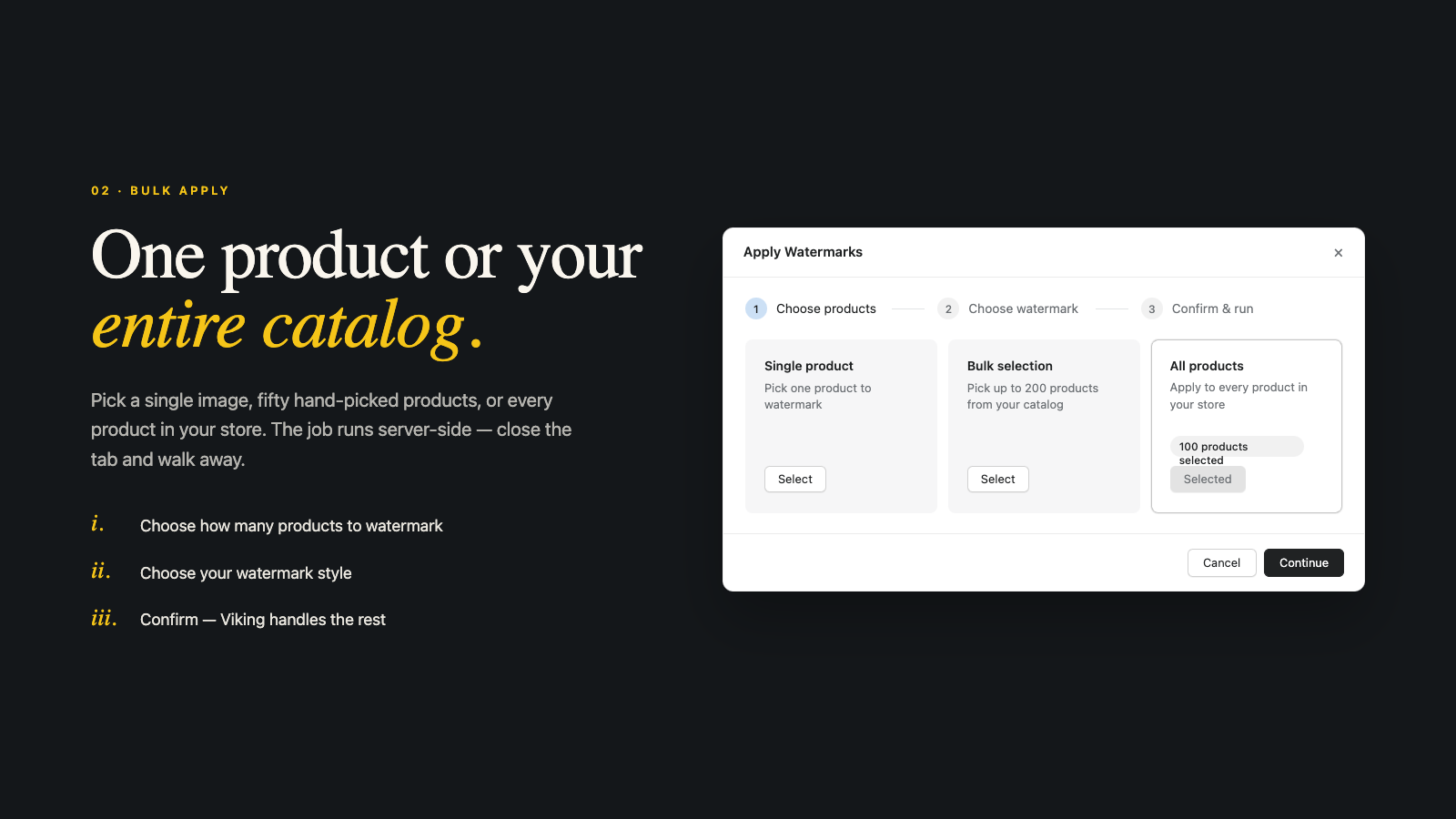
For the visible-label half, this is where a watermarking tool earns its keep. Viking Watermark (by Aegis, new on the App Store) stamps a text watermark reading “AI Generated” onto images, and you can apply it to a single image, a collection, a tag, products of a given status, or all images at once. Auto-watermark adds your label to new uploads automatically, which matters if you crank out AI shots regularly. And the rollback feature restores the clean original from Shopify Files in one click with no quality loss, so you can label gallery shots while keeping a clean primary for Google.
Be honest about what a watermark tool does and doesn’t do. Viking handles the visible disclosure layer: the conspicuous “AI Generated” label New York points toward and the deployer-facing visible label the EU expects. It does not embed C2PA or IPTC machine-readable metadata, and it isn’t an EU “provider” marking tool. That machine-readable layer is the job of your AI generator (Firefly, DALL-E 3, Imagen all embed C2PA) or your feed setup. Use the watermark for the human-eye disclosure; rely on your image source plus feed config for the metadata. You can read more about the tool at vikingwatermark.com.
One platform note that surprises people: Shopify has no product-image AI-disclosure requirement at all, and it actively promotes AI photography through Shopify Magic. There’s no “I used AI” checkbox like the one Etsy added on January 14, 2026. So nobody at Shopify is going to remind you. The compliance call is yours. If you want the step-by-step, our walkthrough on how to add an AI Generated label to Shopify product images covers the exact clicks, and the 2026 AI image disclosure compliance calendar keeps the dates straight. For broader image hygiene, the Shopify product image SEO guide and the bulk watermarking guide pair well with this.
FAQ
General information, not legal advice. Consult a qualified attorney for your specific situation.
Do I have to disclose AI-generated product images on Shopify?
For product-only images with no AI people, New York and California do not apply. The EU can: since the Commission’s July 2026 guidelines, an AI product image that misleads about the real product needs a visible disclosure even with no person in it. For images with an AI-generated realistic person, disclosure may apply, most firmly under the EU AI Act for EU customers. New York’s coverage of static product photos is unresolved. Routine edits never trigger disclosure.
Are AI-generated backgrounds or upscaled photos a problem?
An AI background behind a real product, or an upscale, stays outside both New York 396-b and EU Article 50. A fully generated product image that makes the product look different from the one you ship does need EU disclosure, per the Commission’s July 2026 guidelines. Keep the feed image clean for Google Merchant Center, which wants metadata but disallows visible watermarks over the product.
Does the New York law definitely cover AI fashion models in product photos?
No, it’s a gray zone. The statute emphasizes “performance,” and static product photography sits in an unresolved space. An AI human model in a still photo may be covered depending on how the NY Attorney General interprets it. The safe move is to label realistic AI model shots conspicuously while the interpretation settles.
Am I personally fined under California SB 942?
Generally no. SB 942 binds “Covered Providers,” the AI systems with over 1 million California monthly users, not merchants using those tools. The $5,000-per-violation penalty targets the providers. A separate large-platform rule (over 2 million CA monthly users) starts January 1, 2027 and still isn’t most merchants.
What does the EU AI Act cost me if I ignore it?
Article 50 violations run up to 15 million euros or 3% of total worldwide annual turnover, whichever is higher. The deployer deepfake disclosure (your visible label on realistic AI people) has no grace period. It applies to non-EU sellers too, as long as the image is used in the EU.
Is a visible watermark enough on its own?
Not quite. Best practice is two layers: a visible “AI Generated” label (durable but croppable) plus machine-readable metadata (invisible but easily stripped, and Shopify’s CDN strips IPTC on compression). A watermark tool handles the visible half; your AI generator’s C2PA marking handles the metadata half.
Does Shopify require an AI disclosure checkbox?
No. Shopify has no product-image AI-disclosure requirement and promotes AI photography through Shopify Magic. There’s no “I used AI” toggle like the one Etsy added in January 2026. Compliance is entirely your call, which is exactly why a deliberate labeling workflow matters.
Related reading
- New York synthetic performer law: what Shopify stores with AI models need to know
- EU AI Act Article 50 and your Shopify AI product photos
- How to add an AI Generated label to Shopify product images
- Do watermarks hurt Shopify SEO and Google Shopping?
- Combined listings and AI model photo disclosure
One last gut check before you publish a single AI image: open it and ask, “is there a person in here who never existed?” If no, ship it clean. If yes, label it and keep your feed copy tidy. Compliance in 2026 really is mostly that one question, asked honestly, every time.

Umid
Co-Founder at Craftshift