Protect your product photos from competitors

To protect product photos from competitors and dropshippers, the brands most at risk are the ones who do everything right: they shoot original photography. Ironically, if you sell generic supplier images that 200 other stores also use, nobody bothers stealing yours. But if you booked a studio, styled the set, and produced photos that make your product look better than anyone else’s, those photos are now a target. They are the asset that makes you stand out, which is exactly why someone wants to take them.
So this is for the brands with real photography to lose: apparel labels, jewelry makers, furniture sellers, artists, handmade and craft shops. The plan is the same across all of them: mark the photos so theft is traceable, block the casual save on your storefront, and keep clean originals so protection never costs you anything. Let me walk through why your photos matter this much, who is coming for them, and the setup that defends them.
In this post
- Your photography is the moat
- Who copies original photography
- What it looks like by niche
- The protection plan
- Turning theft into free advertising
- FAQ
- Related reading
Your photography is the moat
Think about what actually separates two stores selling a similar product. Often it is not the product. It is how it is presented. The lighting, the styling, the model, the props, the consistency across the catalog. Good photography is frequently the single biggest reason a shopper trusts one brand over another, and it is expensive and slow to produce. That combination, high value and hard to replicate, is the definition of a moat.
Which means when a competitor lifts your photos, they are not just borrowing an image. They are renting your credibility for free. Their cheaper version suddenly looks as trustworthy as yours, because it is wearing your photography. That is the real damage. Not the copyright technicality, the erosion of the visual edge you paid for. Protecting it is brand defense, not paranoia.
Who copies original photography
Three groups, each with a different motive:
- Dropshippers who resell the same item and want photos that convert. Yours do, so they take them. You paid for the studio, they keep the margin.
- Direct competitors whose own photos look worse. They quietly swap in yours and hope nobody notices the two catalogs now share images.
- Marketplace counterfeiters selling knockoffs under your photos. This is the most damaging, because buyers who get a fake associate the disappointment with your brand.
None of these need to be skilled. A right-click, or a bot, or a screenshot, and your work is theirs. That is the uncomfortable part: the better your photography, the lower the bar for someone to benefit from copying it. So the defense has to assume the thief is lazy and opportunistic, because most of them are.
What it looks like by niche
The threat is the same shape everywhere, but the stakes differ by category. Picture each of these, because they are common:
| Niche | What gets stolen | Why it stings |
|---|---|---|
| Apparel and fashion | Model and lifestyle shots | Casting and styling cost the most to reproduce |
| Jewelry | Macro detail shots | Hard to light well, easy to scrape |
| Furniture and home | Room-staged scenes | Whole sets built just for the photo |
| Art and prints | The artwork itself | The image basically is the product |
| Handmade and craft | Process and texture shots | They tell your story, then tell theirs |
Artists have it worst. When the product is a print or a design, the photo is the thing being sold, so a clean download is a full-quality theft. For that group, a tiled watermark on display images is not optional, it is the only thing standing between a portfolio and a free download. For everyone else, a lighter mark plus storefront protection usually does the job.
Choosing the right apps for your category is its own topic. We keep category guides like the best Shopify apps for apparel stores and the best Shopify apps for jewelry stores if you want the wider stack.
The protection plan
Here is the setup I would run for any brand with original photography. It is three moves, and a good watermark app does all three.
- Watermark the gallery, mark it to your brand. Add a logo or text mark to your secondary shots. Keep it subtle on storefront images so it does not fight the product, and go heavier (tiled) on the photos you most want to keep, like artwork or signature lifestyle scenes.
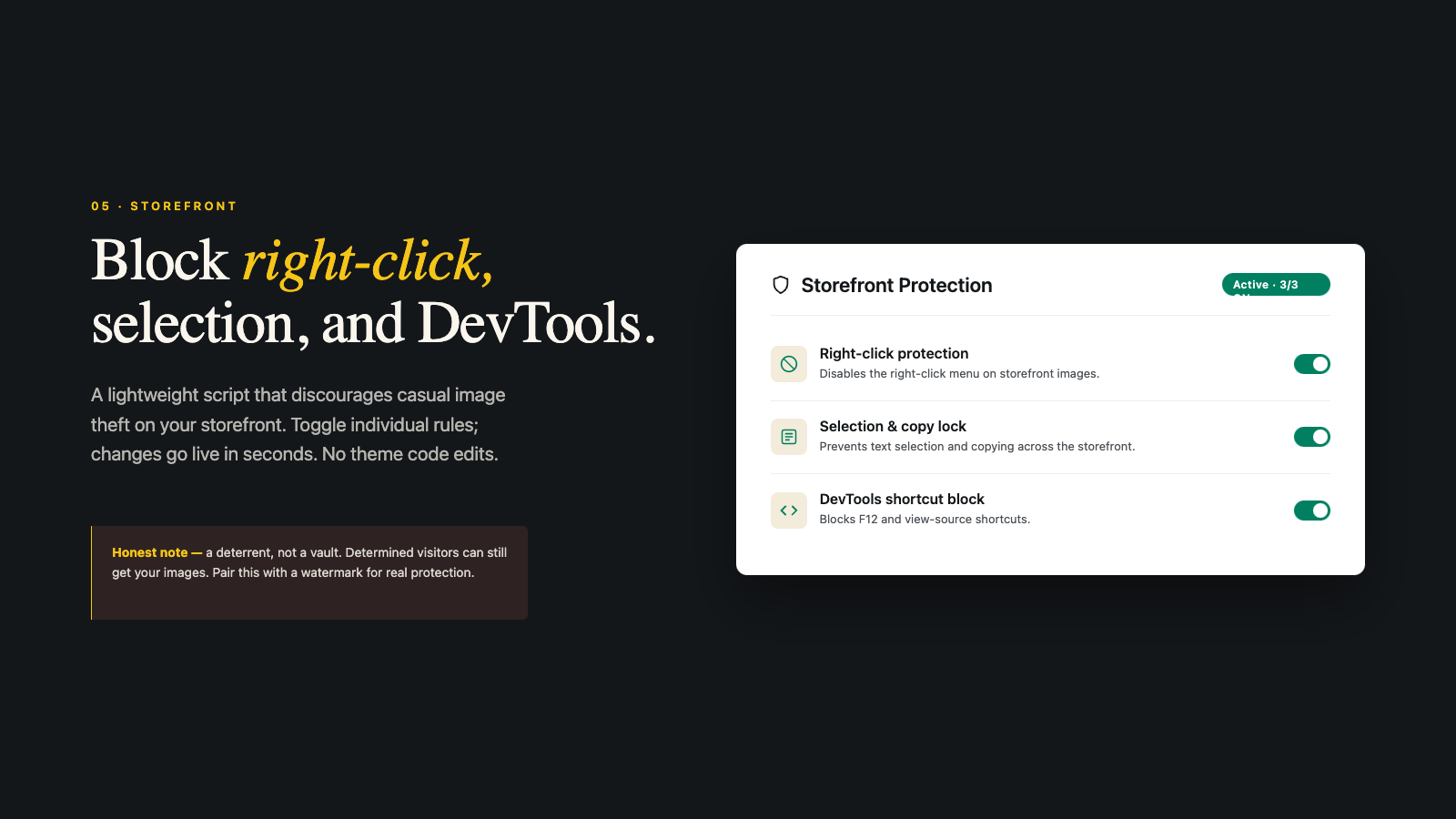
- Turn on storefront protection. This is the image protection layer: block (or disable) right-click, copy, drag-and-drop saving, and developer tool shortcuts so the casual copier gets nothing on the spot.
- Automate it for new uploads and keep originals. Every new product shoot should be protected the moment it goes up, not in a cleanup pass you will forget. And keep clean originals so you can roll back for Google Shopping or a logo change.
Viking Watermark, a Shopify watermark app, was built for exactly this three-move plan. Bulk-apply a mark across a collection, let Auto Watermark catch new uploads, and rely on storefront protection (free on every plan) to block casual saving. Every original is copied to Shopify Files first, so rollback is one click and there is no quality loss. The full step-by-step is in our bulk watermarking guide, and the two-layer logic is in the image theft guide.
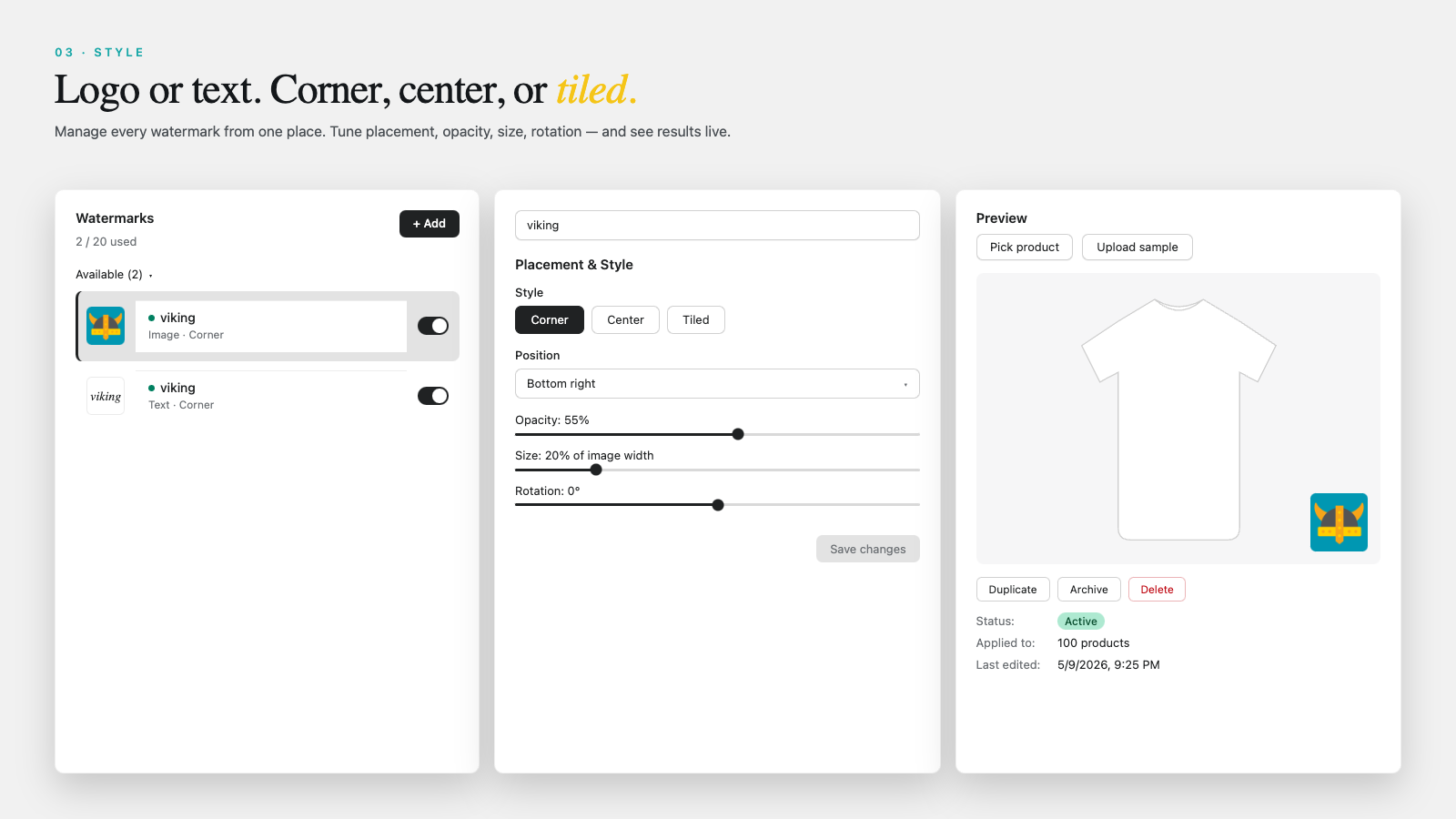
One reminder for anyone running ads: keep your primary feed image clean, because Google Shopping disapproves watermarked feed images. Watermark the secondary shots and use rollback before a feed sync. The details are in the watermark and SEO guide. Audit which images you have live first with our free image audit tool and check how much your pages lean on them with the product page grader.
Turning theft into free advertising
Here is the mindset shift that makes watermarking feel less defensive and more like strategy. You will never stop every theft, so stop trying to win that fight. Win a different one: make sure that when a photo does escape, it works for you.
A reseller who grabs your watermarked photo and posts it without editing is now showing your brand name to their audience. A shopper who sees the same gorgeous image on a cheap marketplace listing, your mark in the corner, may well go searching for the real source. Theft becomes a billboard you did not pay for. That only happens if the mark is on the image, which is why the watermark matters more than the right-click block. The block stops the lazy. The mark turns the determined into accidental marketers.
Protected photos are step one. They still have to do their selling job, which means the right image showing for the right variant on the product page (that is variant image filtering) and a tidy collection page when you carry many colors and sizes (that is combined listings). Shoot great photos, protect them, then make them work. That is the order.
FAQ
Can competitors legally use my product photos?
No. Photos you create are your copyright, and using them without permission is infringement. But enforcement is slow and cross-border cases are hard, so deterrence (watermarks and storefront protection) is your first and most practical line of defense.
Should I watermark every image?
Watermark your secondary gallery shots and keep the primary feed image clean for Google Shopping. Use heavier marks on your highest-value photos, like artwork or signature lifestyle scenes, and lighter marks elsewhere.
Will a watermark make my store look cheap?
Not if it is subtle. A low-opacity logo in a corner reads as branding, not clutter. The mistake is a giant mark across the product, which hurts conversion. Keep it light on the images shoppers are evaluating.
What is the fastest way to protect a whole catalog?
A Shopify app with bulk apply and auto-watermark. Set the design once, apply it across a collection, and let automation catch new uploads. Viking Watermark does this and keeps originals for rollback.
Does protecting images stop dropshippers completely?
Not completely, but it changes their incentives. Storefront protection blocks the easy grab, and a watermark means any photo they do take advertises your brand. That makes your catalog a worse target than an unprotected one.
Related reading
- How to stop image theft on your Shopify store
- How to watermark Shopify product images in bulk
- Does blocking right-click protect Shopify images?
- Shopify variant images FAQ
- Shopify Combined Listings explained
You spent real money making your products look better than the competition. Spend a few minutes making sure that advantage stays yours. Mark the photos, block the easy save, keep your originals, and let the thieves who slip through carry your name wherever they go.

Umid
Co-Founder at Craftshift