Skims Shopify Store Breakdown 2026
Skims hit a $4 billion valuation by 2025, four years after launch, on Shopify Plus. The brand sells shapewear, loungewear, and underwear in shade and size ranges that dwarf most competitors. The product is good. The marketing is famous. The Shopify storefront is what closes the loop and converts the campaign into revenue, and it deserves more attention than it gets.
This breakdown looks at skims.com the way we look at any high-converting Shopify store: theme stack, collection filters, product cards, app stack, drop strategy, and the patterns merchants in adjacent niches can copy. Skims sells inclusive sizing across band, cup, and tone. That makes their filter and variant logic harder than the average apparel brand. Their solution is studied for a reason.
In this post
- Business context: $4B in 4 years
- What theme does Skims use?
- Collection filters: 8 facets, deep inventory
- Color swatches and shade range
- Product page editorial style
- Klarna and Buy Now Pay Later
- Okendo reviews and social proof
- Klaviyo and email-driven retention
- Drop strategy and waitlists
- Takeaways for Shopify merchants
- Where Rubik fits for stores like Skims
- FAQ
- Related reading
Business context: $4B in 4 years
Skims launched in 2019, founded by Kim Kardashian and Jens and Emma Grede. By 2023 the company was valued at $4 billion. Reported revenue passed $750 million by the same year, with the brand growing from shapewear into loungewear, underwear, swim, and men’s. The Shopify Plus storefront has scaled with each expansion.
The agency behind the storefront is publicly known: King & Partners (Shopify Plus partner) led the brand system, UX, and Shopify Plus build. That kind of agency-of-record relationship is normal for Plus brands at this scale, and it shows in the consistency between the on-page brand experience and the broader marketing voice.
What theme does Skims use?
Skims runs a custom Shopify Plus theme. Theme detector tools cannot pin it to a specific Theme Store entry, which is the signature of a bespoke build. The look is editorial: large hero imagery, neutral palette (cream, sand, taupe, black), generous whitespace, and typography that leans serif for headers and clean sans-serif for body.
If you are trying to replicate a “Skims-feel” store on a smaller budget, the closest off-the-shelf Plus themes are Atelier and Ritual from the Shopify Horizon collection (we cover both in our Horizon theme customization guide). They give you the neutral editorial baseline and let you customize from there.
Collection filters: 8 facets, deep inventory
Open the Skims best-sellers collection and the filter rail surfaces 8 facets: Gender, Size, Band/Cup size, Type, Color, Collection, Material, and Sleeve Length. That is a lot. For most apparel stores it would be too many. Skims sells inclusive sizing in a way that makes each filter genuinely useful, so the count matches the inventory complexity.
The lesson here is not “add more filters.” It is “match filters to the actual decision points your customers care about.” Skims sells bras with band sizes 28-46 and cup sizes A-J. If band/cup were a single size dropdown, customers could not narrow down. So band and cup are independent filters. If you sell t-shirts, you do not need a band filter. You probably need a sleeve length filter and a fit filter and a fabric filter.
Worth noting: filters this deep require either Shopify’s native storefront filters (which got a major upgrade in 2024) or a search-and-filter app like Boost AI or Searchspring. Skims’s volume justifies the investment.
Color swatches and shade range
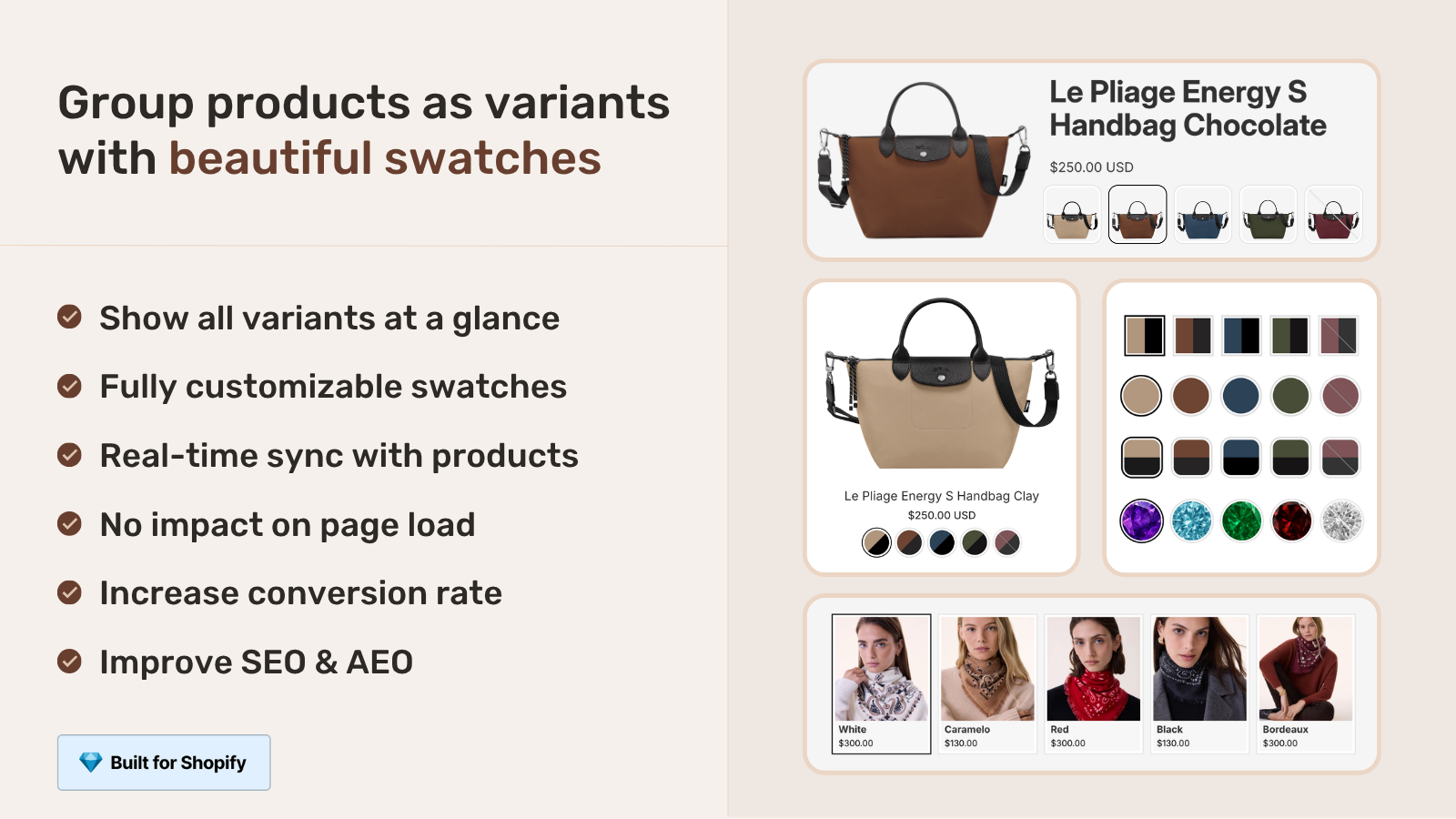
Most Skims products come in 6-10 colors, sometimes more. On the collection page, each product card shows the available colors as small clickable swatches directly under the product image. Click a swatch and the card image swaps to that color. The customer can preview the full shade range without clicking through.
This is the same pattern Gymshark uses (we covered it in our Gymshark Shopify store breakdown). The two brands sell different categories but share the swatch logic because the underlying problem is the same: high-color-variant products fail conversion if customers cannot scan colors before clicking.
For non-Plus Shopify merchants, the closest off-the-shelf solution is Rubik Combined Listings. We built the collection-page swatch feature specifically because so many apparel and lingerie merchants asked for the Skims and Gymshark pattern. It works on every Shopify theme without code edits.
Product page editorial style
The product page reads like a catalog spread. Multiple model views (front, flat, and on-body), generous gallery, neutral lighting, minimal product chrome. The variant picker is above the fold. Shade swatches sit alongside size selection. Sticky add-to-cart on mobile.
The patterns to copy:
- Lifestyle photography that shows the product on real bodies in real settings, not floating on white.
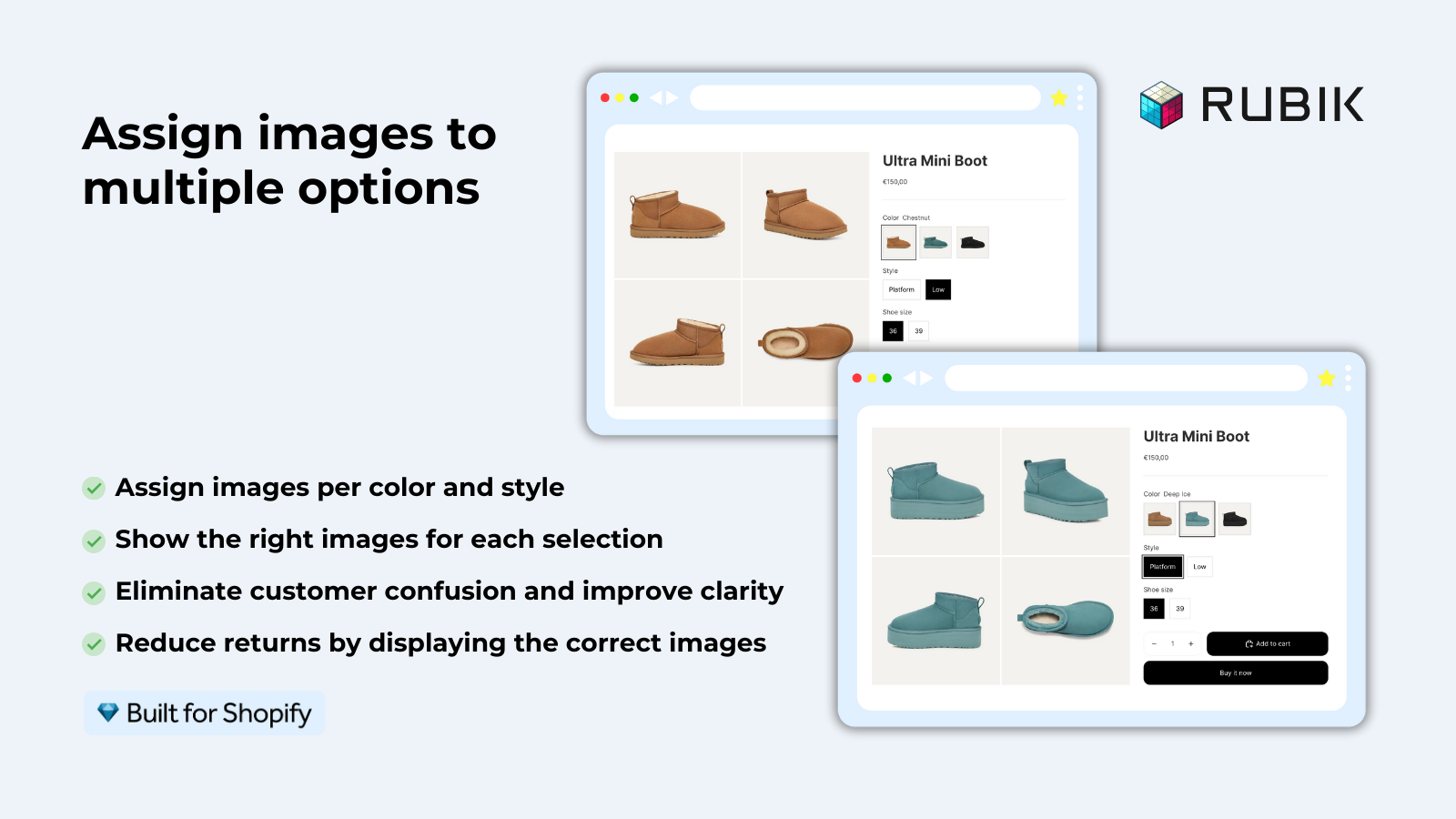
- Multiple gallery angles per variant (front, side, flat, detail). When you switch shades, the gallery updates.
- Variant picker above the fold so the commit happens before the long product description.
- Size and fit guide accessible without leaving the page.
- Reviews surfaced as part of the product flow, not as a footer block.
The variant gallery filtering point is critical here. If you sell bras in 12 shades, customers picking “Sienna” need to see Sienna photos. Showing them the Cocoa photo because that was the first variant uploaded is exactly the kind of small UX miss that costs conversions. Rubik Variant Images handles this on every theme.
Klarna and Buy Now Pay Later
Skims integrates Klarna On-Site Messaging on every product page and the cart. The “4 interest-free payments of $X” message appears under the price. Klarna handles the payment plan; Skims handles the messaging that lifts conversion before checkout.
Why does this matter? Average order value on Skims products is in the $40-80 range. Customers hit Klarna’s “4 payments of $13” message and the perceived price drops by 75%. Conversion lifts in studies of BNPL on apparel range from 10% to 25%, with average order value also rising as customers feel more comfortable adding a second item.
If you sell apparel, beauty, or anything with a $40+ AOV, BNPL on the product page is the lowest-effort, highest-impact change you can make. Klarna, Afterpay, Affirm, and Shop Pay Installments all integrate natively with Shopify.
Okendo reviews and social proof
Skims uses Okendo for reviews. The product page surfaces star ratings near the title, then expands into review text further down. What separates Okendo from a generic review widget is the structured data: customers can filter reviews by size, body type, and use case, which is exactly the data shoppers need when buying inclusive-sizing apparel.
The takeaway: review platforms are not interchangeable. If you sell something where the right fit depends on body type, climate, skin tone, or activity, pick a review platform that captures structured attributes (Okendo, Yotpo, Stamped). If you sell something where reviews are pure star + text, Judge.me is fine and cheaper.
Klaviyo and email-driven retention
Skims runs Klaviyo for email and SMS. The list strategy hinges on segmentation by drop interest, size, color preference, and purchase history. Klaviyo’s tight Shopify Plus integration lets the brand fire targeted emails the moment a drop hits or a back-in-stock notification triggers.
For a smaller store, the lesson is not “spend $5K/month on Klaviyo.” It is “your email list is your most valuable retention channel and it deserves segmentation.” Even on Klaviyo’s free tier you can segment by purchase recency and product category. That alone outperforms the “send to all subscribers” pattern most stores still default to.
Drop strategy and waitlists
Skims runs limited-edition drops, exclusive collections, and waitlist-driven launches. The pattern is well-documented: scarcity, anticipation, FOMO, and a recurring reason to come back. The Shopify Plus storefront supports this with scheduled product releases, pre-orders, and back-in-stock automation.
For a smaller brand, drops are achievable without Plus. Shopify supports scheduled product publishing, and apps like Back in Stock, Stocky, and Klaviyo flows handle the waitlist mechanics. The hard part is not the technology; it is committing to the drop cadence and resisting the urge to discount everything else.
Takeaways for Shopify merchants
- Filter taxonomy should match real decision points (band/cup, sleeve length, fit), not generic ones (size only).
- Show color swatches on collection cards. Customers should preview shades without clicking through.
- Filter the product gallery by selected variant. Picking “Sienna” shows Sienna photos.
- Add Klarna or Shop Pay Installments messaging to product pages with $40+ AOV.
- Pick a review platform whose structured data matches your category (size, body type, skin tone).
- Segment your email list by drop interest, size, and category. Klaviyo or alternatives.
- Run drops with waitlists. Scarcity is a recurring revenue driver.
- Keep the editorial brand voice on the product page, not just the campaign.
Where Rubik fits for stores like Skims
Two patterns from Skims map directly to our apps. Variant gallery filtering (picking a shade updates the gallery to show that shade’s photos) is what Rubik Variant Images does. Collection page color swatches with image swap on hover is what Rubik Combined Listings does. Both apps work on every Shopify theme with no code edits.
If you sell apparel, lingerie, or any high-shade-variant product and you cannot afford a Plus build, the apps are the closest you can get to the Skims experience without writing custom code. Apparel-specific setup is documented in our fashion variant images guide.
“This app makes it super easy to manage images for products that have multiple variations (size and flavor in my case). The support is great as well!”
Anonymous merchant on the Shopify App Store, 2026-02-18. Read more Rubik Variant Images reviews.
See the Rubik Variant Images live demo, watch the multi-option walkthrough, or read the getting started guide.
Frequently asked questions
Is Skims on Shopify?
Yes. Skims runs on Shopify Plus, with a custom theme built by Shopify Plus partner agency King & Partners. The brand has been a Shopify Plus reference since launch in 2019.
What theme does Skims use?
A custom Shopify Plus theme. Theme detector tools cannot match it to a Theme Store entry, which is the signature of a bespoke build. The visual style mirrors the editorial brand voice: neutral palette, generous whitespace, serif headers.
What apps does Skims use?
Visible apps include Klarna On-Site Messaging (BNPL on product pages), Klaviyo (email and SMS marketing), and Okendo (reviews with structured data filters). The full stack also likely includes a search-and-filter app, a back-in-stock platform, and a personalization layer typical of $4B Plus brands.
How does Skims show shade swatches on collection pages?
Each product card on the collection page surfaces 6-10+ available colors as small clickable swatches under the product image. Click or hover and the card image swaps to that shade. Most Shopify stores get the same effect with Rubik Combined Listings on top of any theme.
Can a small store copy Skims’s tactics?
Most of them, yes. Collection swatches, variant gallery filtering, deep filter taxonomy, BNPL messaging, segmented email, drops with waitlists, structured-data reviews are all achievable on a non-Plus store with off-the-shelf apps. The custom theme and full agency build are Plus-tier moves.
What is Skims’ valuation?
Skims hit a $4 billion valuation in a 2023 funding round, four years after launch in 2019. Reported revenue passed $750 million in the same year. The brand operates on a single Shopify Plus storefront with category expansion driving most of the recent growth.
Related reading

Umid
Co-Founder at Craftshift