Kylie Cosmetics Shopify Store Breakdown 2026
Kylie Cosmetics has been one of Shopify’s flagship case studies since launch. The brand’s first viral hit (the Lip Kit) reportedly sold out in under a minute and crashed the storefront on day one. Years later, the store is still on Shopify Plus, still selling shades and kits in single-digit-second-sellout drops, and still teaching merchants how to handle high-shade-count beauty catalogs at scale.
This breakdown looks at kyliecosmetics.com the way we look at any high-conversion Shopify store: theme stack, how the shade variant problem is solved, the bundle strategy, the social proof structure, and what smaller beauty merchants can copy. Beauty has its own variant problems (15+ shades per product, swatches that need to look exactly right, photography that has to communicate skin tone accuracy). Kylie Cosmetics has years of data on how to solve them.
In this post
- Business context: from viral drop to platform
- What theme does Kylie Cosmetics use?
- 15+ shades per product: how it’s solved
- Swatch photography: 4 layers
- Bundle and curated look strategy
- Real Results: consumer test data as social proof
- Embedded video demos
- Out-of-stock handling on viral drops
- Takeaways for beauty merchants
- Where Rubik fits for beauty stores
- FAQ
- Related reading
Business context: from viral drop to platform
Kylie Cosmetics launched in 2015 with the Lip Kit, sold out, scaled into a portfolio brand, and was acquired in 2019 by Coty in a deal valuing the company at around $1.2 billion. By 2026 the brand operates as part of the Coty portfolio while keeping its direct-to-consumer Shopify Plus storefront. The DTC channel is where shade launches debut and where the brand keeps its first-party customer data.
What matters for the breakdown: every design choice on kyliecosmetics.com is optimized for high-shade-count beauty drops where the customer journey is “I saw this on Instagram, I want it now.” Pages have to load fast, shades have to be findable instantly, and the cart has to be one tap away.
What theme does Kylie Cosmetics use?
Public sources point to the Vogue theme by Out of the Sandbox as the design baseline, with significant customization on top. Theme detector tools sometimes show the storefront under a “Production, BVA” label, suggesting a bespoke production fork rather than a vanilla Theme Store install.
For beauty merchants who want a similar editorial, image-forward feel without the Plus build, the Horizon theme Atelier or the Out of the Sandbox Symmetry theme are the closest off-the-shelf options. Both let you push photography forward and let typography breathe.
15+ shades per product: how it’s solved
Take the Matte Lip Kit page. The product comes in shades like Bare, One Wish, Dolce K, Candy K, Exposed, Kylie, Snow Way Bae, Koko K, Autumn, Posie K, Angel, Queen, Sweater Weather, Kristen, and Better Not Pout. That is 15 shades on a single product, with stock status varying by shade (some marked OutOfStock).
The variant selector is a dropdown rather than swatches. This is intentional. With 15 shades, an inline swatch grid would dominate the viewport, especially on mobile. The dropdown saves space while still surfacing all options. The trade-off: customers cannot see all shades at once on the variant picker, so the brand compensates with rich swatch photography elsewhere on the page.
The lesson for beauty brands: dropdowns are the right call when shade count exceeds about 8-10. Swatches are the right call below that. Going swatch-first with 20 shades hurts mobile conversion.
One detail worth flagging: the dropdown signals out-of-stock status per shade rather than hiding sold-out shades. This is a deliberate choice that lets customers join a back-in-stock list for their preferred shade, which feeds the email retention engine that drives the next viral drop.
Swatch photography: 4 layers
What the dropdown takes away in shade visibility, the swatch photography brings back. The Matte Lip Kit page surfaces swatches in 4 distinct layers:
- On-lips photography showing how each shade looks worn.
- Macro close-ups in light and dark conditions, so customers see the shade range under different lighting.
- Arm swatches for color payoff comparison.
- Grouped swatch images organizing shades by tone family (pinks, berries, nudes, reds, corals, browns).
The grouped tone-family image is the smart move. A customer arriving from Instagram who saw “berry tones” can see all 4 berry shades in one image and pick from there. This compresses the discovery cycle that a single dropdown cannot do alone.
If you sell beauty, the photography brief here is the takeaway. On-product, on-skin, macro, grouped. Four shots minimum per shade. It is more work upfront and substantially better at the conversion moment.
Bundle and curated look strategy
Bundles on Kylie Cosmetics are not generic “save 10% on a 3-pack.” They are themed: “Pamper Your Pout” pulls a lip kit + balm + scrub. “Kylie’s Everyday Glam Look” pulls the products Kylie wears, framed as a complete look. Each bundle is a curated edit, not a discount mechanic.
Why this works for beauty: customers want to know what to buy, not just what is available. Curated edits do the work of a beauty consultant inside the Shopify storefront. AOV lifts naturally because the bundle is the answer to a question the customer was already asking.
For a smaller beauty store, the lesson: replace your “buy 3, save 10%” bundle with a themed “Date Night Look” or “Office Glow Routine” bundle. Same products, different framing, much higher click-through.
Real Results: consumer test data as social proof
The product page surfaces a “Real Results” section with consumer acceptance test claims like “100% agreed the product provides full coverage on lips” and similar attributes. This is structured social proof: percentages, attributes, testing methodology implied.
The pattern works because it is not “5 stars from happy customers.” It is specific claims tied to specific attributes (coverage, wear time, comfort). For a customer evaluating “will this matte lipstick actually be matte?” the “100% agreed true-matte finish” line answers the question directly.
If you can run consumer tests (even small ones with 30-50 panelists), the structured-claim format converts better than generic 5-star reviews. The Real Results format requires more work upfront and pays dividends on every product page that uses it.
Embedded video demos
The Matte Lip Kit page embeds a video demonstration showing application technique. The video sits in the gallery flow, not as a separate page or a “watch on YouTube” link. Customers scrolling the gallery hit the video naturally as part of the product evaluation.
For beauty, video on the product page is non-optional. A still photo cannot communicate matte vs satin vs gloss. A 12-second clip can. Most Shopify themes (Horizon, Dawn, Prestige, Impulse) support video in the gallery natively as of 2026. There is no reason not to use it.
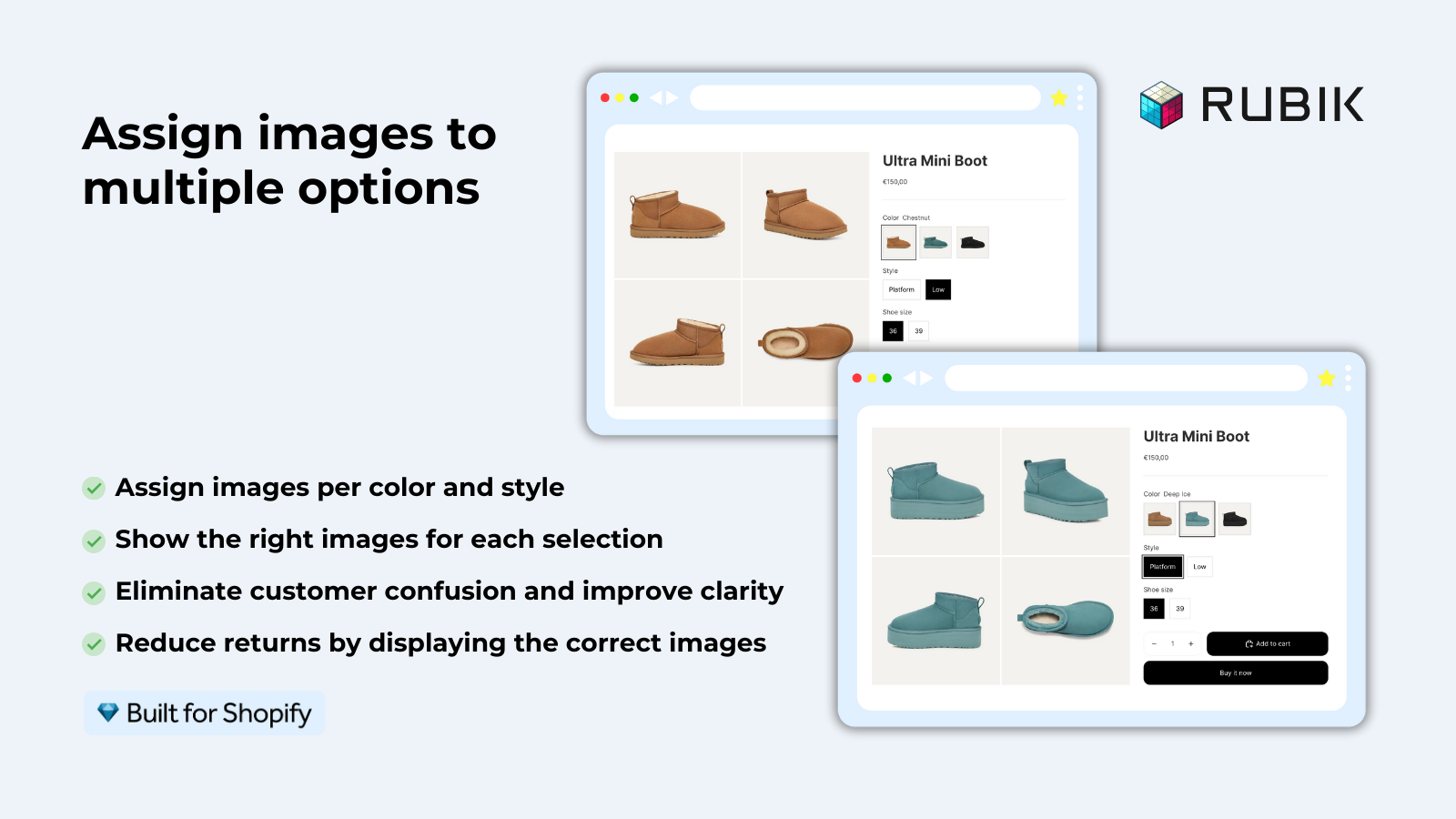
The catch: variant-specific videos are not native. If you want different videos for different shades, you need an app. Rubik Variant Images supports videos and 3D models per variant alongside images, so picking a shade can swap to a video specific to that shade.
Out-of-stock handling on viral drops
The Kylie Cosmetics product pages mark out-of-stock shades explicitly in the dropdown rather than hiding them. The customer can still pick the shade and trigger a back-in-stock notification. This turns scarcity into list growth: every sold-out shade is an email signup opportunity.
For drop-driven brands, this is the right play. Hiding sold-out variants makes the page tidier but loses the email signup. Showing them with the right messaging (“Notify me when back”) captures the demand signal and feeds it back into the email engine.
Apps like Back in Stock (Shopify), Klaviyo’s back-in-stock flow, and Notifyx all handle this on non-Plus stores. Pick one and integrate it into your product page.
Takeaways for beauty merchants
- Use dropdowns for shade selection when shade count exceeds 8-10. Use inline swatches below that.
- Show out-of-stock shades with a back-in-stock notification rather than hiding them.
- Photograph shades in 4 layers: on-product, on-skin, macro, grouped by tone family.
- Embed video on the product page. Beauty cannot be communicated in stills alone.
- Replace generic “save 10%” bundles with themed curated edits (“Date Night Look”).
- Run small consumer tests and surface results as structured claims, not generic stars.
- Add variant-specific videos where they exist (use Rubik Variant Images).
- Wire back-in-stock notifications to your email platform (Klaviyo flows are easiest).
Where Rubik fits for beauty stores
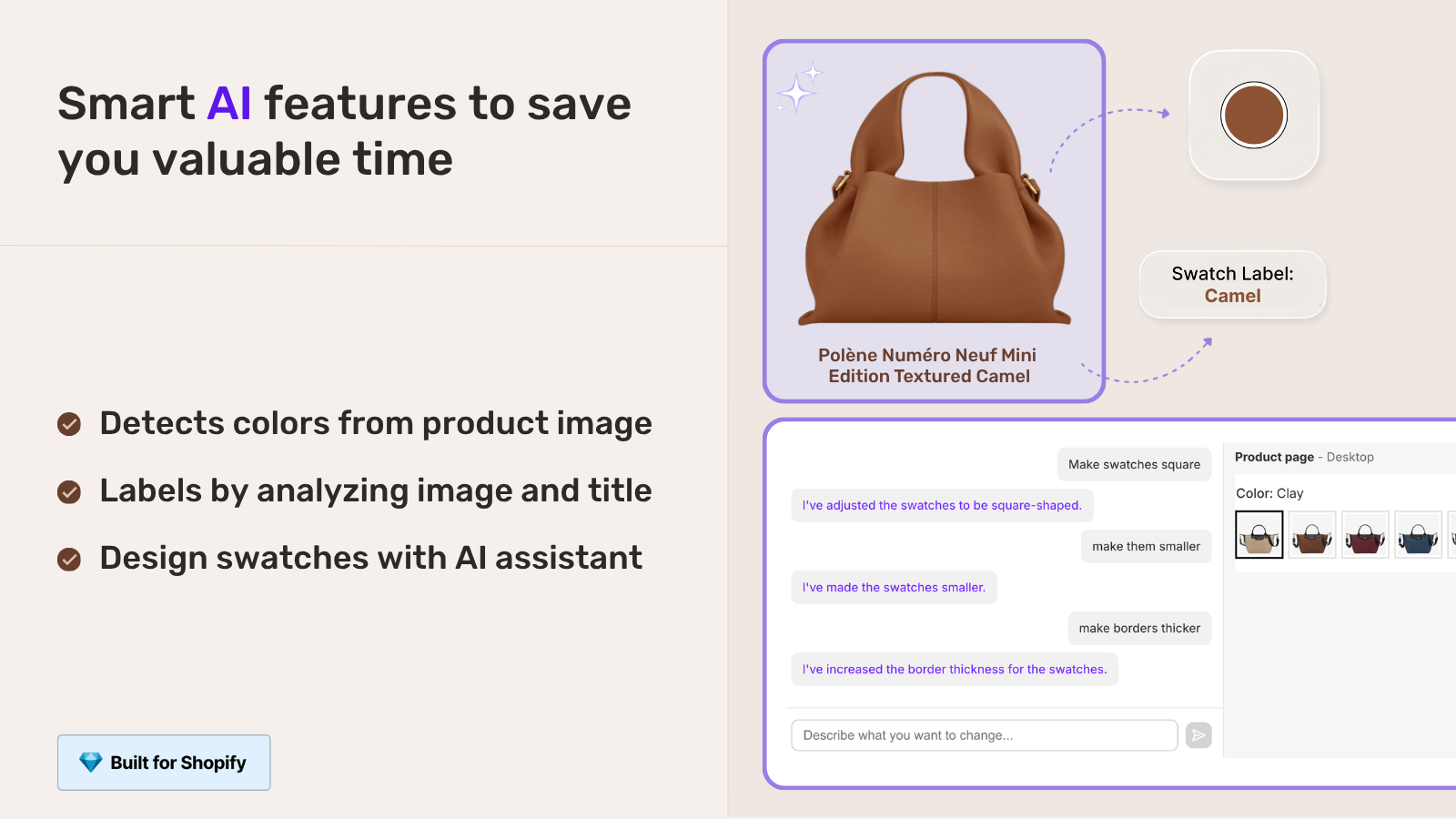
Beauty product pages have two specific Rubik fits. Rubik Variant Images handles multi-image, multi-video, multi-3D-model per shade. Picking “Berry” can show 4 berry images plus a 12-second video, all distinct from the 4 nude images and nude video. The native Shopify gallery cannot do this; the app does.
For collection pages where you sell shade families that span multiple products (e.g. “Berry Collection” pulling lipstick, gloss, and liner), Rubik Combined Listings can group them with shared shade swatches, so customers can preview the family without clicking through.
“This app makes it super easy to manage images for products that have multiple variations (size and flavor in my case). The support is great as well!”
Anonymous merchant on the Shopify App Store, 2026-02-18. Read more Rubik Variant Images reviews.
See the Rubik Variant Images live demo, watch the multi-option variant walkthrough, or read the getting started guide.
Frequently asked questions
Is Kylie Cosmetics on Shopify?
Yes. Kylie Cosmetics has been on Shopify Plus since launch in 2015 and remains there in 2026. Coty acquired the brand in 2019 but the DTC storefront stayed on Shopify Plus.
What theme does Kylie Cosmetics use?
Public sources reference the Vogue theme by Out of the Sandbox as the design baseline, with significant customization on top. Theme detector tools sometimes show a “Production, BVA” label suggesting a bespoke production fork. Either way, what is on production is heavily customized from any Theme Store original.
How does Kylie Cosmetics handle 15+ shades on one product?
The variant selector uses a dropdown rather than inline swatches when shade count exceeds about 10. The dropdown signals stock status per shade. The page compensates for the missing inline swatches with rich photography in 4 layers (on-product, on-skin, macro, grouped by tone family).
Does Kylie Cosmetics use video on product pages?
Yes. The product gallery embeds short application videos showing how the product works in real use. Beauty product pages without video underperform; the medium is part of the product evaluation.
What does the “Real Results” section do?
“Real Results” surfaces consumer acceptance test claims like “100% agreed the product provides full coverage” with attributes tied to product benefits. It is structured social proof, not generic 5-star reviews, and converts better when the claim is specific and ties to a question the customer is already asking.
Can a small beauty store copy Kylie Cosmetics’s tactics?
Most of them, yes. Dropdown variant pickers for high-shade products, 4-layer swatch photography, themed bundles, video on product pages, structured-claim social proof, and back-in-stock notifications are all achievable on a non-Plus store with off-the-shelf apps. The custom theme and full Plus build are the only Plus-tier moves.
Related reading

Umid
Co-Founder at Craftshift