Best Shopify Apps for Cosmetics & Beauty Stores 2026: The Complete Stack
Picture a foundation product with 24 shades. Each shade needs at least 3 photos: the bottle, an arm swatch, and a face application shot. That is 72 images in one product gallery. A customer looking for “Warm Beige” should not have to scroll past 68 photos of other shades to find the three that matter. But that is exactly what Shopify does by default.
Beauty and cosmetics stores have a specific set of problems that general-purpose Shopify apps do not solve well. Shade-heavy product lines, ingredient sensitivity, EU compliance for selling skincare across borders, limited edition drops that sell out in minutes, and product pages that need to educate customers on undertones and formulas before they buy. The best Shopify apps for cosmetics and beauty stores in 2026 address all of these.
We build two of the apps on this list (Rubik Variant Images and Rubik Combined Listings), so we know the beauty vertical well. The other five are apps we have seen beauty merchants pair with ours repeatedly. Every app here is Built for Shopify certified, actively maintained, and rated 5.0 stars. No filler picks.
In this post
- 1. Rubik Variant Images (shade-specific galleries)
- 2. Rubik Combined Listings (group shades as one listing)
- 3. Kaching Bundles & Upsells (beauty routine bundles)
- 4. Pandectes GDPR Compliance (EU ingredient & data rules)
- 5. Jotly Size Chart & Size Guide (shade finders & volume guides)
- 6. Instant AI Page Builder (custom beauty PDPs)
- 7. STOQ Preorder & Back in Stock (limited drops & restock alerts)
- Quick comparison table
- FAQ
- Related reading
1. Rubik Variant Images: show only the selected shade’s photos
What it does: Filters the product page gallery so customers see only the images assigned to the shade they selected. Pick “Berry Red” and the gallery swaps to Berry Red bottle shots, arm swatches, and application photos. Pick “Nude Pink” and the gallery updates instantly. No page reload.
Why cosmetics stores need this. Beauty products are shade-driven. A lipstick in 18 colors, a concealer in 12 undertones, a nail polish in 30 finishes. Without variant image filtering, every shade’s photos pile into one unmanageable gallery. Customers get confused, pick the wrong shade, and return the product. Or worse, they leave without buying. We built the image filtering specifically because this problem gets exponentially worse as shade ranges grow. A foundation line with 30+ shades and 4 photos each? That is 120 images in a single gallery. Nobody scrolls through 120 photos.
Rubik supports images, videos, and 3D models per variant. For beauty brands that shoot application tutorial clips per shade, you can assign a video to each color variant alongside the static photos. The AI auto-assign feature analyzes product images and matches them to the correct shade variant automatically, which saves real time when you are onboarding a 30-shade foundation line.
Three swatch types are available: image swatches (show a tiny swatch photo of the actual product color), color swatches (hex-based circles), and pill buttons. For a deep dive on adding swatches to your beauty store, check our swatch setup guide. For cosmetics, image swatches tend to work best because foundation shades and lip colors are notoriously hard to represent with flat hex colors. A swatch photo of the actual product on skin communicates the shade far better than a beige circle. You can check our swatches vs dropdowns comparison for conversion data on why visual pickers outperform text selectors.
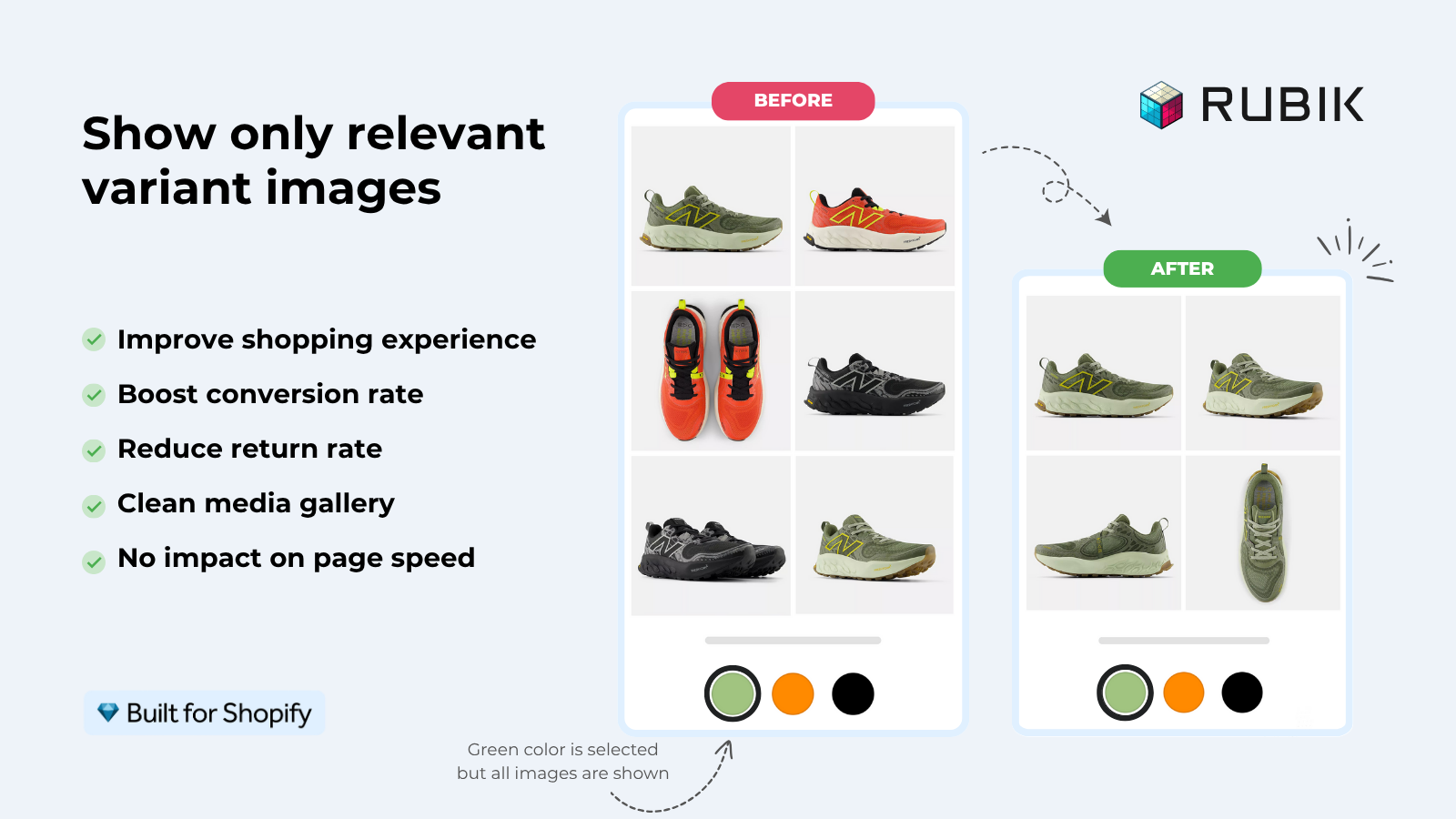
Pricing: Free $0/1 product, Starter $25/100, Advanced $50/1,000, Premium $75/unlimited. Flat pricing, not tied to your Shopify plan. Every plan includes monthly AI credits for auto-assign.
Rating: 5.0 stars, 436 reviews.
App Store: apps.shopify.com/rubik-variant-images
“This app makes it easy to hide non-variant product photos and keeps the product page looking clean. It also helps to show clean custom swatches. Their customer service is outstanding and they reply almost immediately. They were able to fix a bug for me with minimal weight time.”
Anonymous merchant, 2026, Rubik Variant Images on the Shopify App Store
2. Rubik Combined Listings: group 20+ shades as one visual listing
What it does: Links separate Shopify products together and displays them as if they were variants of one product, with color or image swatches on both product pages and collection pages.
Why beauty brands use this. Shopify caps you at 100 variants per product (2,048 on Combined Listings with Shopify). For a foundation line with 30 shades, that is fine as a single product. But when each shade also comes in 3 finishes (matte, dewy, satin) and 2 sizes (travel, full), you are at 180 combinations. That breaks the variant limit.
The smarter approach for cosmetics: create each shade as its own product. “Warm Beige Foundation,” “Cool Sand Foundation,” “Deep Espresso Foundation.” Each gets its own URL, its own SEO title, its own image gallery. Then Rubik Combined Listings groups them together with shade swatches. On the product page, customers see swatches for all 30 shades. Click one, and it navigates to that shade’s dedicated product page. On collection pages, small shade swatches appear under each product card.
There is an SEO angle here too. Each shade gets its own indexed URL. “Warm Beige Foundation” ranks for “warm beige foundation” on Google. “Cool Sand Foundation” ranks for its own keywords. A single product with 30 variants buried behind a dropdown? Google only indexes the parent URL. If you are debating the tradeoff, our variant limit guide breaks down the numbers.
The AI Magic Fill feature auto-detects shade names and swatch colors from your product images. For a beauty brand uploading 30 foundation shades, it saves a lot of tedious manual color-picking in the admin.
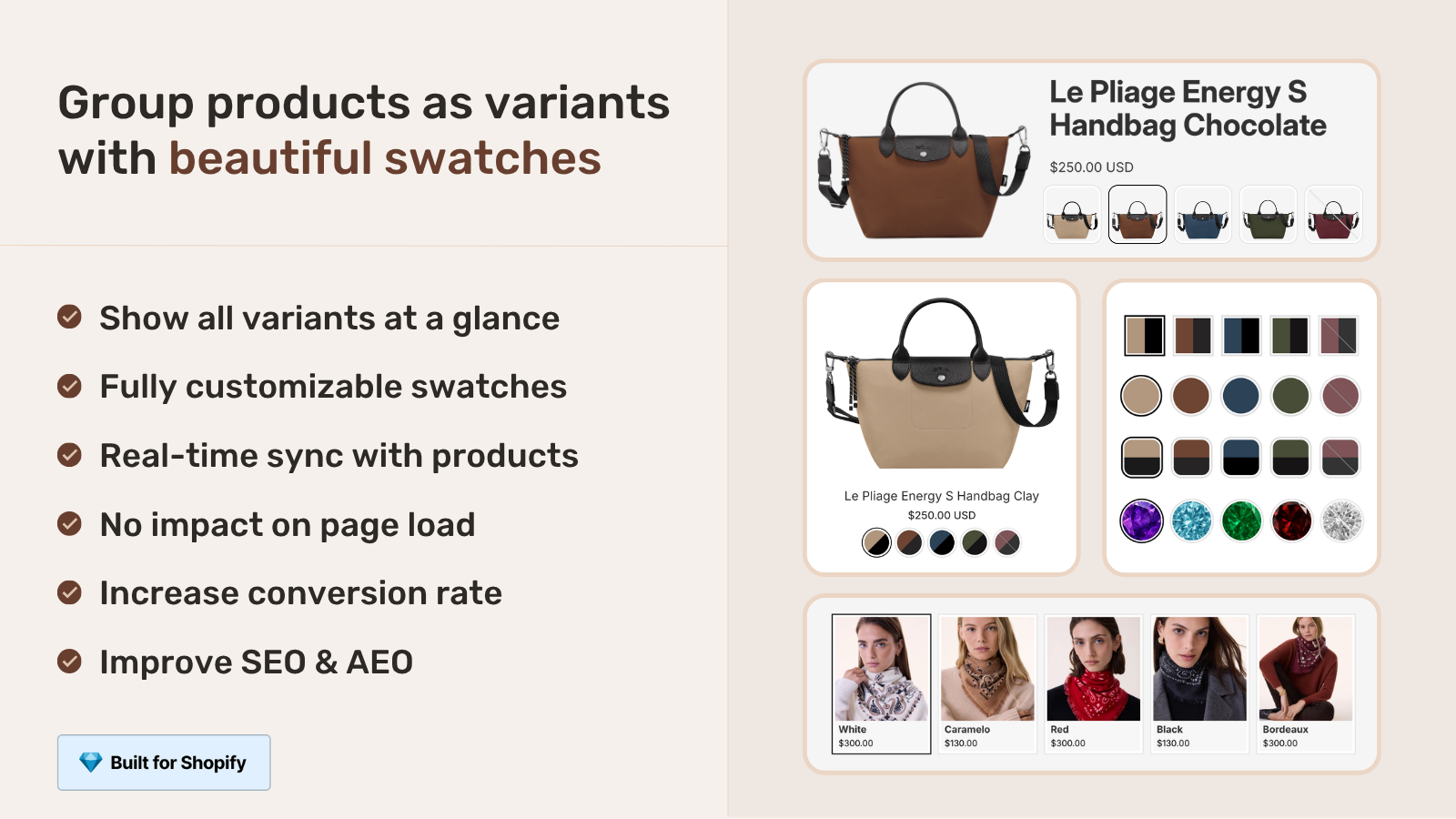
Pricing: Free $0/5 groups, Starter $10/100, Advanced $30/500, Premium $50/5,000. Annual billing saves 17%.
Rating: 5.0 stars, 78+ reviews.
App Store: apps.shopify.com/rubik-combined-listings
“I was struggling with separate product pages for different colors/flavors (e.g., aftershave red, green, blue as individual products for better SEO and unique URLs), but I wanted customers to see swatches and switch between them easily, like real variants, on BOTH the product page and collection pages (under each card). This app does it perfectly.”
Ostwint, Romania, March 2026, Rubik Combined Listings on the Shopify App Store
3. Kaching Bundles & Upsells: beauty routine bundles and BOGO deals
What it does: Creates product bundles, BOGO offers, volume discounts, and upsell workflows directly in the Shopify checkout.
Why cosmetics stores need this. Beauty is one of the few verticals where bundling feels completely natural. Customers already think in routines: cleanser, toner, serum, moisturizer, SPF. A “Complete Morning Routine” bundle that saves 15% practically sells itself. BOGO on lip products (“buy 2 lip glosses, get 1 free”) moves excess inventory fast. Volume discounts on refillable products (shampoo refills, skincare pods) encourage repeat purchases.
Kaching handles all three formats. You can build pre-made bundles, “mix and match” bundles where the customer picks their own products (choose any 3 lip colors), and quantity-based discounts. It supports product page widgets, cart page upsells, and post-purchase offers.
The one thing I genuinely respect about Kaching is that it does not try to do everything. It does bundles and upsells. Period. Too many apps in this space bolt on email marketing, loyalty programs, and popup builders until the whole thing becomes bloated. Kaching stays focused. And with 3,969 reviews at a 5.0 rating? That is not easy to maintain at scale.
Pricing: Starts at $14.99/month. Built for Shopify certified.
Rating: 5.0 stars, 3,969 reviews.
App Store: apps.shopify.com/bundle-deals
4. Pandectes GDPR Compliance: mandatory for selling beauty to the EU
What it does: Manages cookie consent banners, data processing records, privacy policy generation, and GDPR/CCPA compliance workflows.
Why beauty brands specifically need this. Selling skincare and cosmetics to EU customers involves more compliance exposure than selling, say, phone cases. Beauty products collect ingredient preference data, skin type quizzes, shade matching data, allergy information, and sometimes even photos of customers’ skin. All of that is personal data under GDPR. And the fines are real: up to 4% of global revenue or 20 million euros, whichever is higher.
Why does Shopify not handle this natively? Honestly, it should. But it does not, at least not fully. Shopify’s built-in cookie banner covers the basics but lacks granular consent categories, geo-targeted banners (different rules for EU vs California vs Brazil), and proper consent logging that auditors actually accept. If you are running Facebook Pixel, Google Analytics, TikTok Pixel, and a shade-matching quiz tool, you need proper consent management for each one.
Pandectes handles the full stack: cookie consent banners with geo-detection, consent logging, privacy policy and terms of service generation, and integration with Shopify’s native consent API. The free plan covers basic compliance, which is enough for stores just starting to sell internationally.
Pricing: Free plan available. Paid plans for advanced features. Built for Shopify certified.
Rating: 5.0 stars, 2,781 reviews.
App Store: apps.shopify.com/gdpr-cookie-consent
5. Jotly Size Chart & Size Guide: shade finders and volume conversion charts
What it does: Creates visual guides, charts, and tables that attach to product pages. Despite the name focusing on “size charts,” the app supports any type of reference chart.
Why beauty stores use this differently. Clothing stores use size chart apps for bust/waist/hip measurements. Beauty stores repurpose the same tools for shade finders (warm vs cool vs neutral undertone charts), product volume guides (30ml vs 50ml vs 100ml with oz conversions), and ingredient breakdown tables. A shade finder chart with undertone photos next to each foundation shade reduces returns significantly. Customers who can match their undertone before ordering are far less likely to send the product back.
Jotly stands out because it supports rich media in charts, not just plain text tables. You can embed images of skin undertones next to shade names, add icons for skin type (oily, dry, combination), and create accordion-style guides that collapse and expand. For a foundation product, imagine a tab on the product page labeled “Find Your Shade” that opens into an undertone chart with photo references. That kind of guidance used to require custom theme code or an expensive page builder section. Now it is a few clicks.
Volume conversion is another underrated use case. International beauty customers constantly wonder if 1 fl oz equals 30ml or 29.57ml (it is 29.57ml, but most brands round to 30). A simple volume guide on travel-size products saves customer service tickets. And it is the kind of small detail that makes a store feel professional rather than thrown together.
Pricing: Free plan available. Built for Shopify certified.
Rating: 5.0 stars, 55 reviews.
App Store: apps.shopify.com/size-chart-guide-by-jotly
6. Instant AI Page Builder: custom PDPs for hero beauty products
What it does: Visual drag-and-drop page builder with AI-assisted layout generation. Creates custom product pages, landing pages, and collection pages without touching theme code.
Why beauty brands reach for this. Most Shopify themes give you one product page template. Every product uses the same layout: image gallery on the left, buy box on the right, description below. That is fine for a routine repurchase product like a cleanser. But for a hero launch product (your new $68 vitamin C serum, for example), a generic template does not cut it.
Beauty brands want before/after sliders showing skin improvement, ingredient spotlights with hover-to-expand details, shade finder sections built into the product page, video testimonials from dermatologists, and trust badges specific to clean beauty certifications (cruelty-free, vegan, EWG verified). Building all of that into your theme’s default product template is messy. It affects every product, not just the hero.
Instant lets you build a custom product page for your hero products while keeping the standard template for everything else. The AI layout generator can take your product description and suggest a page structure, which speeds up the initial design. And because Instant works with Rubik Variant Images (it is one of our 7 supported page builders), your shade filtering and swatches carry over to the custom page without extra configuration.
One opinionated take: do not over-design your beauty PDPs. Some brands go so heavy on animations, parallax scrolling, and full-bleed video backgrounds that the page takes 8 seconds to load on mobile. A fast, clean page with one before/after slider and one ingredient spotlight section will outperform a design-heavy page that customers abandon before it finishes loading. Check your store’s load times with our free SEO Checker before and after adding custom pages.
Pricing: $39/month. Built for Shopify certified.
Rating: 5.0 stars, 297 reviews.
App Store: apps.shopify.com/instant-builder
7. STOQ Preorder & Back in Stock: limited drops and restock alerts for sold-out shades
What it does: Replaces the “Add to Cart” button with a preorder button for unreleased products and adds “Notify Me” back-in-stock signup forms for sold-out variants.
Why beauty stores depend on this. Two words: limited editions. Beauty is one of the few verticals where deliberate scarcity is a core marketing strategy. Holiday collections, influencer collaborations, seasonal shades. These products sell out fast, and the demand does not stop when inventory hits zero. A “Notify Me When Back in Stock” button on a sold-out shade captures emails from customers who already want the product. That is the highest-intent email list you can build. No lead magnet required.
Preorders are equally important for beauty launches. Announce a new product two weeks before ship date, accept preorders with partial or full payment, build buzz on social, ship when inventory arrives. STOQ handles the preorder workflow natively in Shopify checkout, so customers pay through the normal Shopify flow. No third-party checkout pages, no friction.
The variant-level control matters for cosmetics. A lipstick might be in stock in “Coral” and “Mauve” but sold out in “Berry.” STOQ can show the preorder or notify-me button only for Berry while keeping the normal add-to-cart for the other two. That per-variant granularity is exactly what shade-heavy beauty catalogs need.
Pricing: Free plan available. Built for Shopify certified.
Rating: 5.0 stars, 2,966 reviews.
App Store: apps.shopify.com/back-in-stock-restock-alerts
Quick comparison table
All 7 apps at a glance:
| App | Category | Rating | Reviews | Starting price | Free plan? |
|---|---|---|---|---|---|
| Rubik Variant Images | Variant image filtering | 5.0 | 343+ | $25/mo | Yes (1 product) |
| Rubik Combined Listings | Product grouping | 5.0 | 21+ | $10/mo | Yes (5 groups) |
| Kaching Bundles | Bundles & upsells | 5.0 | 3,969 | $14.99/mo | No |
| Pandectes GDPR | Privacy compliance | 5.0 | 2,781 | Free | Yes |
| Jotly Size Chart | Shade guides & charts | 5.0 | 55 | Free | Yes |
| Instant Page Builder | Custom PDPs | 5.0 | 297 | $39/mo | No |
| STOQ Preorder | Preorders & restock alerts | 5.0 | 2,966 | Free | Yes |
How these apps work together for a beauty store
These seven apps are not random picks. They form an actual stack. Here is what it looks like in practice for a mid-size beauty brand selling foundations, lipsticks, and skincare:
- Rubik Combined Listings groups your 30 foundation shades into one visual listing with shade swatches on collection pages and product pages. Each shade has its own URL for SEO.
- Rubik Variant Images filters the product gallery on each shade’s product page. Customer selects “Warm Beige” and sees only Warm Beige photos, not all 30 shades mixed together.
- Jotly adds an undertone shade finder chart to the product page so customers pick the right shade before ordering.
- Kaching offers a “Complete Routine” bundle (foundation + concealer + setting powder) with a 15% discount, plus BOGO on lip products.
- STOQ captures emails for sold-out shades and handles preorders for your new holiday collection.
- Instant builds a custom PDP for your hero serum with before/after photos and ingredient spotlights.
- Pandectes makes sure your EU customers get the right cookie consent banner and your data handling complies with GDPR.
No conflicts between any of these. We have tested Rubik Variant Images alongside Instant extensively (Instant is one of our 7 supported page builders). The rest operate in different areas of the store and do not overlap.
See variant image filtering in action
This demo shows how shade-specific galleries work with Rubik Variant Images. The filtering applies to any product type, including cosmetics with dozens of color variants:
See the live demo store, or read the getting started guide for setup instructions. For combined listings, try the combined listings demo store or check the RCL getting started guide.
Frequently asked questions
What are the best Shopify apps for cosmetics and beauty stores in 2026?
The top 7 are Rubik Variant Images (shade-specific image filtering), Rubik Combined Listings (group shades as one listing), Kaching Bundles (beauty routine bundles), Pandectes GDPR (EU compliance), Jotly Size Chart (shade finders), Instant Page Builder (custom beauty PDPs), and STOQ Preorder (limited edition drops and restock alerts). All are rated 5.0 stars and Built for Shopify certified.
How do I show only one shade’s images on a Shopify product page?
Use a variant image filtering app like Rubik Variant Images. Assign your photos to each shade variant, and when a customer selects a shade, the gallery filters to show only that shade’s images. It works with images, videos, and 3D models across 420+ themes.
Can I group 20+ foundation shades into one listing on Shopify?
Yes. Create each shade as a separate product for SEO benefits, then use Rubik Combined Listings to group them with shade swatches. Customers see all shades as if they were variants, but each shade has its own URL, inventory, and images. No Shopify Plus required.
Do I need GDPR compliance for a beauty store?
If you sell to EU customers, yes. Beauty stores collect extra sensitive data through shade quizzes, skin type assessments, and ingredient preference tracking, all of which falls under GDPR. Pandectes GDPR Compliance handles cookie consent, geo-targeted banners, and consent logging. The free plan covers the basics.
How do beauty brands handle sold-out shade alerts on Shopify?
STOQ Preorder & Back in Stock adds a “Notify Me” button to sold-out variants. When a shade sells out, customers enter their email and receive an automatic notification when it restocks. The app works at the variant level, so in-stock shades keep their normal add-to-cart button while only sold-out shades show the notify form.
What is a shade finder guide and how do I add one to Shopify?
A shade finder is a visual reference chart showing undertones (warm, cool, neutral) matched to product shades. Jotly Size Chart & Size Guide lets you create rich visual guides with embedded images and attach them to specific products. No theme code edits needed.
Can I build a custom product page for my hero beauty product?
Yes. Instant AI Page Builder creates standalone product page templates for individual products. Add before/after sliders, ingredient sections, video testimonials, and custom layouts without affecting your other product pages. It works alongside Rubik Variant Images for shade filtering on custom pages.
Related reading

Umid
Co-Founder at Craftshift