Orbe Geolocation review for Shopify (2026)

Orbe Geolocation solves a problem that only shows up once you sell across borders: a shopper in Germany lands on your US store, sees dollars and English, and leaves before they ever find the version of your site built for them. Orbe catches that visitor, works out where they are from their IP and browser language, and either shows a polite popup or quietly routes them to the right country experience. It sits at a near-perfect 4.9 stars across 286 reviews, it’s a Built for Shopify app, and it’s made by a Madrid team that launched it in April 2022.
This is our honest review. We build Shopify apps ourselves (variant images and combined listings), so we read the parts a listing page skips: how the redirect actually works, what it does to your SEO, the pricing fine print, and the single one-star review, which turns out to be a misunderstanding worth explaining. If you run Shopify Markets, multiple expansion stores, or a Global-e setup, this one’s directly relevant.

In this review
- What Orbe actually is
- Why Shopify’s own geolocation isn’t enough
- How the redirect works (and why it protects SEO)
- Multiple expansion stores, one selector
- Pricing, and what a “redirect” means
- What merchants say, including the one-star
- Where Orbe shines
- Where it falls short
- Orbe vs native Shopify vs the rest
- Geolocation meets the localized catalog
- FAQ
What Orbe Geolocation actually is
Orbe is a routing and recommendation layer that sits on top of your international setup. It does not create your localized prices, currencies, or translations, that’s Shopify Markets or Global-e doing the heavy lifting underneath. What Orbe does is decide which of those localized experiences a given visitor should see, and then get them there. The listing puts it plainly: “Show products, prices, language, and currency by country.”
The pieces are a customizable welcome popup (styled from the theme editor to match your brand), a country selector and language switcher, automatic redirect for returning visitors, and, on the top plan, the ability to route shoppers between entirely separate expansion stores. One thing to be clear about up front: Orbe does not convert currency. The docs say so directly, currency is “managed natively by Shopify Payments.” Orbe points the shopper at the right storefront; Shopify handles the money.
Who’s behind it? Orbe is a Madrid studio, co-founded by Roberto Senabre (CEO) and Alberto González (CTO). That Roberto name will come up again, because he shows up personally in review after review doing hands-on support. Their mission line, “Local everywhere,” is corny, sure, but it’s the actual product in three words.
Isn’t Shopify’s own geolocation enough?
Most “just use the free one” advice misses a detail that changed everything: there is no free one anymore. Shopify’s standalone Geolocation app was shut down entirely on March 24, 2025. And even while it existed, it only ever recommended. Per Shopify’s own help doc, it “doesn’t automatically adjust a country or language based on a visitor’s location. Customers need to accept the recommendations.” It never auto-redirected, it offered colour customization and nothing more, and it could not route between separate expansion stores.
So the gap Orbe fills is real and it predates the shutdown: automatic redirect for returning visitors, brand-styled popups, and, above all, multi-store routing. If your international architecture is several separate Shopify stores (a common setup for larger brands), native Shopify has never had an answer for sending a shopper from one store to another based on where they are. That’s the specific hole this category exists to fill.
How does the redirect work, and why does it protect SEO?
This is the part that separates a thoughtful geolocation app from a reckless one, and it’s where Orbe is genuinely smart. It does not blindly redirect visitors by IP on their first visit. Instead, on that first visit it runs a one-off geolocation check, shows the popup, and waits for the shopper to choose. Only after that explicit choice does it save the preference (in a first-party cookie, for a duration you configure, such as 60 days) and auto-redirect on future visits.
Why build it that way instead of just bouncing everyone by IP? Because blind IP redirects wreck your international SEO, and Orbe’s docs explain exactly why: search crawlers mostly crawl from US IP ranges, so an IP-based auto-redirect can trap Googlebot in your US experience and stop it ever seeing your localized pages. By recommending rather than force-redirecting on first contact, it lets search crawlers read each localised experience without being funnelled into one. That is not marketing fluff, it’s the correct answer to a real and common way stores tank their own hreflang setup. If you’re wrestling with international indexing, our companion piece on separate products vs variants and the SEO decision digs into the hreflang side.
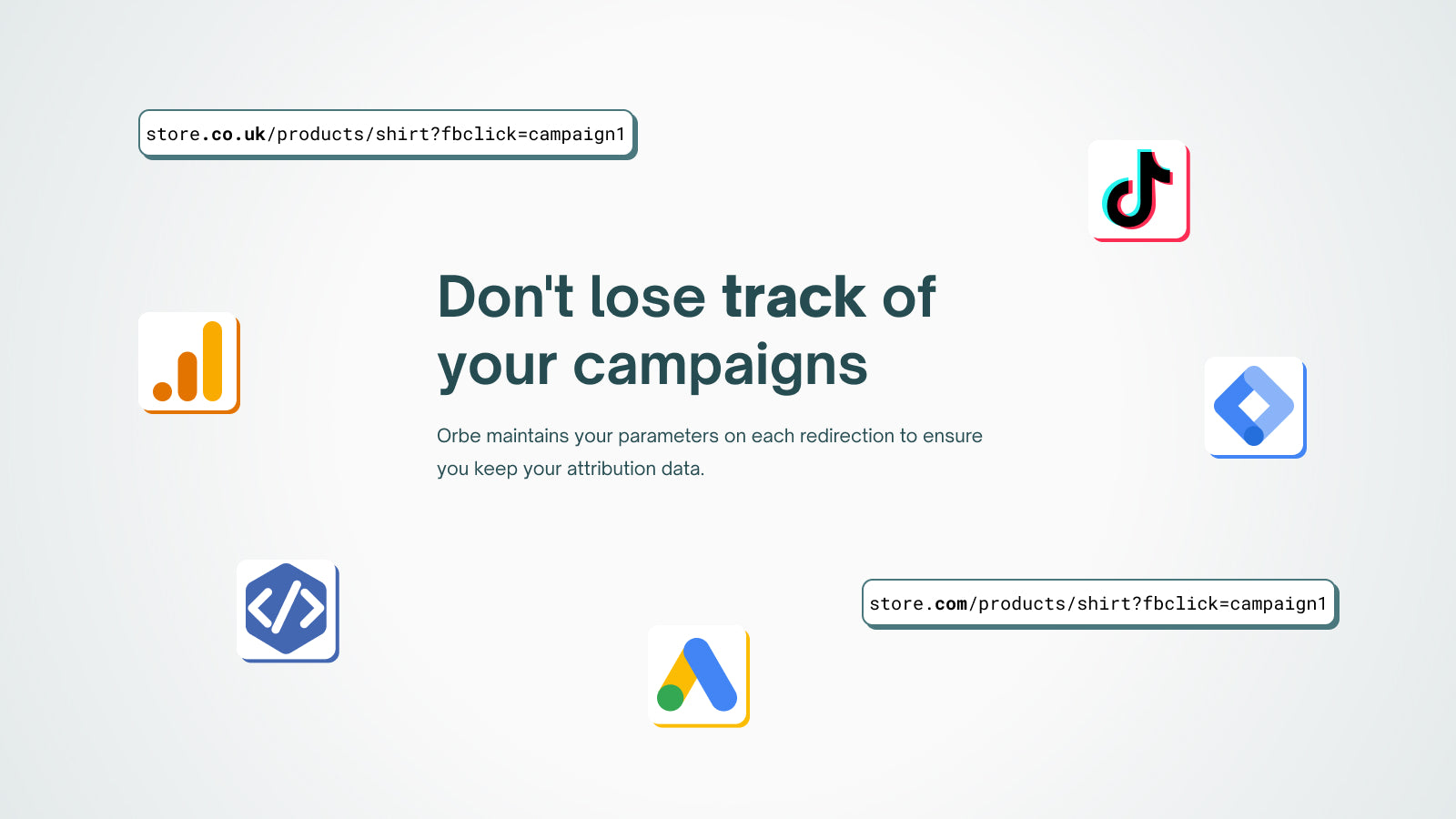
Two more technical points worth knowing. First, it keeps your marketing attribution: if a French shopper clicks a Facebook ad with UTM parameters and lands on the US store, Orbe redirects them to the French experience while preserving the full URL and its UTM tags, so you don’t lose the campaign credit. Second, it requires Shopify Markets, Global-e, or multiple expansion stores as the localization backend. Orbe is the routing layer, not the localization engine, so if you haven’t set up Markets yet, that comes first.
Multiple expansion stores, one selector
This is Orbe’s headline differentiator and the reason larger brands pick it. Plenty of international Shopify businesses don’t run one store with Markets; they run several separate stores, sometimes on different systems. Orbe merges the country and language options from all connected stores into a single selector, so a shopper sees “the full list of markets you support, without knowing they’re navigating between different stores behind the scenes.”
The billing model here is quietly generous and worth calling out. You subscribe on one main store; the other connected stores stay on the free plan and are, in Orbe’s words, “fully sponsored.” Up to 4 stores on the standard Plus plan, more via a custom Enterprise arrangement. There’s also a full-path redirect option, so if /products/example exists in both stores, the shopper lands on the exact same product rather than getting dumped on the homepage. Little touches like that are what the reviews from multi-store brands keep praising.
How much does Orbe cost?
Three plans, plus a custom Enterprise tier. A real free plan, then flat monthly pricing with a 25% discount if you pay annually. Paid plans get a 7-day free trial (15 days if you start on annual).
| Plan | Price | Key inclusions |
|---|---|---|
| Basic | Free | Up to 300 redirects, geolocation popup, unlimited selectors, Shopify Markets integration, automatic redirect, analytics, UTM parameters |
| Advanced | $29/mo (or $261/yr) | Everything, plus unlimited redirects, SEO-friendly popups, translated popup, Klaviyo integration, custom CSS |
| Plus | $59/mo (or $531/yr) | Everything, plus redirect between up to 4 expansion stores, welcome popup adapted by country, multi-store country selector |
One thing to understand before you pick a tier: what counts as a “redirect.” Orbe’s own docs define it narrowly, “we only count a redirect when a visitor lands in the wrong shopping experience and then moves to the correct one.” So a domestic visitor who’s already in the right place never burns a redirect. Worth noting a small inconsistency in Orbe’s own copy: the App Store listing says “300 user redirections/month” while the pricing docs phrase the free tier as “300 total redirects.” If the free plan is central to your plan, confirm which it is with support before you build on it.
Is $29 a month fair? For a store doing real international volume, easily, and the free tier is a genuine on-ramp rather than a demo. But Orbe is not the cheapest app in this category (more on that below), so the honest question is whether you value its polish and support enough to pay a premium. If you’re weighing the international expansion decision more broadly, our guide to choosing a Shopify plan covers where expansion stores and Markets fit, and the Shopify fee calculator will show you the currency-conversion cut Shopify takes on cross-border sales.
What do merchants say about Orbe?
286 reviews, nearly all of them five-star, and one theme runs through nearly all of them: the support. Roberto, a co-founder, keeps showing up by name, and so do teammates Mariana, Rosamie and Camila. For an app that plugs into the genuinely fiddly world of Markets, Global-e and multi-store setups, that hands-on help is arguably as much the product as the software.
“Works flawlessly and does perfectly what it should. We use it the manage the correct pricing for various EU countries based on the shipping location the client chooses and offering them the correct VAT rate (shown as including VAT prices)”
Chill Pepper, Netherlands, July 6, 2026 (12 months using the app), Orbe on the Shopify App Store
“Great app for multi market routing, but the support is what made the difference. Roberto guided us through the full setup for Denmark and Germany, explained the catalog and pricing logic clearly, and kept everything on a draft theme so nothing went live before I checked it. Responsive, patient, and no pressure. Happy so far.”
Paper Straight, Netherlands, June 11, 2026 (15 days using the app), Orbe on the Shopify App Store
A couple of reviews name a mild rough edge, and it’s a fair one: one merchant noted “the setup can be a bit confusing” before praising the support that got them through it. That tracks. Geolocation touches Markets, themes, currencies and sometimes a second store, so the configuration surface is genuinely large. This is not a one-click app, and anyone telling you geolocation is one-click is selling something.
Now the single one-star, because it’s the most instructive review on the page. A store rated it one star after 11 minutes, writing “there is no geolocation, it just shows up by default even if you are in the correct country.” The co-founder’s reply is the useful part: on the Free plan, the welcome popup shows to every visitor by design, so it can confirm and save their preference. The behaviour the merchant actually wanted, where the popup only appears for visitors who landed in the wrong country, is a paid-plan feature. So the lone bad review isn’t a broken app, it’s a Free-plan expectation gap that eleven minutes wasn’t enough to discover. Fair warning all the same: if you want conditional, wrong-country-only popups, budget for at least the Advanced plan.
Where Orbe shines
- SEO-safe by design. Consent-based recommendation on first visit instead of blind IP redirect, which keeps crawlers out of the trap that breaks so many international stores. This is the best-reasoned thing about the app.
- True multi-store routing. One selector across up to 4 separate expansion stores, with the connected stores sponsored on free. Native Shopify has never done this.
- Keeps your attribution. UTM parameters survive the redirect, so cross-border ad spend still gets credited correctly.
- Genuinely brand-styled. The popup and selectors are customized from the theme editor with dynamic variables (flags, country and currency codes) and custom CSS on paid plans, not a generic third-party box.
- Founder-level support. A co-founder answering setup tickets by name, sometimes with personalized video walkthroughs, is the model that actually fixes complex international configs.
- Real free tier. 300 redirects a month is enough for a smaller store to run the core popup and redirect without paying.
Where it falls short
- It needs Markets or Global-e first. Orbe routes; it doesn’t localize. If your prices, currencies and translations aren’t already set up in Shopify Markets or Global-e, Orbe has nothing to route to. Set up the backend before you install.
- No currency conversion. That’s Shopify Payments’ job. Merchants in countries without Shopify Payments will need a separate currency solution.
- Not the cheapest. At $29+ a month it’s priced above several capable competitors. You’re paying for the polish and the support, which the reviews suggest is worth it, but it’s a premium.
- hreflang isn’t native. For multi-store hreflang, Orbe partners with a separate app (Hreflang Manager) rather than emitting the tags itself. Fine, but it’s another moving part.
- Setup has a learning curve. Several happy reviews still admit the initial configuration is confusing. Budget time, and lean on that support team.

Orbe vs native Shopify vs the rest
The native standalone app is gone, so the real choice is between paid apps. Here’s the honest field, with ratings checked on the App Store in July 2026. Orbe is the polished, support-heavy option; it is not the cheapest.
| App | Rating (reviews) | Cheapest paid | Multi-store redirect |
|---|---|---|---|
| Orbe Geolocation | 4.9 (286) | $29/mo | Yes (Plus) |
| Shopify native app | discontinued Mar 2025 | was free | No (recommend only) |
| Selecty (Geolocation & Markets) | 5.0 (293) | $11.99/mo | Yes (Premium) |
| geolizr | 4.5 (80) | $10/mo | Yes (locale stores) |
| Blaze Country Redirect | 5.0 (52) | $6.49/mo | Yes |
| Geos: Geolocation & Redirect | 4.9 (60) | $19/mo | Not stated |
Honest positioning: Selecty is Orbe’s closest rival, and it’s cheaper with slightly more reviews, so if budget is the deciding factor, get both trials open. What Orbe is betting on is the consent-based SEO-safe architecture, the multi-store polish, and the founder-level support that fills its review page. For a large brand with several expansion stores and a complex Markets or Global-e setup, that combination is the pitch, and the 4.9 across 286 reviews says it lands. For a single-store shop that just needs a basic country popup, one of the cheaper apps will do the job for less. Either way, don’t stack two geolocation apps at once; that’s exactly the kind of app-sprawl we warned about in the hidden cost of free Shopify apps.
When geolocation meets the localized catalog
This is our lane, so let’s be useful. Orbe gets the right shopper to the right storefront. What that shopper sees when they arrive, the product catalog, is a separate problem, and international stores tend to hit both at once.
Two catalog issues get worse the moment you go multi-market. First, translated storefronts still need their product structure to make sense per language. If you sell the same shirt as five separate colour products, a Markets storefront shows five near-duplicate cards in every language, which reads as a glitch to a French or German shopper just as much as an English one. Rubik Combined Listings groups those separate colour products into one card with swatches, so the grouped listing stays clean in whichever market Orbe routes the shopper to. Second, the international SEO angle: grouping and hreflang interact, which we cover in combined listings and international SEO.
And on the product page itself, per-variant images need to render correctly no matter which market’s translation is loaded. Rubik Variant Images assigns images per variant through metafields, so the imagery follows the variant regardless of the storefront language. None of this competes with Orbe, it’s the layer underneath the storefront Orbe sends people to. If you’re mapping out your whole international app stack, our must-have Shopify apps guide and the Dynasort merchandising review cover the neighbouring pieces.
Frequently asked questions
Does Orbe hurt my international SEO?
No, and avoiding that harm is a core design choice. Orbe does not auto-redirect by IP on a visitor’s first visit, because IP-based redirects can trap search crawlers (which mostly crawl from US IP ranges) in a single experience and stop them indexing your localized pages. Instead it shows a recommendation popup first, saves the shopper’s explicit choice for a duration you configure, and only auto-redirects on later visits. That keeps every localized version crawlable.
How much does Orbe cost?
There’s a free Basic plan covering up to 300 redirects, then Advanced at $29/month (or $261/year) for unlimited redirects, translated popups, Klaviyo and custom CSS, and Plus at $59/month (or $531/year) which adds routing between up to 4 expansion stores. Annual billing saves 25%, and paid plans include a 7-day free trial (15 days on annual). A custom Enterprise tier covers more than 4 stores.
Does Orbe convert currency?
No. Orbe routes shoppers to the right country experience, but the actual currency conversion is handled natively by Shopify Payments. Orbe requires Shopify Markets, Global-e, or multiple expansion stores to be set up as the localization backend; it is the routing layer on top, not the currency or translation engine.
Can Orbe redirect between separate Shopify stores?
Yes, on the Plus plan. It merges the country and language options from all connected stores into one selector, so shoppers see your full list of markets without realizing they’re moving between different stores. You subscribe on one main store and the connected stores stay free. Up to 4 stores on Plus, more via Enterprise.
Why did the popup show even though I was in the right country?
On the free Basic plan, the welcome popup shows to every visitor by design, so it can confirm and save their country and language preference. It won’t appear again on later visits. If you want the popup to appear only for visitors who land in the wrong country experience, that conditional behaviour is available on the paid plans. This exact point is what the app’s single one-star review was about, and it’s a plan feature, not a bug.
Do I keep my ad campaign tracking through the redirect?
Yes. When Orbe redirects a visitor to their correct country experience, it preserves the full URL including UTM parameters, so the traffic attribution for your marketing campaigns is not lost. This is one of the listing’s stated features and it’s confirmed in the documentation.
Related reading

Umid
Co-Founder at Craftshift