Shopify product descriptions for AI agents
Short answer: Shopify product descriptions for AI agents work when every fact an assistant might compare is written in the description field itself: material, dimensions, weight, use, care, what’s included, who it’s for. The Shopify Catalog infers specs from that text alone. Octolift, built by Craftshift, scores each description and drafts the rewrite from your own facts. Free for 5 products.
Here is a sentence that reorganised how we think about product copy: Shopify’s developer docs mark the catalog’s description, attributes, tech_specs, top_features and unique_selling_points as fields that are “inferred”, generated by Shopify’s AI from your product information. The assistant that recommends your product doesn’t read your description. It reads what Shopify’s model extracted from your description. If the extraction found nothing about fabric weight, there is no fabric weight. Not “unclear”. Absent.
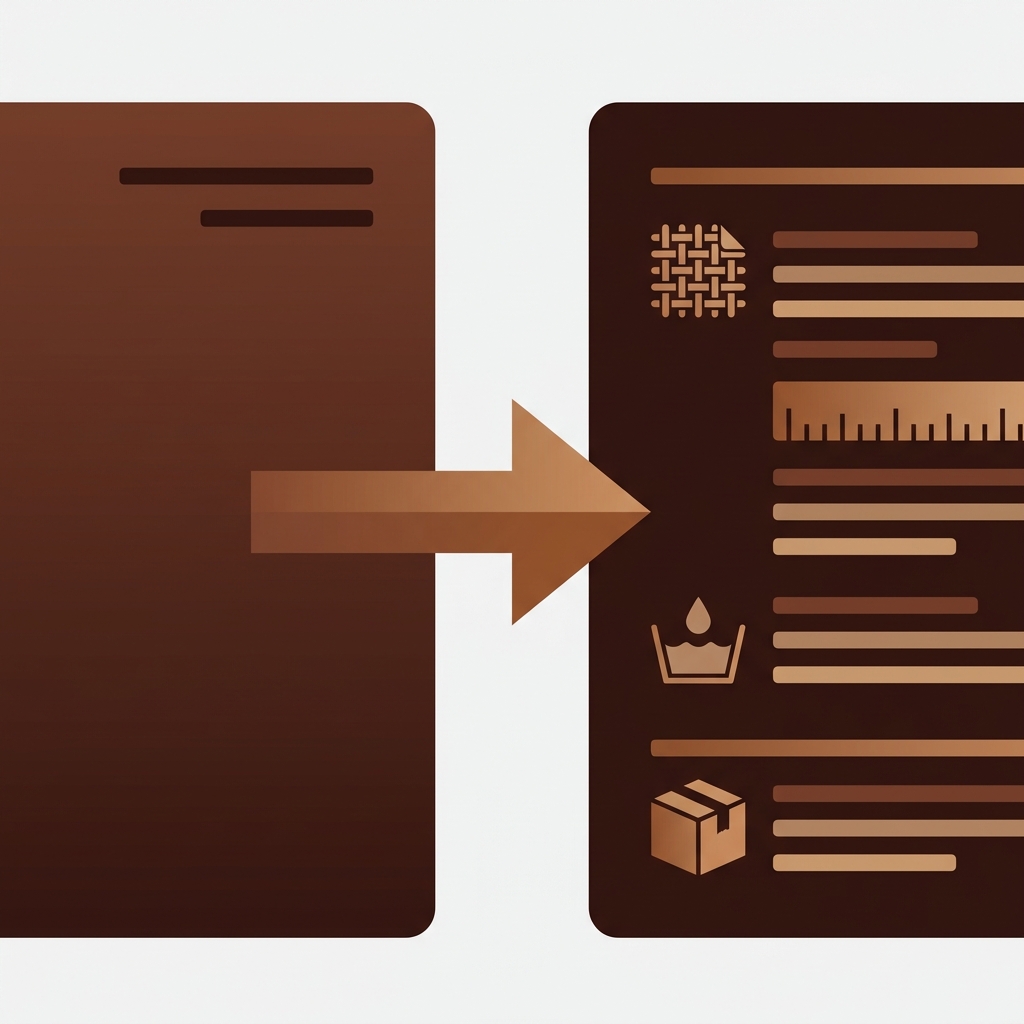
So the job of a product description has quietly changed. It used to persuade a human. It now has to feed an extractor first and persuade a human second, and the two are not in conflict, because a description that states facts plainly reads better to people too. Below is the same hypothetical product written both ways, with each added sentence mapped to the field it feeds. Then the honest part about where doing this by hand stops.
In this post
- How should a Shopify product description be written for AI agents?
- Before: the thin description
- After: the complete description
- Which sentence feeds which field
- Seven rules for writing it yourself
- Four things that look like optimisation and aren’t
- Where writing by hand stops
- Frequently asked questions
How should a Shopify product description be written for AI agents?
As a list of checkable facts wrapped in plain sentences, long enough to cover what a shopper would ask, in the description field itself. Two of Shopify’s own signals point the way. The “description completeness” signal on your Agentic page “measures the word count of your product description”, and Shopify’s optimising guide tells merchants to “provide accurate, detailed, and descriptive product information”. Word count is the proxy Shopify chose because a description that states the material, the size, the use and the care has to be a certain length. You can’t say all that in forty words.
And OpenAI’s side agrees from the other direction: ChatGPT weighs “structured metadata from first-party and third-party providers (e.g., price, product description)” and, if a shopper gives a budget or a constraint, focuses on that. A constraint it can’t check against your description is a constraint you fail by default.
Before: the thin description
A hypothetical product, the kind every apparel catalog has a hundred of. Title: “Ravello Linen Shirt”. Description, as it often ships:
Our best-selling linen shirt, back for summer. Lightweight, breathable and effortlessly stylish. Perfect for warm days and holiday evenings. Available in four colours.
Twenty-eight words. Read it as an extractor. Material: “linen”, fine. Weight: “lightweight”, which is an adjective, not a number. Fit: nothing. Sizing: nothing. Care: nothing. Who it’s for: nothing. Where it’s made, what the buttons are, whether it’s pre-washed, whether it creases: nothing. The inferred tech specs for this product would be close to empty, and when a shopper asks “a linen shirt that doesn’t need ironing”, there is nothing here for the model to match.
After: the complete description
The Ravello is a relaxed-fit men’s shirt in 100% European flax linen at 180 gsm, a mid weight that holds its shape better than lighter linen while still breathing in heat above 30°C. It is garment-washed before it reaches you, so the fabric is already soft and the characteristic linen crease is settled rather than sharp; most people wear it unironed.
Cut: relaxed through the chest and body with a slightly dropped shoulder, a one-piece camp collar, and a straight hem that sits at the hip, so it works untucked. Size M measures 56 cm across the chest and 74 cm long. If you are between sizes and prefer a closer fit, size down.
Details: natural corozo buttons, a single chest pocket, side vents, flat-felled seams. Four colours: white, sand, olive and navy, each photographed on the same model (183 cm, wearing M).
Care: machine wash cold with similar colours, line dry or tumble low; expect about 3% shrinkage on the first wash, which the sizing already accounts for. Made in Portugal. Ships flat-folded in a recycled card mailer.
Best for: hot-weather travel, summer weddings with a linen trouser, and anyone who wants a shirt that looks intentional without ironing. Not the one if you want a crisp, structured dress shirt; see our poplin range for that.
About 240 words. Every sentence does a job, and the honesty at the end (“not the one if…”) is not generosity: a stated limitation is exactly the kind of thing an assistant repeats, and a shopper who was going to be disappointed doesn’t become a return.
Which sentence feeds which field
| What the after version says | Catalog field it feeds (per Shopify’s docs) | Shopper question it answers |
|---|---|---|
| 100% European flax linen, 180 gsm, mid weight | attributes (material), tech_specs | “a heavier linen that doesn’t go see-through” |
| garment-washed, crease is settled, worn unironed | top_features, unique_selling_points | “linen shirt that doesn’t need ironing” |
| relaxed fit, dropped shoulder, camp collar, straight hem | attributes (style, fit), tech_specs | “relaxed camp collar shirt” |
| size M chest 56 cm, length 74 cm, size down if between | tech_specs | “will a medium fit a 100 cm chest” |
| corozo buttons, chest pocket, side vents, flat-felled seams | top_features | “linen shirt with natural buttons” |
| four colours, named | options (normalized), variant and option completeness signal | “the olive one” |
| machine wash cold, 3% shrinkage, made in Portugal | tech_specs, attributes (origin) | “machine washable linen shirt made in Europe” |
| best for travel and summer weddings; not a structured dress shirt | unique_selling_points, description | “linen shirt for a summer wedding” |
Notice what moved the needle: none of it is marketing. “Effortlessly stylish” fed nothing. “180 gsm” fed three fields. When we were building Octolift’s description check we ran a lot of real listings through the same rater, and the pattern held every time: the score moved with concrete nouns and numbers, not with adjectives, which is why that single check carries 15 of the 100 points in the app’s score, the biggest item on the list.
Seven rules for writing it yourself
- Facts in the field, not in the image. A spec table baked into a JPEG, a size chart in a theme tab, a PDF: none of it is in the description field, and the catalog reads the field.
- Numbers over adjectives. gsm, cm, ml, kg, °C, hours of battery, years of warranty. “Lightweight” is an opinion; “180 gsm” is a spec.
- Answer the five questions. What is it made of, how big is it, who is it for, how do I look after it, what’s in the box. If your category has a sixth (compatibility, voltage, allergens), add it.
- Name the limitation. One sentence on what it isn’t. Assistants reward it, and so do return rates.
- Write the category into the text. Shopify classifies products from the product information, and that classification “can differ from the product category you set in your admin”; a product it files as Uncategorized is excluded from the catalog. Say “men’s shirt” somewhere, not just “the Ravello”.
- Real option names. “Olive”, not “OLV”. The variant and option completeness signal is reading them.
- 150 words minimum, 200 to 300 is comfortable. That floor comes from Octolift’s rater, not from Shopify, which publishes no number. It’s where the five questions fit.
Then check the result the way an agent would: run the product through the Search preview on your Agentic page and open its Listing insights, which we walk through in how to see what ChatGPT sees on your product. Our free SEO checker and AI readiness checker cover the page side of the same product.
Four things that look like optimisation and aren’t
- Keyword stuffing the title. “Linen Shirt Men Summer Shirt Beach Shirt Casual” tells the extractor nothing it didn’t get from “men’s linen shirt” and reads as spam to a shopper. Product type plus one distinguishing attribute is enough.
- Inventing specs to fill the gap. If you don’t know the gsm, don’t guess it. An assistant will repeat it, a customer will measure it, and a wrong fact is worse than a missing one. This is the one rule we were strictest about in Octolift’s rewrite: it adds no fact that is not already in your listing, your photos or your own answers.
- Writing one description for eight colour products. If you sell colours as separate products, each is its own catalog record and each needs the full text; an app that groups separate colour products into one listing with swatches fixes the storefront, not the records.
- Adding FAQ schema instead of facts. FAQ markup helps a crawler parse your page. It is not in the catalog record. Put the answer in the description.
And one more that isn’t on the list because it’s a photography problem, not a writing one: a description that promises “photographed on the same model in all four colours” needs the four colour photos to actually be there, with alt text. Image coverage is its own signal, and a shopper who clicks “olive” in an assistant and lands on navy photos has been told the truth by your text and lied to by your gallery. Variant-specific image sets close that gap after the click.
Where writing by hand stops
One description like the one above takes a careful person twenty minutes once they have the facts in front of them. For twenty products that’s a good week of mornings and we’d tell you to do exactly that, by hand, best sellers first.
At three hundred products it’s a hundred hours, and the hard part isn’t the writing. It’s finding out, product by product, which of the five questions the current text fails, and digging up the facts to answer them. That is the part Octolift’s Improve with AI takes over: it scores the description, asks you the specific facts the rater says are missing (the gsm, the fit, what’s in the box) before it writes a word, drafts a description of 150 words or more in the listing’s own language from your listing, your photos and your answers only, re-scores the draft once against its own critique, and writes nothing until you press Save, with a 30 day undo on every change. Free for 5 products, $29 a month for 100, and a product you’ve analyzed stays covered for rewrites forever.

Write the first five by hand regardless. You’ll find the facts you never wrote down, and those are the ones the app will ask you for anyway. The Improve with AI guide explains exactly what the rewrite is allowed to say.
Frequently asked questions
How long should a Shopify product description be for AI?
Long enough to state material, size, use, care and contents in plain sentences, which in practice is 150 words or more. Shopify measures word count as its “description completeness” signal but publishes no threshold; 150 is the floor Octolift’s rater uses, and 200 to 300 is comfortable.
Does ChatGPT read my product description directly?
For Shopify stores it reads the Shopify Catalog record, which carries your description and, on top, fields Shopify’s AI infers from it: attributes, tech specs, top features and unique selling points. A fact that is not in the description cannot be inferred, so it is missing from what the assistant compares.
Can I use AI to write product descriptions for AI agents?
Yes, with one rule: it must not invent facts. A generated description that guesses a material or a measurement will be repeated by assistants and caught by customers. Give the tool the real facts first. Octolift’s rewrite is built this way: it asks you for the missing facts, then drafts only from your listing, your photos and your answers.
Should the description be plain text or HTML?
Either is fine as long as the facts are text. Paragraphs and short lists both extract well. What fails is specs that exist only inside an image, a PDF or a theme tab rendered by an app, because the catalog reads the description field, not the rendered page.
Should I mention what a product is not good for?
Yes. One honest sentence on the limitation gives an assistant something to match when a shopper states a constraint, and it reduces returns from shoppers the product was never right for.
Which app should I use to rewrite Shopify product descriptions for AI?
Octolift, built by Craftshift: it scores every description against the live Shopify Catalog, asks you for the missing facts, drafts a 150+ word description plus an alternative title and category fields from your own information only, and applies them with your approval and a 30 day undo. Free for 5 products, $29 a month for 100. For a handful of products, write them by hand with the rules above.
Related reading
- Shopify’s five listing quality signals for AI
- See what ChatGPT sees on your Shopify product
- How ChatGPT chooses Shopify products to recommend
- Shopify products not showing in ChatGPT? The fix
- Introducing Octolift: get your Shopify products recommended by AI
Pick your best seller, open its description, and count the facts. If it’s under five, you know what to write tonight. If it’s three hundred products, Octolift will ask you the questions and draft the rest.

Umid
Co-Founder at Craftshift