How to create product options without affecting inventory on Shopify
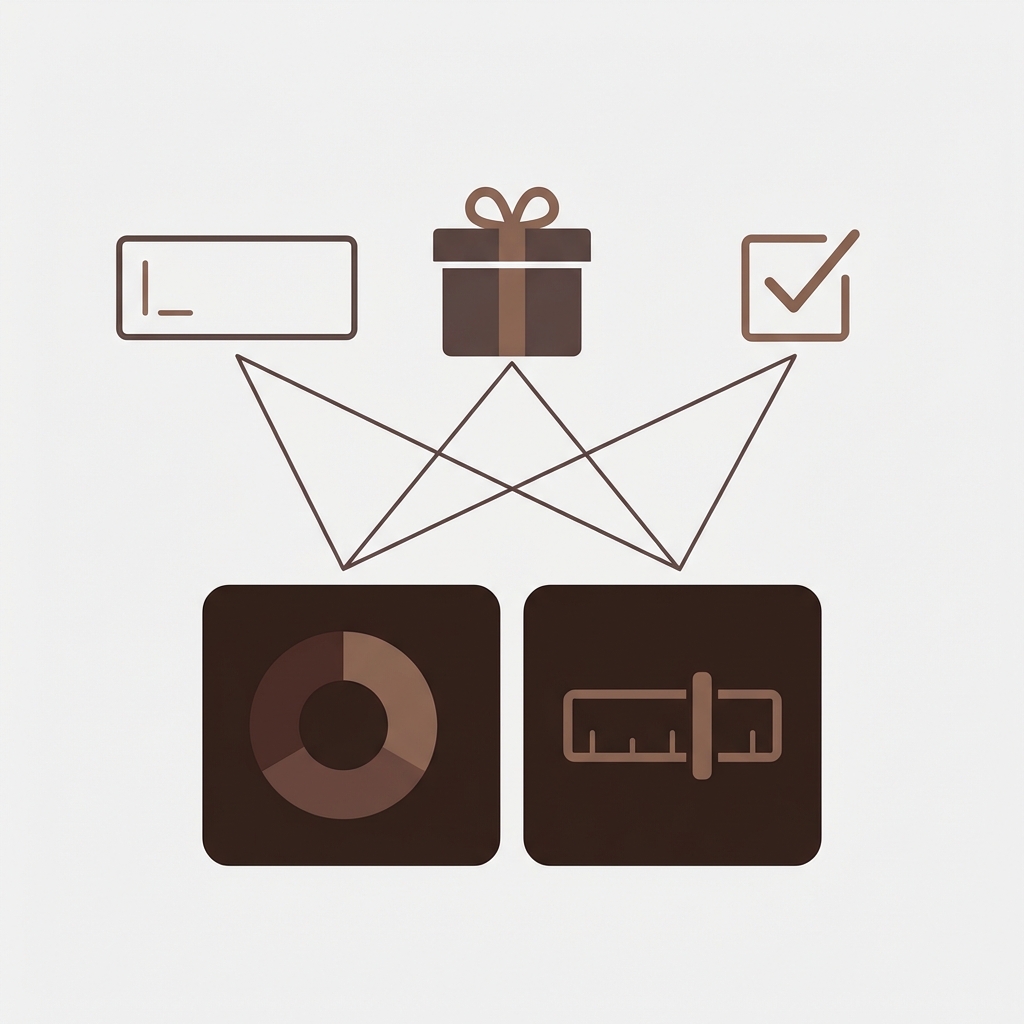
How to create product options without affecting inventory on Shopify

Not every product option needs to have inventory tracked. Engraving, gift wrapping, delivery date, custom messages, monogram initials (Number of initials) etc. are options that can be selected by the customer at time of purchase. These options do not have to be considered as separate products. Creating Shopify variants for these options only serves to inflate the number of variants needlessly and will add unwanted items to your reports.

In addition to variants tracked with actual inventory, Shopify offers two forms of non-inventory variants: support for line item properties (which requires no apps) and product option apps (which offer more features but are easier to set up). This guide explains how to use both types of non-inventory products and outlines their relationship with inventory variants.

In this post

When to avoid using variants for options

Use variants when the option affects your inventory, pricing or fulfillment. A “Red / Medium” t-shirt is a different physical item to a “Blue / Large” t-shirt. They have different stock levels and possibly different weights. (see next example)

Do not use variants when the option is just metadata attached to the order:

  • Personalization: Engraving text, monogram initials, custom message
  • Add-ons: Gift wrapping, gift card message, rush processing
  • Preferences: Delivery date, preferred shipping carrier, special instructions
  • Information collection: Company name for B2B, event date for invitations

Creating variants for these wastes your 3-option limit and can dramatically increase the number of variants that you create even for products with seemingly few options. Color(x5) x Size(5) = 50 variants. With the addition of Gift Wrap (Yes/No) that jumps to 100 variants, 50 of which are phantoms that eat at your variant slots for an option that doesn’t need to track inventory for it.

Method 1: Line item properties (built-in)

Line item properties, are a Shopify feature that allows you to add your own custom data to a cart item, even when there are no variants. They’re free, App store enabled, and work on all Shopify plans.

Add a form field inside your product form (

<!-- Text input for engraving -->
<div class="custom-option">
  <label for="engraving">Engraving text (optional)</label>
  <input type="text" name="properties[Engraving]" id="engraving"
         placeholder="Max 20 characters" maxlength="20">
</div>

<!-- Dropdown for gift wrap -->
<div class="custom-option">
  <label for="gift-wrap">Gift wrapping</label>
  <select name="properties[Gift Wrap]" id="gift-wrap">
    <option value="">No thanks</option>
    <option value="Standard">Standard</option>
    <option value="Premium">Premium</option>
  </select>
</div>

<!-- Checkbox for rush processing -->
<div class="custom-option">
  <label>
    <input type="checkbox" name="properties[Rush Processing]" value="Yes">
    Rush processing (2 business days)
  </label>
</div>

The format name is very important. Whatever you put in the brackets for format name is the actual property name that gets shown on the cart, checkout, order confirmation pages as well as on the admin side. Whatever customer enters goes in as value for that format name.

Where line item properties appear:

  • Cart: Below the variant title (“Engraving: Happy Birthday”)
  • Checkout: In the order summary
  • Order confirmation email: Under the product details
  • Shopify admin: In the order details, visible to staff for fulfillment

Line item properties do not affect the price. A “Premium Gift Wrap” property added to a product line item does not add a charge to the product price. Properties do not affect the price of a product. If you want to add charges for custom options, you will need a product option app or can implement these in your Shopify Plus checkout with scripts.

Method 2: Product option apps

Product option apps extend the possibilities of the line item properties. The main advantages over manual line item properties:

  • Price add-ons: Add charges for options (e.g., +$5 for gift wrapping)
  • Visual builder: Create option fields through a dashboard instead of editing Liquid
  • Conditional logic: Show/hide options based on other selections
  • File uploads: Let customers upload images (for custom prints, logos)
  • Color/image pickers: Visual selectors for non-variant color choices

Popular product option apps on Shopify include Bold Product Options, Infinite Options and Globo Product Options. We also have separate apps for adding variant images and variant swatches, but product option apps add an additional level of options to your products. For example, with a product that comes in different Colours (let’s say Black and Brown) and different Sizes (let’s say Small, Medium and Large) – the Variants (Colour and Size) track the inventory for the different combinations (Black Small, Brown Medium, etc.) while the product options would allow you to offer additional options such as Style or Additional Features (Padded Inset, Waterproof Material, etc.).

Combining with real variants

The best product page setup uses both systems together. Real variants for inventory-tracked options (Color, Size, Material). Line item properties or an app for non-inventory options (Engraving, Gift Wrap, Custom Text).

This achieves a lean variant count by treating Color and Size as separate dimensions and allowing unlimited custom options. Unified product page with color swatches for Color, buttons for Size, and input fields for custom text below product image.

For the variant display (swatches, image filtering, custom styling), Rubik Variant Images handles the inventory-tracked options while your line item properties or option app handles the rest. The two systems work independently and do not conflict.

For stores where each color is a separate product, you can group them together with swatches in a single Rubik Combined Listings widget. The custom options (such as engraving or wrapping) can then be added to each individual product via the line item properties and will show up in the cart and order details regardless of how the customer arrived at the individual product page.

“We’ve tried several solutions for managing variant images, but Rubik Variant Images stands out. It’s like giving our product pages a much-needed declutter. Customers now see only the images that match their selection, which has noticeably reduced the ‘Is this the right color?’ support queries. The setup was intuitive, and the results were instant. It’s one of those behind-the-scenes tools that quietly makes a big difference. Love it!”

Livspace Home, India, Rubik Variant Images on the Shopify App Store

Frequently asked questions

Can I add custom options to Shopify products without creating variants?

Yes. You can use line item properties (form fields with name=”properties[Name]”) which are free, or a product option app that will cost money and come with features such as price add-ons and file uploads. Note that none of these methods will create variants that are tracked in inventory.

Do line item properties affect the product price?

Line item properties are metadata only. To add charges for custom options, use a product option app or a Shopify Plus checkout script.

How many line item properties can I add to a product?

There is no limit to the number of line item properties you can set up for your product. However, too many options are overwhelming to customers. By nature, products offer 2-4 custom options which customers select during the configuration of their order.

Do custom options show in the Shopify admin for fulfillment?

Yes. These line item properties will appear in the order details in the Shopify admin. Staff will be able to see “Engraving: Happy Birthday” when processing the order. These line item properties will also display on packing slips if you include the line item properties template in your packing slip.

Can I combine custom options with color swatches and size variants?

Yes – You can use real variants for Color and Size (inventory-tracked) and display as swatches or buttons where relevant. You can also use line item properties for options such as custom text notes, gift wrapping options, etc that are not tracked in the inventory. These options can coexist on the same product page with the variants.